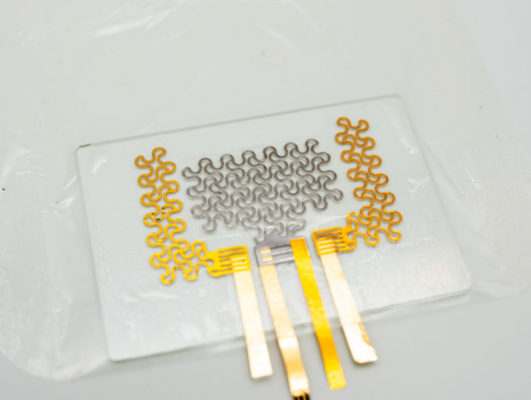
You can get an ink tattoo anywhere you want, but what if you got an electronic tattoo — and it monitors your heart? A team of engineers at The University of Texas at Austin has created a device that does just that.
“Our cardiovascular e-tattoo sticker was invented to battle the No. 1 killer, which is cardiovascular disease,” says engineer Nanshu Lu. Lu and her research team at the Cockrell School of Engineering developed a new wireless e-tattoo that can be patched onto anyone’s chest to help doctors track heart health in a machine- and wire-free way.
Once patched, the device simultaneously measures electrical and mechanical signals from the heart. Unlike an electrocardiogram (ECG), which requires being connected to a machine, the e-tattoo can be worn for days at a time, and because of its flexible and skin-like texture, it causes little to no discomfort.
“We hope that we can monitor heart health in everyone’s everyday life instead of just in hospital settings,” says Lu.
Heart disease is the leading cause of death in Texas. This new device could launch care into the future by providing greater insight into heart health.