Tuesday, February 23, 2010
Solar energy research: The cake pan demo

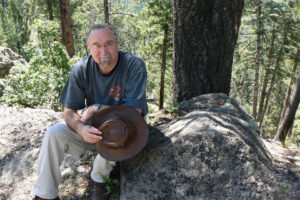
Loren Kaake
See the video of charge transport in a cake pan
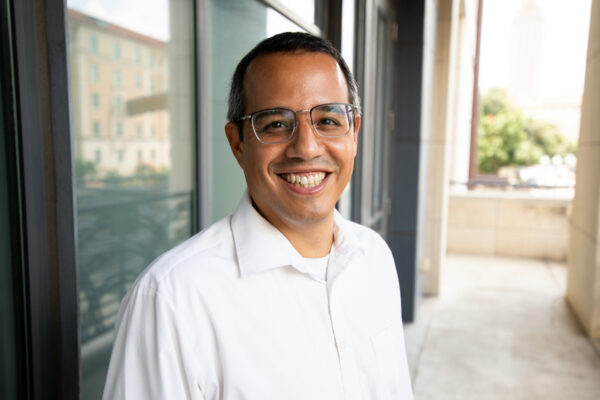
At the Electronic Frontiers Research Center (EFRC) on Charged Transport and Polymers, Loren Kaake, a post-doctoral fellow, researches how to make organic semiconductors for solar panels.
The organic materials in question are polymers, or plastics. Photovoltaic cells made from plastic would go a long way toward making solar energy less expensive and more efficient than technologies that use silicon-based semiconductors.
Plastics might be cheap to make, but electrons don’t dash across their surfaces like they do across silicon.
“What happens in a normal semiconductor, is that charges can flow through easily,” said Kaake, who earned his Ph.D. in chemical physics at the University of Minnesota. “But organic semiconductors can have these sort of energetic boundaries (called grain boundaries) that the charges have to leap over. And they can get stuck there, they can get trapped in the middle, just like a dog inside a fence.”
This is called charge trapping and it causes problems for scientists and engineers trying to maintain a steady current of electricity.
Kaake’s cake pan demonstration illustrates the problem.

The cake pan
The straws represent the boundaries.
Then he placed orange BBs, the electrons, at one end of the pan.
He tilted the pan and placed it on a machine in the lab. The tilt represents voltage and the vibrations from the machine represent thermal energy.
As the pan shook, BBs rattled toward the other side of the pan. Some of the BBs came to rest on the far side of the pan and others were stuck inside the straw barriers.
“The grain boundaries are high-energy areas for electrons, so it made sense to translate energy space into height, and make a physical barrier,” Kaake said. “The trick here was to make the barrier height not too tall so that the BBs could roll over them with a little shaking, in much the same way as the electrons roll over the grain boundaries with enough thermal energy.”
The cake pan demo helped Kaake’s thinking about the problem.
“Whenever possible, I like to have pictures, and/or visualizations of some sort to aid my thinking,” he said. “It just seems so much more conceptually efficient. The only trick is not to interpret these pictures too literally. I tried to match the picture in my head to some concrete arts-and-crafts items in the same way I would draw a picture during a discussion.”
The grain boundary was one of several problems that Kaake and professors Xiaoyang Zhu and Paul Barbara wrote about in a paper recently published in the Journal of Physical Chemistry Letters.
It was the first paper from their EFRC. It has been funded for five years with $15 million from the American Recovery and Reinvestment Act. Find more information about the recovery act at The University of Texas at Austin


1. FunnyDevil says