Thursday, July 22, 2010
Time Scales: That was fast, really fast

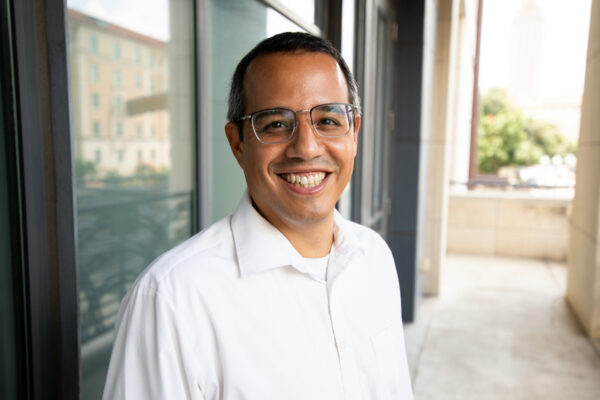
Aaron Bernstein
Aaron Bernstein is a laser physicist and associate director of the High Intensity Laser Group. The group operates the Texas Petawatt Laser.
In explaining the time scales involved in his research, Bernstein sounds like a question on the Scholastic Aptitude Test (SAT).
Bernstein works with lasers that blast pulses of light of durations so short they are measured in femtoseconds, which are one quadrillionth, or one millionth of one billionth of a second.
“It’s kind of hard to get across how short these time scales are,” Bernstein says. “We’ll say that one femtosecond is to a second what three minutes is to the age of the Earth.”
“That sort of boggles their minds,” he says.
Bernstein appreciates how hard such concepts can be to grasp. And he appreciates the ironies involved.
“It’s not much more than a hundred years since strobe or rapid photography had to be used to detect whether or a not a horse’s hooves all left the ground during running,” he said. “It’s only a hundred years since that kind of technology. Now we’ve got basically a strobe light that is so fast that we can resolve what is happening in molecular interactions. So that’s pretty cool.”
When the laser strikes a material, it creates extreme states of matter that occur in the centers of stars and planets. On Earth, that can be done only microscopically and for a short period.
“But we’re able to extrapolate from such experiments what happens within stars,” he says. “The short pulses allow us to reproduce those kinds of events in short amount of times. But I think it’s ironic that we can study things that occur on a cosmic time scale, locally, with these tools.”