Tuesday, February 15, 2011
Texas alumnus gives insight into Watson

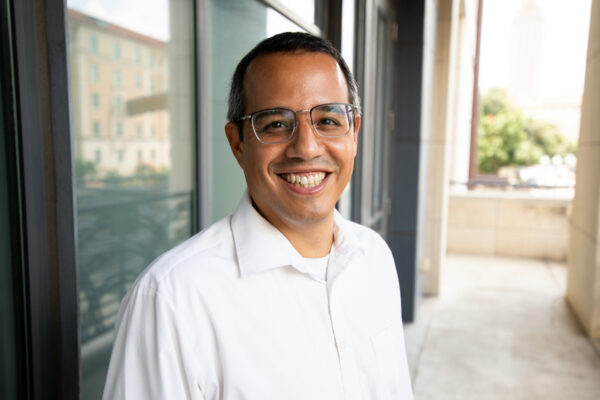
James Fan, who received his Ph.D. at The University of Texas at Austin, is a member of the IBM team that built Watson, the Jeopardy! playing computer.
He returned to campus Monday to watch the first round of the Jeopardy! match between Watson, the IBM computer (named after IBM founder Thomas Watson), and two human champions, Ken Jennings and Brad Rutter.
At the end of the first round, Watson and Rutter were tied with $5,000 in winnings. Jennings had $2,000.
About 200 people watched the broadcast in the Avaya Auditorium in the ACES building. The group was a mix of students, professors and members of the general public, including several children. Computer science professors Bruce Cook, Ray Mooney and Ken Barker, whose research contributed to Watson’s development, also were there.
The crowd seemed to be pro-Watson, letting out a big cheer when the computer—represented on the Jeopardy! set by an avatar—was introduced.
Fan received his Ph.D. in computer science from the university. He’ll be on campus for the Feb. 15 broadcast and watch the Wednesday finale with IBM customers in Dallas.
Fan answered questions and talked about Watson’s strategy during commercial breaks and after the Jeopardy! broadcast.
One piece of strategy was picking Daily Doubles. A Daily Double allows a contestant to bet at least twice the face value of the question.
On its first chance to pick a clue, Watson found the Daily Double, an $800 clue in the category, Literary Character, APB (All Points Bulletin). Watson had $400, wagered $1,000 and answered the question correctly, giving it a total of $1,400.
The clue, given by Jeopardy! host Alex Trebek, was, “Wanted for killing Dr. Danvers Carew. Appearance pale and dwarfish. Seems to have a split personality.”
“Who is Hyde,” Watson responded as soon Trebek finished reading the clue.
Correct! The computer honed in on the murderous part of the split personality of Dr. Jekyll and Mr. Hyde from the Robert Louis Stevenson book.
Fan said that going directly for the Daily Double was part of Watson’s strategy.
The computer had a good idea, through its study of past Jeopardy! games, where the Daily Double would be, he said. And, besides giving Watson a boost to its own earnings, it prevented its opponents from getting a shot at the Daily Double.
Watson seemed to be fast on the buzzer, getting to answer questions before Rutter and Jennings.
There were a couple of times when Watson’s limitations made for awkward moments.
An example: Watson can neither see nor hear. It gets the questions electronically. So when Jennings answered a question incorrectly, Watson jumped in with the same wrong answer.
That was one of Watson’s few stumbles.