University of Texas at Austin

Archive for 2013


Thursday, April 18, 2013

Rock Snot Genomics: The origin of common algae

Diatoms are one of the most common types of phytoplankton and a major group of algae. One species, Didymosphenia geminata, is responsible for creating thick blooms in mountain streams and ponds. It’s a menace to ocean-going vessels, where it causes drag, and in hospitals, where it can coat moist surfaces and promote bacteria.

For researchers in the lab of Edward Theriot at The University of Texas at Austin, diatoms (and their snot) are rich objects of biological research. Read the full
Read More …

Monday, April 8, 2013

Building a better battery

It’s been a rough ride lately for the lithium-ion battery. Though practically all of us carry one around — they power everything from cell phones to iPods — the lightweight cells have sparked some high-profile product failures.

It was bad enough when they caused laptop computers to burst into flames, leading to millions of recalled batteries since 2000. Their reputation took another hit in January, when battery fires in two of Boeing’s new 787 Dreamliner planes caused airlines to ground their
Read More …

Monday, March 18, 2013

My space? Your space? What makes it our space?

Take a look at your bedroom. Is it scattered with laundry? Adorned with photos? Are you only leaving a sliver of space in the closet for your partner’s clothes? These seemingly mundane domestic scenarios may reveal a surprising amount of information about a couple’s relationship, according to a forthcoming study led by Lindsay Graham, a psychology graduate student at The University of Texas at Austin.

In collaboration with Sam Gosling, professor of psychology and author of “Snoop: What Your Stuff Says
Read More …

Thursday, February 21, 2013

Engineering immune cells to resist infection from HIV

Researchers at The University of Texas at Austin and the Stanford University School of Medicine have found a novel way to engineer key cells of the immune system so they remain resistant to infection from HIV, the virus that causes AIDS.
The study, which was published this week in Molecular Therapy, describes the use of a kind of molecular scissors to cut and paste a series of HIV-resistant genes into T cells, specialized immune cells targeted by the virus.

The new approach
Read More …

Thursday, January 17, 2013

Folic acid one of several discoveries that made Esmond Snell world-renowned

Biochemist Esmond Snell, a researcher at The University of Texas at Austin and the University of California, Berkeley, left a legacy that continues to affect people’s lives.

Part of his legacy is that fewer babies are born with neural tube defects such as spina bifida and anencephaly because of one of his discoveries.

In 1941 Snell, who died in 2003, and Texas colleague Herschel Mitchell discovered folic acid, a B vitamin needed to make DNA and RNA and that enables red blood
Read More …

Wednesday, January 9, 2013

Biologist Aims to Hunt Down and Destroy Viruses Where They Hide

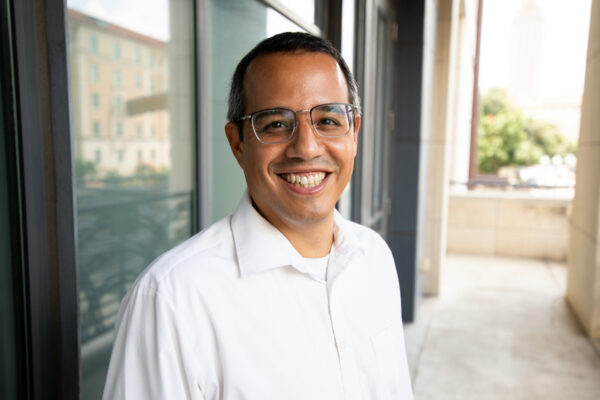
Although his goal is to someday help destroy HIV and other viruses and retroviruses that form persistent, lifelong infections, biologist Chris Sullivan can’t help but admire the strategies that many of these viruses have evolved to evade our defenses.

Chris Sullivan, associate professor of molecular genetics and microbiology.

Chris Sullivan, associate professor of molecular genetics and microbiology.

“It’s brilliant,” says Sullivan, associate professor of molecular genetics and microbiology. “Take Herpes simplex virus 1, for instance, which is one of the masters. It goes in and infects very long-lived neurons, and then
Read More …