Archive for the ‘biology’ Category
Tuesday, September 8, 2009
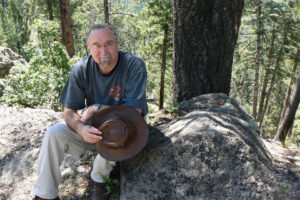
George Pollak
The experiment began in a backyard barn. Instruments used included sophisticated recording equipment. A strong regimen of statistical analysis capped it off.
The result: evidence that suggests that male bats sing songs with distinguishable syllables and phrases to attract females, and in some cases, to warn other males to stay away. The paper written about the study was published in PLOS One.
The research was a collaboration of the owner of the barn, Barbara Schmidt-French of Bat Conservation International; George Pollak, a
Read More …
Tags: bats, communication, courtship song, hard wired, neuroscience, songs, statistics
By Tim Green
Published at 12:00 PM |
No Comments
Monday, July 27, 2009
While KEYE-Channel 42 interviewed Prof. James Tunnell about his optical skin cancer probe, Further Findings also had video equipment rolling.
Here is a clip of Tunnell explaining how the probe might work.
You must have Javascript enabled and the Flash 8 plugin installed to view this content.

Consult your browser's help file for instructions to enable Javascript.
Tags: biomedical engineering, James Tunnell, optical, skin cancer probe
By Tim Green
Published at 1:00 PM |
No Comments
Tuesday, July 21, 2009
Ron Oliveira and James Tunnell
The skin cancer probe being developed in James Tunnell’s lab was featured on KEYE-TV-Channel 42 on the 10 p.m. newscast on July 20, 2009. KEYE’s Ron Oliveira went to Tunnell’s lab in the Biomedical Engineering building to interview Tunnell and Naras Rajaran, one of the graduate students working on the project.
See the video from KEYE.
The optical probe is designed to determine of a spot on the skin is benign or cancerous. If it’s not benign, the spot
Read More …
Tags: biomedical, biopsy, detection, James Tunnell, Naras Rajarin, probe, skin cancer
By Tim Green
Published at 2:30 PM |
1 Comment
Thursday, July 16, 2009
People who get a healthy dose of omega-3 fatty acids in their diets may have a reduced risk of heart disease, high blood pressure and strokes, and fish are a major source of these fatty acids. But what good are omega-3s to the fish?
Omega-3s may give young fish the boost they need to dart away from predators, leading to greater survival of the vulnerable larvae and potentially larger populations of adults.
Read more at the College of Natural Sciences.
Read More …
Tags: Alfredo Ojanguren, fatty acids, Lee Fuiman, Marine Science Institute, Omega-3, redfish
By Tim Green
Published at 10:20 AM |
No Comments
Friday, June 5, 2009
John Wallingford
The new Neko Case, vintage Jimi Hendrix, the Black Keys and the polyester-clad classic “Saturday Night Fever” soundtrack.
An iPod playlist gone rogue?
No, it’s the soundtrack of John Wallingford’s developmental biology laboratory on a typically eclectic day.
“My philosophy is to make a lab a very fun place because I need my people to be here all the time,” he says.
Music is a key ingredient in lab fun. It helps the students stay alive while doing painstaking bench work.
“You’re going to
Read More …
Tags: developmental biology, embryo, Hayes Carll, John Wallingford, neural tube defects, Salesman
By Tim Green
Published at 9:00 AM |
No Comments
Friday, May 29, 2009
The spring 2009 semester has ended and that’s a good time to take another look at some of the research that came out of University of Texas at Austin labs in the past few months.
Here’s a roundup of some of the more interesting discoveries in exercise, psychology, business and statistics.
Add crunch to your post workout recovery
In a study of well-trained cyclists, exercise physiologist Lynne Kammer found that a bowl of whole grain cereal is as good as a sports drink
Read More …
Tags: airport, biology, business, cereal, Exercise, investing, investors, milk, physiology, psychology, security screening, sports drinks, stock market
By Tim Green
Published at 4:22 PM |
1 Comment
Friday, May 22, 2009
Richard Matzner, digs black holes
[caption id="attachment_585" align="alignright" width="300" caption="Pablo Munguia, digs pen shell clams"]
[/caption]Today, Further Findings points readers to two research stories–one in outer space and the other under the sea–posted elsewhere on The University of Texas at Austin Web site.
Aaron Dubrow, the science writer at the Texas Advanced Computing Center (TACC), writes about the research of Richard Matzner, an astrophysicist at the university.
Matzner uses TACC’s Ranger supercomputer to simulate binary black hole mergers and search for gravitational waves. The waves were
Read More …
Tags: black holes, communities, gravitational waves, habitat destruction, Marine Science Institute, Pablo Munguia, pen shells, Richard Matzner, Texas Advancec Computing Center
By Tim Green
Published at 10:08 AM |
No Comments
Monday, March 30, 2009
Dan Bolnick
The threespine stickleback is a fish biologists use as a model organism and have for about a century.
Dan Bolnick, an assistant professor in the Section of Integrative Biology, is a stickleback scientist who’s starting to use the fish in a new way to research relationships between organisms and parasites.
Bolnick’s work earned him selection as a Howard Hughes Medical Institute (HHMI) Early Career Scientist. John Wallingford, an associate professor of molecular cell and developmental biology, also was selected.
They are among 50
Read More …
Tags: Dan Bolnick, Howard Hughes Medical Institute, John Wallingford, model organism, Section of Integrative Biology, Section of molecular and cell biology, threespine stickleback, university of texas at austin
By Tim Green
Published at 11:15 AM |
1 Comment
Tuesday, March 24, 2009
Dendrobates mysteriosus is from the transition between the Andes Mountains to Amazonia in northeastern Perus.
Detectives follow the evidence. Reporters follow the money. Scientists follow the data.
They might not know where these things will lead, but, one way or another, it should be the truth—or at least as close to it as they can get.
Juan Santos, a Ph.D. student in integrative biology, followed the data from the Amazon River basin up into the Andes Mountains and back to the Amazon to
Read More …
Tags: Amazon, Andes Mountains, David Cannatella, dendrobates, Juan Campos, neotropics, poison frogs, Public Library of Science Biology, university of texas at austin
By Tim Green
Published at 4:44 PM |
No Comments
Wednesday, March 18, 2009
James Mauseth
James Mauseth, a professor in the Section of Integrative Biology, has published the fourth edition of his textbook, “Botany: An Introduction to Plant Biology.” Daniel Oppenheimer, a writer in the College of Natural Sciences, talked to Mauseth about the book and cacti, the main interest of Mauseth’s research. Below is an excerpt from the interview. Click here for the full interview and here for a cactus slideshow.
Speaking of stories, why did you decide to study cacti in the first place?
It would
Read More …
Tags: botany, cactus, College of Natural Sciences, Daniel Oppenheimer, James Mauseth, plants, Section of Integrative Biology
By Tim Green
Published at 2:45 PM |
No Comments