University of Texas at Austin

Archive for the ‘geoscience’ Category


Monday, April 5, 2010

Science in process: Part 1

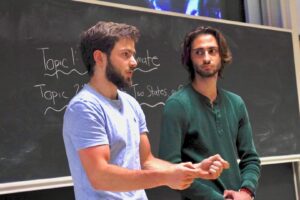
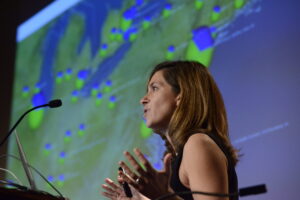
Geoscientists Sean Gulick and Gail Christeson talk about how the scientific process worked in connection with the extinction of the dinosaurs 65 million years ago. They were part of the 41-member team that reviewed the science about the extinction event. They concluded that, yep, a giant meteorite did, indeed, wipe out the dinos.

Monday, December 21, 2009

Dinosaur facts and fantasy

Tawa, ready for its close-up

Tawa, ready for its close-up

Listening to Sterling Nesbitt talk about Tawa hallae, the 215 million-year-old dinosaur that he and his colleagues wrote about in the Dec. 17, 2009 edition of Science, I was struck when he used the word “fantasy.”

Dinosaurs and fantasy are not strangers. From the imaginations of children enthralled by dinosaurs to Steven Spielberg’s special effects, our images of dinosaurs often exceed reality.

But really, how real can scientists be when talking about creatures that lived millions of years
Read More …

Friday, December 18, 2009

Research round up for fall 2009

Why women have sex. Why some ants don’t. Is your online personality the real you? What do bats sing about to each other? Who’s that new meat-eater shaking up the dinosaur family tree? Do toddlers make their own grammar?

These are among the questions that University of Texas at Austin researchers answered in the fall 2009 semester.

Here’s a look back at what they found.

Women and sex: Let me count the whys
Challenging the idea that women’s sexual motivations are tied exclusively to
Read More …

Thursday, August 27, 2009

There will be water

Hydrogeology students in the field.

Hydrogeology students in the field.

Over on the Web site of the Jackson School of Geosciences, writer Marc Airhart tells something of a mystery story about water. The Tecolote Farm, which raises organic produce east of Austin, was running out of level of water in the aquifer their wells tapped got lower and lower. Students from the Jackson School went out to see if they could find another source. Find out what happened.

Thursday, August 6, 2009

Field work on the moon (well, Canada)

Marc Airhart from the Jackson School of Geosciences sends this:

Mark Helper,left, receives a Haughton-Mars Project patch from Pascal Lee.

Mark Helper,left, receives a Haughton-Mars Project patch from Pascal Lee.

For more than 10 years, scientists interested in the exploration of the moon and Mars have visited an ancient impact crater in the Canadian high arctic that they say resembles some craters found on these other worlds.

Video of Mark Helper at Haughton-Mars Project

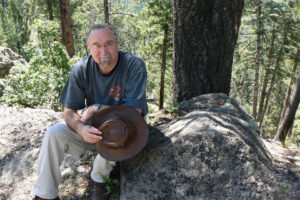
Mark Helper, a geologist at The University of Texas as Austin’s Department of Geological Sciences, recently returned from summer field
Read More …