Social Work professor helps develop
innovative
drop-out prevention
program at local high school
BY NANCY NEFF
Garza Independence High School doesn’t have a football team. But
it does have a mascot — the griffin, a legendary creature that is
part eagle and part lion.
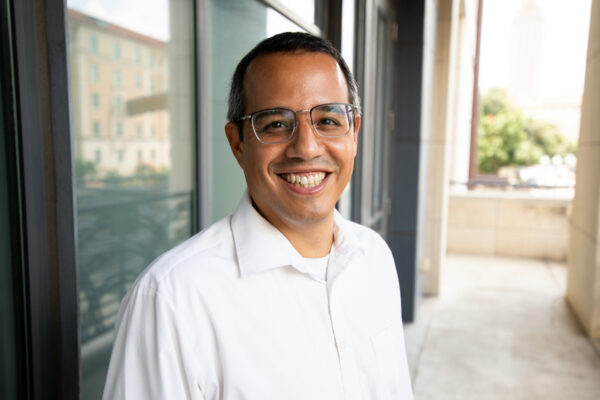
It’s an appropriate mascot for Garza, said Dr. Cynthia Franklin,
professor of social work at The University of Texas at Austin, “because
griffins are guardians of hidden treasures. And that’s what you
find in the students at Garza.”
Professor of Social Work Cynthia Franklin (second from left) helped implement
a solution-focused therapy program at Garza Independence
High School in Austin to foster students’ strengths, personal
and caring relationships, and a sense of success and confidence.
Franklin has been involved as a mentor, evaluator and consultant at the
Austin Independent School District (AISD) alternative high school in East
Austin for the past four years. She also has trained Garza’s teachers
and counselors in solution-focused therapy, which emphasizes students’ strengths,
assets and talents.
The solution-building approach teaches relationship skills, proficient
use of language to gain cooperation, self-motivation and goal setting.
Garza is pioneering the solution-focused approach to dropout prevention
and successful work and career transition.
“A person does not have to be trapped in his or her past,” Franklin
said. “You can transcend above past adversities and concentrate
on the future.
“Everyone is gifted, has untapped aspirations, hidden knowledge,
resources and resiliency. You just need to build upon them to reverse
past misfortunes. This is solution-based therapy.”
Franklin said she is taking a mental health model and bringing
it into an educational setting and equipping the teachers
and the staff in that approach.
“This has not been done much,” she said.
The 350 kids at Garza — all juniors and seniors — are for
the most part smart and gifted students, but have had difficulties at
traditional public schools. The school opened its doors on Chicon Street
seven years ago and has attracted national attention from Harvard University’s
Principals’ Academy and other educational reform associations. International
visitors have made trips to study the school, including educators from
Japan, Sweden, Korea and throughout the United States.
The school was voted “Best Public High School in Austin” by
the Austin Chronicle last fall.
Statistics are encouraging. For the 2003 school year, the percentage
of Garza graduates who go on to college is 75-80 percent.
Vicki Baldwin, principal at Garza Independence High School, says it’s important to treat students with respect because everyone has untapped aspirations and hidden resources.
“The school is what saves them because these are kids who are ‘at
risk’ in all areas of their lives,” Franklin said. “I’m
just a partner in a great thing.
“The school is like a hospital because many of the students have
to heal before they can learn.”
Franklin envisions Garza becoming a model program, with efforts there
leading to implementation at other more traditional schools in Austin
and others across Texas and the nation.
She has presented findings from her work on the benefits of using the
solution-based model in schools at national conferences and recently completed
a training manual and evaluation study for Garza High School. The university’s
Hogg Foundation for Mental Health funded the research.
Dr. Calvin Streeter, also of Social Work, was co-principal investigator.
Franklin also made a training video that is being sold throughout the
world. Her portion of the profit from the video is being donated to Garza
for a scholarship fund.
Findings from the evaluation study are promising. On the School
Success Profile, Garza students rated their high school as being a protective
factor in their lives, while students from AISD comparison high schools
did not rate their high school as favorably.
From the student’s viewpoint, their positive relationship with
their teachers, the curriculum and the extra help they received from teachers,
counselors and social workers at Garza helped them break their barriers
to success.
“The school is what saves them because these are kids who are ‘at
risk’ in all areas of their lives. I’m
just a partner in a great thing.” –Cynthia Franklin
“Cynthia is a godsend,” said Vicki Baldwin, principal at
Garza. “Not only did she come to Garza, but you didn’t have
to explain what was going on. She got it.
“She’s always there for us,” Baldwin said. “We
were doing some solution-based work through our school social worker,
but didn’t have the technical expertise until Cynthia came in.”
She said Franklin was able to get Insoo Kim Berg, the developer of the
solution-focused model, to come to Garza for training workshops.
“Cynthia has been able to reach out and get us resources we would
never have received,” said Baldwin. “Students have never been
treated with such respect. You know there is a real message there.”
Unlike traditional AISD schools, Garza has an open-enrollment policy,
which allows students to start school or complete courses anytime during
the school year. It operates on a self-paced, five-semester system, year-round,
eight weeks of classes followed by two weeks off. Teachers are called
facilitators and they work one-on-one with the students.
Upon graduation, the student gives a portfolio exit presentation and
takes a “Star Walk” — a march around the school.
Many of Garza’s students are finding themselves through art and music. Many have won prizes and awards for their work.
“It’s like a wedding,” Franklin said.
“Garza has become my home,” said one student. “Since
the first day I walked into the building, I was comfortable and knew it
was the place for me. I was losing myself at my old school and needed
something different.”
Garza teachers, or facilitators, said the student, “allow us to
be ourselves, never judging and always caring.”
Most of the kids at Garza are finding themselves through art and music.
Many have won prizes and awards for their work. Lisa, for example, was
a high-school drop-out when she enrolled at Garza. Now a graduate of the
school, she is attending Austin Community College. Her cardboard sculpture, “Purse,” has
been displayed in New York City.
Lisa wants to become a bilingual teacher in elementary school and then
obtain a doctor’s degree in Spanish and teach in higher education.
“I thank Garza for helping me grow up,” she said. “Here
at Garza you have to do it. You have to take things in your own hands.”
|