Web Historical Disclaimer:

This is a historical page and is no longer maintained at this location. Read our Web history statement for more information and visit the link(s) below to access the current version of the site.
The current OnCampus site can be reached at http://www.utexas.edu/oncampus


spacer

On Campus

February 27, 2001 - VOL. 28, NO. 03


greek columnspacerArete: Darius A. Arya

spacer
spacer

Rick Cherwitz and Courtney Dillard


spacer
related photo


return to
On Campus
contents page

Editor's note: Arete is an ancient Greek word for virtue, describing the quest for individual excellence. In this regular feature of On Campus, the University salutes its graduate students — whose considerable contributions to the academy and larger community are truly virtuious. These features will be framed and posted in the lobby of the Office of Graduate Studies, Main 101.

spacerName: Darius A. Arya
spacerHometown: Huntington, W. Va.
spacerProgram of Study: Classical archaeology
spacerPh.D. Adviser: Karl Galinsky
spacerEducation: B.A., University of Pennsylvania (1993); M.A., Latin, UT Austin (1996)

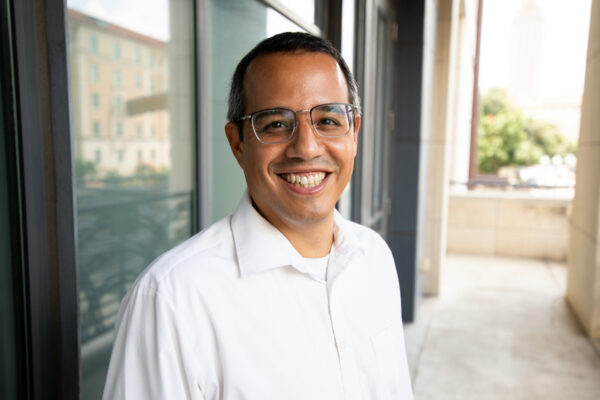
Darius Arya currently is a doctoral student of classical archaeology in the department of classics. His dissertation, "Fortuna in imperial Rome: cult, art, text," is the first comprehensive examination of the goddess of Chance during the first and second centuries C.E. in Rome.

This study is the result of research conducted in Italy through a Fulbright fellowship (1998-9). During his stay in Italy, Arya focused on the relationship among the cults of Fortuna (through temples and sanctuaries in Italy), representations of the goddess in art (usually in the form of marble statuary), and Fortuna in literature and her role in Roman religion and political, social and intellectual life.

He also initiated a research project that is connected to his dissertation during a Rome Prize fellowship at the American Academy in Rome (1999-2000).

The Sopraintendenza of Antiquities in Rome entrusted to him a new analysis of the Basilica Paulli marble frieze, unstudied since 1960. The frieze is a very important art historical document because it depicts unique scenes from Roman mythology (including the goddess Fortuna watching over the foundation of Rome) and history.

Last year, he published (in Italian) a brief account of his research in the catalogue of an exhibit held at the Museo Nazionale alle Terme in Rome. On April 11, he will present a paper on his study of the frieze at UT Austin for the American Institute of Archaeology.

Arya believes the multi-disciplinary approach of his research will have a successful impact on his teaching. No matter what the subject, he contends that any specific study of the ancient Mediterranean world (literature, art history, social history, archaeology) becomes more interesting through the consideration and exploration of related fields and material culture.

His examination of marble sculptures of Fortuna and the frieze has led to the organization of a public, international conference, "Marble in the Roman World," the first symposium on Roman marble studies (April 2001 at the University of Colorado, Boulder). Nineteen academics, scientists, and sculptors will participate.

The conference will include four sessions dedicated to the technical production of marble statuary and reliefs, the restoration and reuse of marbles, the identification of marbles using scientific analysis and the aesthetics of marble in Roman art.

Arya's plans for the future are to complete his dissertation and rework it into a book. His study of the Basilica Paulli frieze has been accepted as a Memoirs of the American Academy volume (if it is not published under the Sopraintendenza in Italian). He will co-edit the proceedings of the marble conference in a Journal of Roman Archaeology supplemental volume.

NOTE: Nominations (including self-nominations) for ARETE should be sent to Associate Dean Richard Cherwitz at spaj737@uts.cc.utexas.edu


spacer
spacer

March 2, 2001
Comments or suggestions to utopa@www.utexas.edu
Website comments to Web Administrator
Copyright © 2001 Office of Public Affairs
at The University of Texas at Austin