Web Historical Disclaimer:

This is a historical page and is no longer maintained at this location. Read our Web history statement for more information and visit the link(s) below to access the current version of the site.
The current OnCampus site can be reached at http://www.utexas.edu/oncampus


spacer

On Campus

April 13, 2001 - VOL. 28, NO. 04


greek columnspacerArete: Patricio Solis

spacer
spacer

Rick Cherwitz and Courtney Dillard


spacer
related photo


return to
On Campus
contents page

Editor's note: Arete is an ancient Greek word for virtue, describing the quest for individual excellence. In this regular feature of On Campus, the University salutes its graduate students — whose considerable contributions to the academy and larger community are truly virtuious. These features will be framed and posted in the lobby of the Office of Graduate Studies, Main 101.

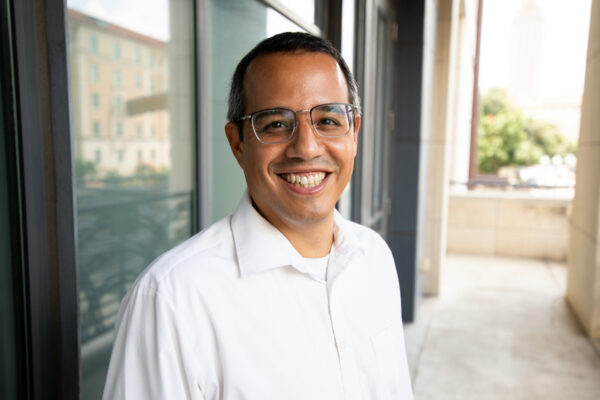
spacerName: Patricio Solís
spacerHometown: Monterrey, Mexico
spacerProgram of Study: Sociology
spacerPh.D. Adviser: Joseph E. Potter and Bryan R. Roberts

Patricio Solís received his bachelor degree in sociology from the Universidad Autónoma de Nuevo León in 1993 and his master's degree in population studies from the Facultad Latinoamericana de Ciencias Sociales (FLACSO) in 1995. Before entering UT, Solís worked for two years as deputy director of demographic analysis at the National Population Council (CONAPO), the state agency dedicated to population research and policy design in Mexico.

Solís’ dissertation research focuses on historical changes in labor opportunities in Monterrey, the third-largest city of Mexico. In the 1960s, a pioneer study developed by researchers at UT characterized Monterrey as a city with abundant job opportunities. Despite their poor and/or rural background, many men were able to improve their occupational position, both in relation to their fathers’ occupation and with respect to the jobs they held earlier in their lives.
There are reasons to believe this situation has substantially changed within the last two decades, including the economic crises experienced by Mexico since the beginning of the 1980s. Between 1980 and 1985, three of the most important industrial firms of the city fired 40,000 workers.

In addition, the restructuring of Monterrey industry and the opening of Mexican economy may have altered labor markets. How have these economic transformations altered the labor trajectories of Monterrey men? Were they able to climb up the occupational staircase, as their fathers did? How have these changes in labor opportunities affected other aspects of men’s lives, such as marriage, parenting and migration behaviors?

For answers, Solís proposed to carry out a representative survey to 1,200 Monterrey men, collecting their complete migration, family and occupational histories. The project was awarded with The Population Council Pre-Dissertation Fellowship and the Andrew W. Mellon Fellowship for Graduate Research, the latter administrated by the Population Research Center at UT. The survey was conducted between August 2000 and January 2001.
Now involved in the analysis of the survey, Solís says of the project: "It was a laborious enterprise, but there are important rewards. We will be able to study how people's lives were shaped by economic changes, thus giving a human face to the broad economic and social transformations experienced by Mexico in recent years. In addition, the project provides continuity to the remarkable tradition of research on Latin American urban issues that has characterized the University of Texas in the last four decades."

Solís has explored other research fields throughout his graduate career at UT. He has written several papers on the social aspects of aging in Mexico. More recently, in collaboration with Dr. Parker Frisbie, he developed a model to estimate the conjoint effects of birth weight and gestational age on infant mortality. The results of this research were published on the November 2000 issue of Demography, one of the most influential journals in population studies worldwide.

His future goals include a return to Mexico to continue his current research. He also plans a teaching career.

NOTE: Nominations (including self-nominations) for ARETE should be sent to Associate Dean Richard Cherwitz at spaj737@uts.cc.utexas.edu


spacer
spacer

April 16, 2001
Comments or suggestions to utopa@www.utexas.edu
Website comments to Web Administrator
Copyright © 2001 Office of Public Affairs
at The University of Texas at Austin