Web Historical Disclaimer:
This is a historical page
and is no longer maintained at this location. Read our
Web history statement for more information and visit the link(s) below to access the current version of the site.
The current OnCampus site can be reached at http://www.utexas.edu/oncampus![]()
![]() |
|
A Publication of THE UNIVERSITY OF TEXAS AT AUSTIN
|
|
|
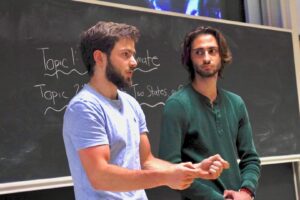
The politics of interpreting Islam: Freshman course on Muslim culture strives to separate religious faith from acts of terrorist perpetrators By Nancy Neff It's unfortunate that it's taken the events of Sept. 11 and the terrorism crisis for America to realize the importance of understanding Islam, say University of Texas at Austin students who have been studying the Muslim culture since classes began in August. In a freshman seminar on "The Foundations of Classical Islamic Culture," the 15 students and their professor Dr. Akel Kahera say they are making every effort to separate the faith of Islam from the acts of the terrorist perpetrators.
Muslims make up one-fourth of the world population and are an ever growing part of the American population, said Alia Khan, a business major from Austin. "Thus, it's important that the rest of America understands what our religion is truly about especially when the current misconceptions are so negative and dangerous in nature," she said. The need to understand Islam is much more urgent in light of recent events, Khan said. "Americans need to understand the terrorists are a very select group of people with very extreme views," she said. Kahera, a university faculty member in Middle Eastern Languages and Cultures, said the politics of interpreting Islam is complex and cannot be done with "sound bites." "Students want to know and understand why Islam, a religion which advocates peace, and Muslims, who adhere to its teachings, are portrayed in the media in such a negative manner," said Kahera. "Students complain that media experts make too many instant generalizations and use too many cliches such as 'fatalism,' 'holy war' and 'Muslim terrorist.'" Kahera said the students in his freshman seminar want to know hard facts, and they ask tough questions. And, because the seminar is three hours, he has the time to respond. "They want to know," he said, "how is it possible that someone can be defined as a Muslim and a terrorist at the same time? What is jihad? Is suicide allowed in Islamic law or the Quran? "We thrash out the complexities of these issues and examine the close affiliations between language and politics," said Kahera, who has taught the seminar for four years. "Knowledge is power," Kahera said. "I prefer to teach my students to appreciate the positive aspects of knowledge that can be gained from studying any non-Western culture. It is better to try and connect different cultures rather than separate them." Michael Hulsey, a history major from Grapevine, said he believes there is a great Continued from Page 1 "I think the popular belief would be that it is more important now to learn about Islam than on Sept. 10. But, in reality, the necessity to better understand the Islamic people and Islamic nations has been very important for dozens of years," Hulsey said. "Unfortunately, only in light of the recent tragedies, are people realizing this." Hulsey and another student, Harrison Speck of Austin, said they learned little in high school about Islamic or Eastern Asian history and culture. "I could write all the Islamic history taught in my high school on a single sheet of paper," said Speck. "I think it's important to learn about as many cultures as possible to understand more about the world we live in, although a culture based solely on its current activity only gives the illusion of understanding." The major misconception after Sept. 11 is that terrorists are supported by Islamic culture, said Speck. "There are many related misconceptions which go along with that idea, such as issues with violence," he said. "Ironically, the nation of Islam teaches peace, rather than violence." Razi Asaduddin of Houston said he enjoys the seminar because it's a small class with open discussions. "Basically, we're all in the same boat," said Asaduddin. "The Muslim kids in the class do not know THAT much more than the non-Muslim kids in the class. Sometimes we know things, sometimes we have just heard of them, other times it's old forgotten knowledge from Sunday school as a child." Asaduddin said he feels lucky to be going to college in Austin because it's an educated community. "There hasn't been anyone who has told me to go back where I came from," he said. In learning about the Islamic culture, students are turning to one of Islam's most famous historians and philosophers Muhammad ibn Khaldun. Ibn Khaldun lived from 1332 to 1406 and is widely believed to be the father of cultural history, modern science and social science and the precursor of Machiavelli, said Kahera. The class examines Ibn Khaldun's Muqaddimah: An Introduction to History. "It is no accident that Alan Greenspan and other economists quote Ibn Khaldun," said Kahera. The university scholar said the misconceptions about Islam and Muslims are too numerous to mention, and are largely due to "ignorance, prejudice and intellectual racism. I teach peace. We have more to gain from peace than engaging in war," Kahera said. top of page next article |
|
|
|
|