The University of Texas at Austin- What Starts Here Changes the World
Services Navigation
  UT Home -> Office of the President -> Speeches & Commentary

Knowledge is Power: The Role of the University of Texas in Regional Economic Development


Presented at the Second Chinese-Foreign University Presidents Forum
Beijing, China
August 9, 2004

******

Please let me begin by expressing thanks to Dr. Zhou Ji, Minister of Education of the People's Republic of China, for his invitation to address this distinguished assembly. I am greatly pleased to join colleagues from leading institutions in China and other nations here in the Central Kingdom. I look forward to meeting as many of you as possible during this meeting.

It is a privilege indeed to return to China. My first trip, almost 20 years ago, took me to Shanghai, where I served for three weeks at Fudan University as a consultant on China 's World Bank project to develop its Key Universities. It was a transformative experience for me, opening my eyes and mind and heart to the ancient richness and modern possibilities of Chinese culture. On many occasions since 1985, I have been able to return to various parts of East Asia to witness dramatic growth and to renew my fascination with this great root of civilization and learning. I am glad to be back once more, on this, my first trip to Asia since 1997, and I marvel at the continued transformation and growth of China.

In my career as a chemistry professor and as a university administrator, I have hosted, taught, and collaborated with Chinese scientists, scholars, and students, and I have seen much of their talent and diligence. Wonderful results have arisen from these partnerships and warm satisfaction remains in the relationships.

When we exchange ideas and resources — when we cross borders and oceans to learn from one another and to experience what other cultures have to offer — then our lives are enriched, our institutions are strengthened, our people benefit in tangible ways. And in the process, we experience the respect and deeper understanding that should always guide the spirit of cooperation between our countries.

******

My job here today, as outlined by the organizers, is to speak about the way in which a university can foster economic development. The success of the University of Texas at Austin in this part of its mission has been notable, so I can address my subject in a particular and historical way.

One of America 's congressional leaders, Tip O'Neill, Speaker of the House of Representatives during the 1980s, used to say that “All politics is local.” That is very largely true, and it is likewise true that economic effects of universities are very largely regional. To understand how a university can benefit economic development in a serious way, one must understand its region and the way in which the university supports the region. If I am to discuss our success in Austin, I must, for this reason, speak for a little while about Texas and about Austin. In the course of that, I will also talk about the scale and shape of the University. Then, I will outline changes of economic importance that have occurred in Texas and in the Austin region, and I will cover some of the specific ways in which the University has promoted economic development in the Austin region. Finally, I will talk more generally about the aspects of a university that are important to regional economic development.

******

The name of Texas has a mythic resonance and is more familiar to people around the world than the names of most American states. When people hear it, they think of cowboys, and cattle, and oil wells, and vast open spaces dotted with cactus and drifting tumbleweeds. Texas is the subject and backdrop of countless books, songs, and motion pictures. But the reality today is that the cowboys are a dwindling breed, the oil wells are producing less than they once did, and over the past 50 years the population has shifted from rural life on farms and ranches to large urban areas like Houston, Dallas, San Antonio – and Austin.

These changes mirror what has been happening in China for the past several decades.

Texas is now better known for the NASA Johnson Space Center than for its once-dominant cotton production. Texas is where the integrated circuit was invented . . . where the heart stint was created . . . where a world-renowned center for cancer research and treatment is saving lives every day. Houston is still the energy capital of the world, but the largest employment sector in Texas is microelectronics and software, not the oil and gas industry. Texas is a far different place in the 21st century than it was when movies like Giant dominated the popular imagination.

I might add that besides being the base for America 's manned space exploration program, Houston is also the place where basketball star Yao Ming plays for the Houston Rockets. Yao is surely Chinese, but he is also now a Texan! We have a saying that "everything is big in Texas " -- which is one reason why Yao is so welcomed there.

******

Modern Texas is a large state with a diverse population, a diversified economy, and considerable political strength.

In physical terms, it is the second largest of the American states – behind Alaska. It is somewhat larger than France or Sichuan Province and the Chongqing Region taken together. It is about the same size as Qinghai Province. In contrast to the popular perception, the land of Texas has a diverse character, with swamps in the southeast and desert in the far west, large, dense forests on hilly terrain in the east and northeast, mountains in the west, a picturesque and popular “Hill Country” in the center, prairie to the north and northwest, and classic ranchland in the south and southwest.

The population of Texas is large by American standards, but – at 22 million – is only about a third of that in France. (But four times the population of Qinghai!) In the United States, Texas is second in population to California. It has grown very rapidly in recent decades and has eclipsed such historically populous states as New York, Pennsylvania, and Illinois. Of course, this population growth accounts substantially for the growing economic power and political strength of Texas.

The gross economic product of Texas is slightly larger than Brazil 's and would be eighth if it were reported separately among the national figures. We are home to America 's busiest maritime international trade port – Houston – and its busiest inland port, Laredo. In 2002, Texas became America 's largest exporting state, sending more than $95 billion worth of goods abroad. 

Texas is the number two state in high-tech activity, with close to half a million high-tech workers.  Even in a state as heavily invested in trade as Texas, the high-tech sector is responsible for about one-third of our total exports.
 
Of the last eight U.S. presidents, three have come from Texas, and a Texan has been either President or Vice President of the United States for 24 of the 44 years since 1960.

About two-thirds of the people of Texas are concentrated in a “Golden Triangle” connecting Dallas-Fort Worth on the north, Houston in the southeast, and San Antonio in the south. There are also large populations on the border with Mexico, one in El Paso, in the far west, and another in the Rio Grande Valley, in the far south.

Austin – on the western leg of the Golden Triangle, between Dallas and San Antonio – is the capital of Texas and, of course, the seat of The University of Texas at Austin. From its central location, the University is able to serve people and organizations statewide, and it has many interactions in the major population centers of the Golden Triangle.

The Texas population is cosmopolitan and is changing dramatically because of immigration, mainly from Latin America, but also from Asia. We are just now at the moment when Texas will no longer have a majority among its racial and ethnic groups. The “Anglo,” or non-Hispanic white, fraction is almost exactly 50% and is falling. The Hispanic fraction is about 33% and is rapidly growing. African-Americans make up about 13% and Asian-Americans about 3%. This audience might be surprised to learn that the class of first-year students at the University of Texas at Austin is typically about 17% Asian-American, nearly all derived from the 3% of the Texas population who are Asian-American.

graph of Texas Population in 2001 vs Texas Population in 2015

The University of Texas is also enriched by the presence of its foreign students. The University hosts students from more than 100 countries and is fifth among universities in America for the number of enrolled international students. This past year, our university enrolled 653 students from the People's Republic of China. That is the third largest group of foreign students, surpassed only by those from India and the Republic of Korea. We are proud to provide an education to Chinese students and to the many others who wish to study with us from abroad. The exchange is two-way – benefiting both the Chinese and American students who interact with one another. One of our responsibilities as a major university is to impart to all of our students a deeper understanding of the history, culture, language, and customs of other parts of the world. We take that responsibility very seriously. There are 10 centers that focus on global studies; our University of Texas International Network Information Systems provide worldwide access to academic databases and information services; and our Latin American Studies program is especially widely recognized for its strength.

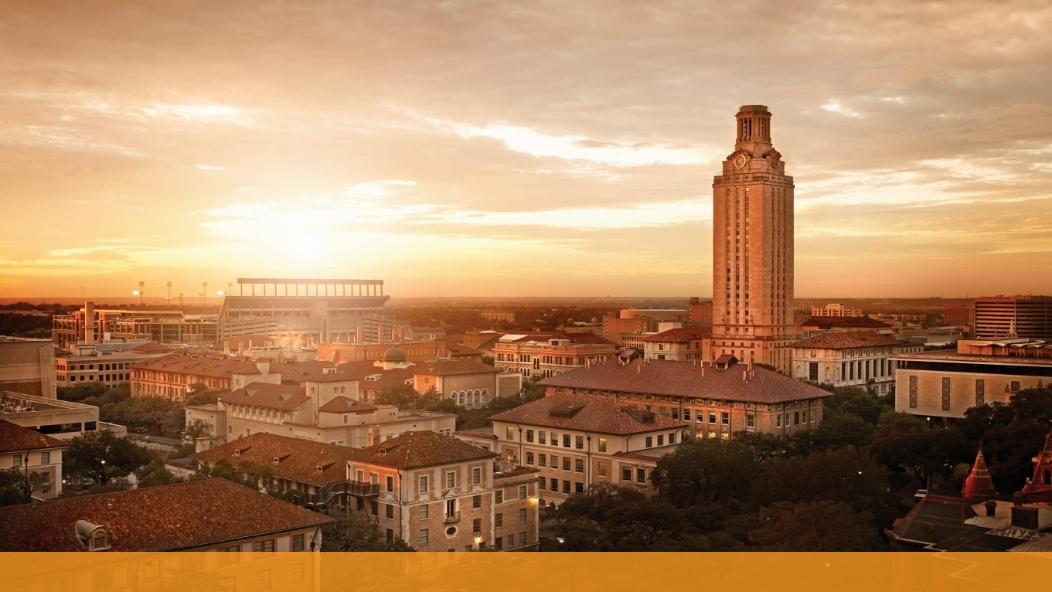
The University's main campus is not far from the Texas State Capitol building and covers about 1.5 square kilometers. The 100-meter-tall Tower is the university's most widely-known landmark. In addition to maintaining our Austin campus, the University operates various research centers in other parts of the state, including a Marine Science Institute on the Texas Gulf Coast and the McDonald Observatory in the Davis Mountains of West Texas. We also provide a home for the presidential library and archive of the late President Lyndon Baines Johnson. Overall, the University has 51,000 students and more than 2,500 members of its faculties. In terms of student population, The University of Texas at Austin is America 's largest. About 40,000 of the students are undergraduates and 11,000 are graduate and professional students. The undergraduates are overwhelmingly from Texas – about 93% of them. The graduate students come to the University from all over the nation and from around the world. There are 16 faculties hosting academic programs spanning essentially all disciplines except medicine and agriculture. The overall university budget is about 1.5 billion U.S. dollars. Of this amount, about 400 million dollars is to support research projects. Among U.S. universities without medical centers, The University of Texas at Austin is second only to MIT in the volume of its national research support.

The University is the “flagship,” or historic root and central member, of the University of Texas System, which is led by a chancellor and governed by a nine-member Board of Regents. Other institutions in the System include eight other universities and six medical centers, including the world-renowned M. D. Anderson Cancer Center and the University of Texas Southwestern Medical Center. The regents are appointed by the Governor of Texas, and each seat on the Board is among the most prized of public appointments. Regents are typically very accomplished and influential citizens of Texas.

The main point that I want to make here is simply that The University of Texas at Austin is not an ordinary place. It is one of the largest and most powerful teaching and research centers in the United States, with a faculty recruited in competition with other top institutions in America. The University has been historically the most important institution for developing leadership in Texas society across the gamut of human activity – in science and engineering, politics and government, media, literature, business, the arts, and so on. Its governing board is very powerful in the larger life of Texas. The public looks to The University of Texas at Austin to provide knowledge and expertise for solving public problems of all kinds, especially those related to the educational challenges associated with the state's demographic shifts. All of these elements conspire to define the University's relationship to its region, which in turn is central to an understanding of its role in regional economic development.

******

Over my professional lifetime, the development in the Austin region has been, by any measure (even traffic), spectacular.

In 1960, the Austin area had a population of about 212,000 and almost no industry. Texas state government was the primary basis of employment. Today, however, Austin is a metropolitan area of 1.3 million people and has become an internationally recognized center of creative activity, not only in technology, but also in the fields related to the arts, such as advertising and film-making. The University of Texas is, without question, the single most important reason for that transformation.

Graph of Population growth in the Austin Region from 1960 to 2004

In real terms, the Austin region's gross product has multiplied fourfold since 1980 and is now about 56 billion U.S. dollars per year. This represents a growth rate of 8% per year on an inflation-corrected basis, impressive even by Chinese standards.

Graph of the change in real gross product in Austin from 1980 to 2004

In the course of it all, the University has also become much larger and more sophisticated. In 1960, it employed about 7,000 faculty and staff members. Today we're Austin's largest employer with 22,000 faculty and staff members. And we have hundreds of employees working elsewhere around Texas. There were about 21,000 University students in 1960. Today there are more than 51,000.

Here is my personal favorite among the statistics: The University budget in 1960 was only about 30 million U.S. dollars. Now it is 50 times larger at 1.5 billion dollars. Of course, a large part of that is due to inflation, but the real growth is in the range of five times.

Graph of budget growth at UT Austin from 1960 to 2004

The University's research facilities, the scale and importance of its libraries and collections, and the volume and influence of its research are incomparably greater now than in the early 1960s.

To be sure, a university as large as The University of Texas at Austin is an economic engine all by itself. Our current students contribute, in direct personal expenditures, more than 500 million dollars into the Austin economy each year, nearly all of it brought in from the outside. The local economic activity derived from the University's own expenditures multiplies to about 7 billion U.S. dollars per year. This is all very stable activity, rather insulated from the business cycle and with good annual growth.

But the economic activity originating in the University is not the reason for economic development of the Austin region. That has come from interactions between the University and the larger society of the region.

The foundation of the development probably lies in the very strong College of Engineering developed at the University under consistently superb leadership over decades. By the early 1960s, the College was strong enough to be hosting some excellent, large research programs in advanced electronics, and it was producing large numbers of well-educated engineers. A seminal technology-based business named Tracor spun out of the research program, and not long afterward Texas Instruments and IBM were attracted by the availability of engineering talent. This was the origin of Austin 's strong suit in technology.

The talent found Austin attractive as a place to live and wanted to stay. By the early 1970s, a new company named Radian had spun out of Tracor, and quite a few entrepreneurial engineers from Texas Instruments and IBM had left those companies to begin smaller enterprises of their own.

Perhaps the most important single event in Austin's development was the region's success, in the early 1980s, in attracting MCC, the Microelectronics and Computer Corporation, in an intense national competition. With American electronics and computing industries under heavy competitive pressure from Japan , the US government sponsored MCC as a richly funded government-industry consortium to conduct leading-edge pre-competitive research. Metropolitan leaders across America saw MCC as an enterprise that would define the future of microelectronics and computing, so they bid fiercely for it to be located in their areas. Austin was the successful bidder. There were five important parts to its package:

•  Financial inducements offered by the Governor of Texas and the civic leadership of Austin.

•  A commitment by the University to locate MCC in a building to be constructed specifically for MCC's needs on University land.

•  The strength and scale of the University's science, mathematics, and engineering programs.

•  Commitments by the State of Texas and by private donors to recruit additional top-level faculty talent into those programs.

•  The attractiveness of the Austin area as a place to live.

Of these five elements, the University was a major factor in all. I will have more to say about such things a little later in this speech.

In the late 1980s, there was a similar success when the Austin area won another national competition for another government-industry consortium dedicated to leading-edge, pre-competitive research in the semiconductor industry. That one, called Sematech, was to support the development of the tools and materials needed for advancement of technology into new generations. The same five elements used to attract MCC were used to bring Sematech to Austin, including a new facility on University land.

Through the 1980s and into the 1990s, a great many major companies in the semiconductor and computer fields placed large facilities in Austin because MCC and Sematech were in town. They typically drew heavily on the talent and expertise available to them at the University.

During this period, a remarkable entrepreneur named Michael Dell went into business making computers at the age of 19, after just one year as a student at The University of Texas at Austin. His company, Austin 's largest corporate success story, has become a global powerhouse in the computer industry.

By the middle and late 1990s, software had also become a significant part of the commercial mix, and Austin became a major center for development of systems, web-based applications and services, and games. Of course, this sector suffered greatly during the dot-com bust in the years after 2000, but there is new vitality in it now.

The Austin area now hosts corporate headquarters for three Fortune 500 companies. The largest is Dell. Second is the recently spun-off Semiconductor Division of Motorola, which is now called Freescale Semiconductor. The third is TempleInland, a major forest products, paper, and financial services company. A fourth company, Whole Foods, is on the verge of entry into the Fortune 500.

Did the University assist in the creation of this scene? You bet! (as we say in Texas ).

Dell was founded by and is led by an ex-student of ours. TempleInland has been brought to Austin by a Texas graduate who built its financial services arm to a substantial degree on Austin-area real estate opportunities extending from the technology-driven growth. Freescale is in Austin because Motorola headquartered its Semiconductor Division there after MCC and Sematech came to town. Whole Foods built its business concept on the cultural independence of Austin, which has its roots in the University. All four of these companies have relied on the flow of educated talent from The University of Texas at Austin.

And there is more:

•  The Austin Technology Incubator, which is part of the University, has graduated 70 technology-based companies. These companies have generated nearly 3,000 jobs in the Austin region and have raised $600 million in capital.

•  Scores of companies have been spun off from the University, including Tracor, Radian, National Instruments, Evolutionary Technologies, and many smaller enterprises.

•  More than 11,000 business managers have been trained in the past five years in our executive education program at the University's McCombs School of Business. Many of the programs are tailored to the individual needs of the companies employing the managers participating in them.

•  The University is committed to developing transnational business partnerships. We are especially interactive with Mexico, our neighbor across the Rio Grande Rive , in industry and educational exchanges. For example, we have ongoing research agreements with PEMEX – the Mexican national oil company – in which our university's geological, environmental, and engineering expertise is put directly at the service of Mexico. The North American Free Trade Agreement (NAFTA) has dramatically increased the volume and variety of business between Texas and Mexico, and The University of Texas at Austin has set a priority upon facilitating positive mutual development on our border.

All of these efforts indicate how engaged we have been over the past 40 years to strengthen our regional economy. But we certainly are not resting on our accomplishments. Here are some things that our university is doing to address the future:

•  About three years ago, the University established the Center for Nano and Molecular Science and Technology. We have raised more than $11 million for advanced instrumentation for nanoscience and nanotechnology, and there are 80 faculty members and more than 100 graduate students and post-doctoral researchers using that instrumentation at the present time. We have formed a partnership with three other Texas universities to seek federal and state funding in this field. The partnership will work together to promote Texas as a center for research in nanotechnology.

•  We have established a new Department of Biomedical Engineering. Our biomedical researchers are collaborating with the world-renowned M. D. Anderson Cancer Center in Houston and the University of Texas Health Science Center in Houston.

•  Our Institute for Computational Engineering and Sciences was established in 2003 to produce world-class interdisciplinary research in computational engineering, science, and technology. Several industrial partners are supporting the institute, including Dell, IBM, Microsoft, and Nortel.

******

Because universities have a concentration of brain power, ambition, and expertise, they are natural partners in building a strong regional economy. In regional economic development, knowledge is indeed power. All sound universities make important, economically significant contributions to the regions that host them. Here are some of the ways that are common to all:

•  Universities are magnets that draw young people of talent from a large area and concentrate them into an interactive, creative community. Much of this talent is retained in the home area of the university.

•  Universities develop knowledge and skills in their students, so that their graduates are capable of making much more valuable contributions to their families and their society.

•  Universities recruit and sustain a talented faculty, who contribute to the creation of a vibrant community outside the university itself and can bring expertise to the solution of public problems or – as inventors and consultants – to the service of commerce and industry.

•  A university has great power to influence the attractiveness of its region as a place to live and work, through the ability, leadership, and creativity of its graduates, through its effect on the intellectual life of its community, through cultural and artistic events that it sponsors, and through its ability to build identity.

•  Universities also have convening power. They can bring people together from all sectors of society to address the issues of the present and future. In this way, and in others, universities become seen publicly as places where the future is created. The reputation and the reality are both valuable for the economic development of the region that hosts the university.

•  Finally, all universities are sizable, stable economic engines in themselves. They bring employment to a community and generate income for many supporting businesses.

With properties such as these, it is no surprise that virtually all regional economic development teams in the United States are placing a strong focus on their local colleges and universities. They are right in doing so, because their educational institutions add value of a kind that cannot be obtained in other ways.

******

On the other hand, a story like the development of Austin is a rare case, and it rests on more than the basic list of contributions made by universities. To realize the kind of university-aided development that has occurred in the Boston area, or Silicon Valley, or the Research Triangle of North Carolina, or San Diego – or Austin, the assets of one or more exceptionally strong universities must come together with special assets of the region itself. For growth of that kind, I believe that four particular conditions must all be satisfied:

•  First, the university must host a superb faculty and truly exceptional research programs, as measured by international standards.

•  Next, the university must have high social importance and public credibility.

•  Third, the region must be a competitively attractive place for talented people to live.

•  Finally, the university leadership must be well engaged with the business and political leadership of the region, and all must be interested in fostering economic development.

Now let me amplify each of these points in turn.

Extraordinary university-assisted growth must be built on the basis of a substantial advantage in some specific portion of the world of ideas. This means that the region must host a commanding presence in critical supporting fields, manifested in resident expertise and respected, intensive research at the very edge of knowledge. Experience suggests that these elements can be brought together only in a university with a top-quality faculty and a large volume of internationally respected research. Unless there is broad strength in the institution, it is practically impossible to recruit academic talent at the level and in the numbers required to produce the focused expertise needed for strong economic development. Because such development typically arises from new forms of economic activity rooted in technical advances, the critical areas are likely to be in science or engineering. However strength in other disciplines is also important, not only to the overall reputation and capability of the university, but also because of their impact on the larger community. The latter point is one to which I will return.

A close observer may note that Austin 's technology base began to develop before The University of Texas at Austin could have laid much of a claim to a top-quality faculty or a large base of research. This is true, but the real take-off in Austin's development as a technology center did not occur until the early 1980s, when the University was rapidly establishing itself as a leading academic institution.

In a region that has already achieved much knowledge-based development, neither the expertise nor the research will be confined to the academic institutions. To the contrary, the bulk of it may reside among the industries of the region. However, the university is still a critical catalyst, because it continuously furnishes new talent, including expert talent in the very fields most relevant to the region's core activity. Moreover, the university can upgrade the abilities of people already involved in that activity; it can offer consulting strength; and it can serve as an exchange point for experts from industry, who otherwise have limited access to open intellectual environments.

When I say, in my second point, that the university must have social importance and public credibility, I mean that people in the broader society of the region must have confidence in the institution and must see it as centrally important to the welfare of the region. They must regard it as a place for educating the most talented of their young people, and they must perceive it as a place where the issues of the society can and will be addressed – where solutions will be found. A university with strength in these public connections has the power to affect events in its region – to make things happen. Just as important, it commands the confidence that it must have to gain the public and private investment essential to the very creation and sustenance of programs that give rise to the knowledge advantage.

As I outlined the role of The University of Texas at Austin in our state, my purpose was to illustrate how well the University is situated with regard to social importance and public credibility. For decades, it has held the leading position among Texas universities in these respects, and that position has been critical to its work on behalf of economic development, not only in the Austin region, but throughout the state.

Third in my list of conditions was that the region must be attractive to talented people. Folks who can enable and drive extraordinary economic development have choices about where to live and work, and they will migrate to the most attractive. Physical beauty and recreational advantages are among their considerations, and both are high among the reasons for the success of Silicon Valley, San Diego , the Research Triangle, and Austin. Good transportation is absolutely essential, and in the U.S., that means convenient access to an airport that offers nonstop service to a significant spectrum of cities. Affordability is a secondary consideration. Of course, the university can do nothing about any of these things, but they do affect – in a strong way – whether extraordinary growth is really possible.

The absence of real advantages in this sphere is probably the main reason for the lack of examples of such development around the truly great universities located in the smaller “college towns” of America. Many of these towns are quite healthy economically, precisely because of the effect of the local university, and many have experienced modest to good recent development rooted in their university's intellectual strengths; but my focus here is on extraordinary development, and college towns just do not have the assets required for that.

Universities do have a strong influence on one important aspect of livability, namely, the cultural milieu. Creative people like to be around universities, because the intellectual atmosphere is lively, and cultural opportunities are more plentiful than in the larger society. The attractiveness of the environment created by the three universities of the Research Triangle is a big part of the success in North Carolina, and the same can be said of Austin. For decades, Austin has been known as a place that harbors a great range of creative people. Favorite T-shirts and bumper-stickers in the Austin area admonish the community to “Keep Austin Weird.” While Austin is widely known as a technology center, it is a multi-dimensional place with all political and cultural viewpoints expressed, with an appreciation for education and intellectual activity, with a strong environmental tradition, with an especially varied live-music scene. I am showing some of the popular aspects of that scene in the slide now on the screen, but Austin also has a professional symphony and professional opera and ballet companies operating at a quite high standard. This is very unusual for a city of Austin's size. There are also strong elements in the visual arts and drama. Finally, Austin is even the home of Lance Armstrong, recently the winner for the sixth time in the Tour de France. Much of Austin 's atmosphere and activity flows from the youth and intellectual liveliness of The University of Texas at Austin, and these things are powerful assets of the community.

My fourth and last condition for extraordinary growth was that the university leadership must be well engaged with the business and political leadership of the region, and all parties must be interested in fostering economic development. Economic development rarely happens in this era just because intellectual conditions are right. It is fostered by collaborations among civic leaders, including the leadership of universities. In the case of Austin, I spoke about how such collaboration was essential to attracting MCC and Sematech. Without the public confidence that I emphasized just a moment ago, the required collaboration could not have happened. But also required was entrée to top-level leadership of the state. The strength of our University's governing board in the life of Texas helps to sustain the essential connections. In the Austin area and in Texas at large, collaboration of this kind continues to be important, as the region seeks to persuade firms to locate new facilities, or to upgrade established ones, in our region.

One final point: Land is a special asset of a university that can be important in collaborative regional economic development. Stanford's use of its extensive landholdings in support of knowledge-based corporate development is a very large part of the Silicon Valley story. Our commitment of land and facilities to MCC and Sematech was likewise critical to the Austin story.

******

For the past 35 years I have been working in academic environments, and I have seen how universities can generate new knowledge, educate future leaders, disseminate mass information, strengthen the regional economy, raise social awareness, and foster a free market for ideas. Nations must take advantage of the expertise and the rich resources of people and research facilities in their universities. The business sector should develop partnerships with universities in projects and initiatives that support the economy and raise the quality of life.

A university is a deep spring that nourishes those things that a society needs in order to make progress: imagination, ambition, a competitive spirit, and a zeal for discovery. I believe that there is no more powerful tool for developing a stronger, more productive, more progressive society.

America 's third president, Thomas Jefferson – author of our Declaration of Independence and founder of The University of Virginia – also believed fervently in what a university could do to strengthen a society. Like all of us, he sought greater public support for his university. In doing so, he admonished public leaders to perceive what he called “the important truths: That knowledge is power; that knowledge is safety; that knowledge is happiness.” Indeed it is, on all counts, and that is really what I have discussed today.

Thank you all for listening.


Click here for a printer friendly PDF version of this speech.


E-mail the Office of the President

Web site comments to Office of Public Affairs