Our Facilities

OVERVIEW

The University of Texas at Austin has grown its Center for Electromechanics into a world class center for modeling, analyzing, designing, and fabricating advanced electrical power generation and distribution systems.  The Center staff includes researchers recognized as world leaders in the development of advanced energy storage and power generation rotating machines for both intermittent and continuous duty applications.  These capabilities are supported by a dedicated laboratory and fabrication facilities unmatched by any university research facility in the United States.

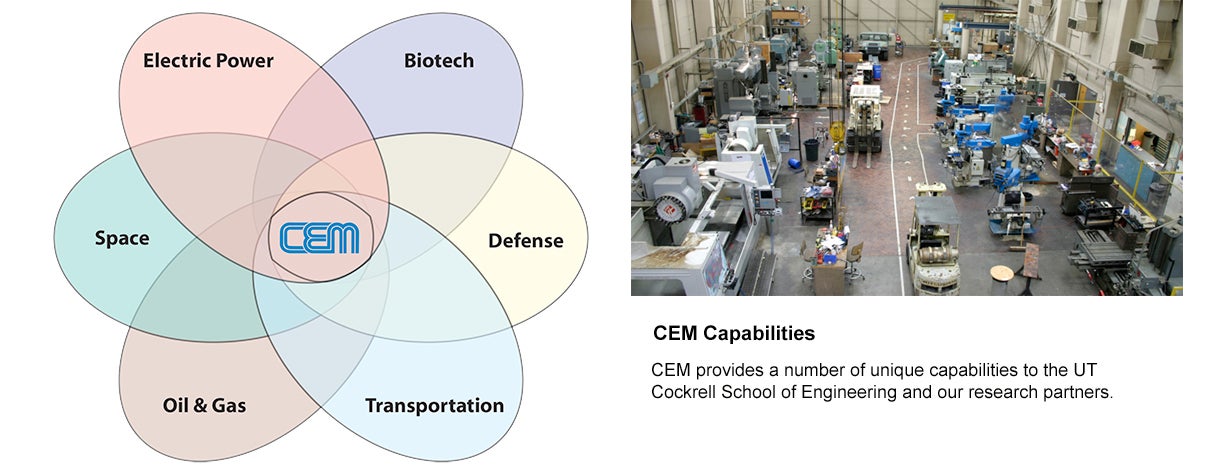
The Center for Electromechanics, located at The University’s J. J. Pickle Research Campus, houses extensive fabrication, assembly, and testing facilities in a 140,000 square ft air conditioned high bay laboratory.  The 70 ft tall high bay features two 25 ton cranes with an additional 25 ton crane servicing a machine shop area.  In addition to the main high bay laboratory, an additional 10,000 square ft of air conditioned space is available in 8 satellite labs, along with a 1,200 square ft welding/fabrication shop.

Main Hi-bay Shop Photo

Main high bay:  Visible in the right foreground is a granite surface plate for dimensional inspections.  A 200 ton hydraulic assembly press is visible in the left foreground and the main high bay doors and the six coaxial inductors of the Balcones Homopolar Generator Power Supply (BHPG) are visible in the background.

The Center uses a distributed manufacturing approach to fabrication.  Novel machines are designed by the research staff and component testing is done to provide the engineering data needed to fabricate these first-of-a-kind machines.  Components that can be fabricated using conventional industrial practices are fabricated by experienced suppliers.  When materials or other factors beyond current industrial practice are required, the Center researchers develop new fabrication processes in-house.  If these new processes are needed routinely, they are transferred to competent industrial suppliers.  In this way, the researchers remain focused on novel systems, but the results of the earlier work are available to others through a competent base of industrial suppliers.

Typically, final fabrication and testing is done in the Center facilities.  When there is a high likelihood that subsequent similar machines will be needed, the Center teams with a manufacturer who participates in the assembly and test activities.  This is an effective way to transfer the technology to an industrial supplier.

Machine Shop photo
Machine Shop:  In the foreground is a HAAS Model VF7CNC machining center and the tool crib window is visible at the right center edge of the picture.  The main machine shop door is visible in the background, along with the entrance, to the right, to the auxiliary machine shop area.

Auxilliary Machine Shop

Auxiliary Machine Shop:  On the left are manual lathes and a grinding and sheet metal forming area.  On the right are a radial arm drill, a 5 ton crane, and manual mills.

The facility also houses a high energy spin test bunker designed to safely contain a 20 psig internal overpressure.  The 600 square ft. spin test bunker features 30 in. thick fiberglass reinforced concrete walls with 6 in. thick aluminum door, window, and roof closures.  A stainless steel tie down structure is rated for 5 million pound vertical load and torque loads of up to 20 million lb-ft.  A metal building located immediately adjacent to the spin test bunker was designed for installation and testing of gas turbines, with openings for intake air and integral exhaust ducting in the roof.  This structure can also be used for local instrumentation and data acquisition for experiments being conducted in the spin test bunker.

A 75 ft deep vertical gun range is located between the north end of the main high bay and the spin test bunker.  The 7-story vertical range is serviced by a 3-person elevator and currently houses a 90 mm bore x 10 m long railgun and bore honing system.

Vertical Gun Range

This exterior view of the North end of the main high bay shows the vertical gun range, the spin test bunker, the turbine enclosure, and the honing tower above the gun range.

FABRICATION AND TESTING CAPABILITIES

The laboratory houses several specialized manufacturing and testing facilities designed to support prototype development and testing efforts.

Machine and Fabrication Shop

The Center’s machining capabilities were updated in 2003 with the installation of several new machine tools, including lathes, manual mills, and a horizontal band saw.  Important additions to the machine shop include a HAAS Model VF7 CNC machining center that provides fully programmable 4-axis machining and a Hurco machining center.

HAAS and Hurco Machine

In the Machine Shop, the HAAS (left) and HURCO (right) Machining Centers provides fully programmable 4-axis machining.

The machine shop is also supported by a fully stocked tool crib, including measuring and inspection tools under NIST traceable calibrations.  Although the Center does not have an on-site Coordinate Measuring Machine (CMM), one is available at The University of Texas at Austin Applied Research Laboratories, also located at the Pickle Research Campus.  Below is a list of the machine tools available in the Center’s Machine Shop.

UT-CEM Machine Shop Equipment List

Milling Machines

Lathes

Haas Model VF7 Machining Center

Lodge & Shipley 20”x 80”

Hurco CNC Model MD1

LeBlond 31” x 60”

Bridgeport Series I 2 hp 9” x 48” Table (3x)

Victor 20” x 80”

Bridgeport Series II 3 hp11” x 60” Table (3x)

Victor 17” x60”

Summit 350 3 hp 10” x 50” Table (2x)

LeBlond 18” x 60”

Summit 550 5 hp 11” x 52” Table (3x)

Sebastian 13” x 32”

Giddings & Lewis 3” Horizontal Boring Mill

Sheldon 6” x 24”

Grinders

Lagun (American Turnmaster) 64” x 16’

K.O. Lee Surface Grinder

Ryazan 52” x 16’

Harig Surface Grinder with DRO

Lehmann 36” x 66”

2 hp Tool Post Grinders (2x)

King Vertical Turret 62” Table 48” Height

Hammond 8” Pedestal Grinder

Hercules 32” x 80”

Rockwell Disc/Belt Sander


Saws

Drill Presses

Grob Vertical Band Saw 18” Throat

Summit Radial Arm 18” Column 6’ Arm

Tannewitz Band Saw 36” Throat

Miscellaneous Drill Presses (2x)

WF Wells Horizontal Band Saw 16” Throat


Kalamazoo Horizontal Band Saw 6” x 12”


In addition to the extensive machining capabilities, the Center also maintains a welding and fabrication shop.  The welding shop features a 2-axis programmable Ingersoll Rand/ESAB Autopath GX 60,000 psi abrasive waterjet cutting system capable of cutting metals, ceramics, and composite materials without introducing significant heat into the part.  An ESAB 2-axis combination oxy-acetylene and plasma cutter is also located in the welding shop, along with both metal/inert gas (MIG) and tungsten/inert gas (TIG) welding machines.

Waterjet Hi Pressure Cutter

The Ingersoll Rand/ESAB Autopath GX 60,000 psi abrasive waterjet cutting system is capable of cutting metals, ceramics, and composite materials without introducing significant heat into the part.

Plasma Torch

ESAB 2-axis combination oxy-acetylene and plasma cutter.

Composites Processing Facility

There is significant in-house expertise in the design, analysis, and manufacture of composite structures used in high performance rotating machines.  To aid in rapidly prototyping complex composite structures with known mechanical properties, the Center developed a set of linked computer codes (CEMWIND) that generates detailed material property data that can be exported to finite element analysis codes, along with programs that control fiber placement and orientation in the filament winding machine.  One winding machine is a McClean Anderson 4-axis CNC filament winding machine installed in a dedicated low lab with local environmental control.  The system is capable of processing parts up to 66 in. in diameter and 40 ft long using both wet winding and pre-impregnated fiber tows.  The winding machine has been modified with a specially designed fiber payout system to enable processing of high modulus graphite fibers with minimal fiber damage.

McClean Winding Machine

The McClean Anderson 4-axis CNC Filament Winding Machine is capable of processing parts up to 66 in. in diameter and 40 ft long using both wet winding and pre-impregnated fiber tows.


The newest winding machine is an ENTEC 5-axis CNC filament winding machine installed at the end of the McClean Anderson machine.  It has been modified to accommodate heavy mandrels up to 15 ft in length.  This machine has also been modified with a special payout system for advanced graphite and glass fiber systems used in high performance rotors.

ENTEC winding machine

The ENTEC 5-axis CNC Filament Winding Machine is capable of processing parts up to 34 in. in diameter and 164 ft long modified to accept a max weight of 2,000 lbs.

A dedicated autoclave, manufactured by American Autoclave, is used to cure composite structures.  The fully programmable autoclave is rated for 650° F and 250 psig and can process composite parts up to 7 ft in diameter and 11 ft long.  The autoclave can process a range of materials including epoxies, cyanate esters, BMIs, some lower temperature polyimides, and thermoplastics.  In addition to the autoclave, the facility includes a 12 ft x 20 ft curing oven with programmable time/temperature profiles for curing wet wound and resin transfer molded (RTM) composite structures and adhesively bonded assemblies.

Autoclave Oven

Autoclave for Pressure Cured Composite Processing.

To support the composites development program, the Center researchers developed and validated specialized testing equipment and procedures to measure the hoop modulus and strain to failure of filament wound composite materials.  The testing is required to quickly evaluate the performance of different fiber and resin combinations or variations in the processing procedures to ensure that the delivered mechanical properties satisfy the design requirements.  The test equipment and procedures are under review by the American Society for Testing and Materials (ASTM) as a new standard for quantifying mechanical properties of composite materials.  Composite specimens are instrumented with strain gages and then subjected to internal hydraulic pressure, creating predominantly circumferential (hoop) stresses in the specimen.  Data from multiple specimens is processed using MIL-HDBK-17 statistical analysis procedures to generate A-Basis and B-Basis design allowables.

The fabrication of advanced composite structures also required the development of custom fixtures for assembly of composite structures.  Composite rotors are typically constructed using multiple concentric rings assembled with interference fits.  This assembly approach is used to create radial preload and control the magnitude and distribution of radial stresses in the rotor structure.  The facility includes custom hydraulic presses specifically designed by Center researchers for assembly of composite rotors.  The largest assembly press is 40 ft tall and is capable of generating forces in excess of 550 tons; a smaller assembly press is 10 ft tall and rated for 200 tons.

C

The primary Composites Assembly Press in the high bay is 40 ft tall and is capable of generating forces in excess of 500 tons.

Electronics and Instrumentation

In-house testing and experiments are supported by a wide array of electronic test equipment and instrumentation.  The facility contains two dedicated EMI/RFI shielded control rooms to isolate instrumentation and controls during high energy testing.  Fast transient data can be collected using digital storage oscilloscopes and custom designed data acquisition systems are available to monitor and analyze the performance of rotating electrical machines, including rotor vibration and housing accelerations in both time and frequency domains.  Below is a partial list of the available measurement and data acquisition equipment.

Available Measurement and Data Acquisition Equipment

Digital Storage Oscilloscopes


Nicolet Pro-40/90 & Integra series

40 channels

Tektronics 3000-series

12 channels

Agilent Mixed Signal Oscilloscope #54622D

2+16 channels

Tektronics 2000-series Oscilloscopes

14 channels

Zonic WC Vibration Analyzer

16 channel

Oros #OR-38 Vibration Analyzer

16 channel

HP/Agilent #34970A Scanning Digital Multimeter (3)

>96 channels

Cambridge 510A Micro-Ohmmeter


Biddle 15kV Mega-Ohmmeter


Hipotronics #880PL, 80kV DC Insulation Tester


HP #4261A LCR Impedance Meter


Agilent #4284A LRC Impedance Meter


Walker Scientific MG-5DP Gaussmeter


Valhalla Scientific #2300 Digital Power Analyzers (2)


Strain gage / thermocouple / RTDs & other input types


Hottinger-Baldwin Measurements, Inc. #UPM-40 Strain Gage System


Imacon #468 High-Speed Imaging Camera


Other flash X-ray (10 ns)


Streak & HS Framing cameras (film media)


In addition to various bench top instrumentation power supplies, the Center also has a 250 V 6,000 A dc power supply located in the main high bay.

Balcones Homopolar Generator Power Supply

The Center’s laboratory facility was built in 1985 as an energy storage and pulsed-power prototype test facility.  To support this effort, The University of Texas funded the manufacture and installation of the Balcones Homopolar Generator Power Supply (BHPG).  The 60 MJ BHPG power supply includes six 10 MJ homopolar generators and six 2-turn coaxial inductors, along with a high current, high voltage bus turret to enable flexible series/parallel interconnection.  The generators are installed in a hexagonal pit in the high bay with the central bus and inductors mounted at floor level.  Each drum-type homopolar generator is capable of producing output pulses of 1.5 MA peak current at approximately 100 V dc.  Using the coaxial inductors and explosive opening and closing switches, output pulses at voltages of >10 kV with peak currents of up to 3 MA have been delivered to railgun loads.  Timed staging of the switches can be used to tailor the characteristics of the output pulse.

Homopolar Generators

Balcones Homopolar Generator Power Supply (BHPG) shortly after installation.