

Welcome to the PASP website.
Here you will find:
- Updates on PASP’s latest projects
- Visit reports written by scholars and artists on their work with PASP and its materials
- Information on our archival collections and the people who contributed to them
- Links to thousands of items of our archival materials hosted at Texas ScholarWorks.
- Links to hundreds of published articles spanning decades on Aegean scripts by PASP fellows
- A summary of the archives work done at PASP in the May/June 2019 issue of Archival Outlook in the article The Ancient Past: Learning a Language to Connect Materials with Users.
From the imaging and publication of the Pylos tablets, to our new annual research program focusing on script use throughout the world, to our proposal to expand PASP into a larger research center for the study of scripts and decipherment, we are moving in new directions and will be keeping you informed on all of them.
Tom Palaima’s scholarship and public intellectual work pertaining to war and violence and to Dylanology can be found at his homepage. Also included there are links to over three hundred Editorials and Featured Articles authored for publications like the Times Higher Education and Austin American-Statesman.
Get to know PASP taking a video tour with our director, Tom Palaima
PASP News and Project Updates
January 15, 2024
AIA Paper 2024, Ciphers, The Grid, Transfer of PASP Archives to University of Cincinnati, and More
AIA CHICAGO 8B: Writing in the Bronze Age.
Held on January 7, 2024
Tom Palaima “Chairs and Stools and their Status Implications in the Pylos Ta ‘Totenmahl’ Inventory”


INTRODUCTION:
Tom Palaima says he is someone who has been lucky to work literally for 50 years now on Linear B, for forty-nine years off and on on the Ta series alone.
For the first thirty-seven years, he worked at first under and quickly alongside a kind, supportive, honest, music-loving, accepting, quietly playful and truly gentle man, Emmett L. Bennett, Jr, recipient of the AIA gold medal in 2001, who passed away twelve years ago on December 15, 2011.
Emmett became a trusted friend to Tom and, eventually, in his last five years, with Alzheimer’s, a twelve-year-old boy who loved ice cream and music, two lifelong passions. The many times Tom arrived at Emmett’s final place of care in Madison, and his daughter Cynthia would ask Emmett “Who’s that?”, Emmett would answer, “He’s my friend.” That is, Tom says, the greatest honor of his life.
Tom reports that the process is well underway, as some of you know, of transferring from PASP at UT Austin the papers, research notes, photographs, manuscripts, and typescripts, and letters of Alice E. Kober, Emmett L. Bennett, Jr., Michael Ventris, William Brice, Elizabeth Barber and other related scholars (like John Franklin Daniel and Tom’s own extensive research papers) to their permanent home in the archives of the Department of Classics University of Cincinnati. There they will merge with the archives of Bennett’s revered mentor Carl Blegen.
He wants to thank publicly Garrett Bruner, PASP-INSTAP archivist at UT, Jeff Kramer, archivist at UC, Jack Davis, Kathleen Lynch, Daniel Markovich and the entire Classics program at UC for making sure that these valuable materials will be preserved and available for future scholars. He also thanks INSTAP and UT Austin for many, many years of support.
There is much work to do still with these archives—Brent Davis and Anthony Bronzo just this past year in the last eight months made a brilliant breakthrough in how the over 200,000 cigarette carton notecards relate to Kober’s Brooklyn College notebooks and how transferring the data analytically from one to the other led to her discovery of the sign groups appearing as triples, which we now know, as Ventris ascertained, are Cretan place names and their masculine and feminine adjectival forms. Using the PASP archives has produced, since Margalit Fox’s sensational book on Kober’s work, The Riddle of the Labyrinth (2013), the following:
Ciphers – An Opera (2023)
by Bernadine Corrigan
‘Ciphers’ tells the true story of two brilliant and complex people, Michael Ventris and Alice Kober, and their quest to decipher the ancient script known as Linear B. It is a story of clashing personalities, thwarted ambition, success and tragedy. The opera uses dramatic reconstruction, comedy and mythical fantasy to reveal the fascinating lives of two extraordinary people.’
Music by Greg Arrowsmith
Libretto by Bernadine Corrigan
Cast
Michael Ventris – Henry Ross (voice); Simon Stallard
Alice Kober – Katharine Taylor-Jones
Theseus – Benjamin Noble
Ariadne – Alice Johnston
Sir John Myres – Graeme Danby
Michael’s Mother – Camilla Jeppeson
Directed by – Elaine Tyler Hall
Director of Photography – Bjorn Ventris
Camera Operator – George Petais
Edited by – Bjorn Ventris
Sound Engineer – Anthony Galatis
Costume – Hannah Heaf
Producers – Bernadine Corrigan & Patrick Thompson
Deciphering the Silence: A Literary Journey to Alice E. Kober
By Regina Dürig
In the autumn of 2017, Regina Dürig visited PASP to complete her dissertation, Deciphering the Silence: A Literary Journey to Alice E. Kober. In it, she explored Kober’s life in creative ways, taking a literary journey with her in order to start ‘deciphering the silence’.
For the PASP website, she authored a piece about her visit to Austin, Texas, and her work at PASP.
More about Regina’s research and other works can be found at this interview with the Swiss Consulate of New York.
The Grid
by Eli Payne Mandel
The American edition of Eli Mandel’s brilliant tri-sequenced 92-page narrative poem, The Grid, has just appeared. It focuses for its first forty-seven pages on Kober’s life and work.
Released by the UK based press Carcanet in late 2023, The Grid was named The Telegraph’s Poetry Book of the month August 2023. From the publisher’s website, The Grid‘s abstract reads:
“The Grid is about the end of worlds, ancient and modern. In three sequences of poems interspersed with Mandel’s own translations from classical texts, figures of obsession and loneliness try to decrypt what Maurice Blanchot called ‘the writing of the disaster’. Like a detective novel, the title sequence pieces together archival fragments into a lyric essay about Alice Kober, the half-forgotten scholar behind the decipherment of the ancient writing system called Linear B. Across different wartimes, Mandel adapts the typography and formatting of archived papers, their overlaps and errors and aporias, which compel readers to invest creatively in the very act of reading, learning new ways into language as they go.”
“I Pity the Poor Immigrant: Celebrating the Gradually Un-forgotten Life and Work of Alice Elizabeth Kober”
May 21/22, 2023 National Archaeology Week 2023 at Macquarie University, Australia
Tom Palaima delivered an opening Key-Note Lecture in connection with the exhibition Mysteries Revisited: From Ancient Codes to Comic Culture. The exhibition featured original research materials of Alice Kober from the PASP archives.
Updated on January 15, 2024 by Garrett R. Bruner. garrettbruner@utexas.edu
October 6, 2023
I Pity the Poor Immigrant: Celebrating the Gradually Un-forgotten Life and Work of Alice Kober
On May 23, 2023, Tom Palaima, University of Texas at Austin Robert M. Armstrong Centennial Professor and Director, Program in Aegean Scripts and Prehistory (PASP), presented on Zoom this key-note opening lecture for the National Archaeology Week 2023 at Macquarie University, Australia, in connection with their exhibition Mysteries Revisited: From Ancient Codes to Comic Culture, which featured original research materials of Alice Kober from the PASP archives.
Archival materials from PASP were shipped to the continent of Australia in August 2022 to become centerpieces of the exhibition at the Macquarie University History Museum exhibition: Mysteries Revisited! From Ancient Codes to Comic Culture. 26 September 2022 – 31 March 2023. More information about this exhibition can be found at https://www.mq.edu.au/faculty-of-arts… . The show was extended through the summer by popular demand.
Palaima gave a Zoom lecture on May 21, kicking off national archaeology week in the land down under. He highlighted what the materials on loan reveal about how researchers attacked the problems of deciphering three related scripts and the as yet unidentified languages they represented as ‘visible speech’.
He also marked out the recent discovery made in April 2023 by Melbourne University Professor Brent Davis and UT graduate student Anthony Bronzo regarding how Kober’s voluminous work notes relate to her dense and detailed notebooks.
Updated on October 6, 2023 by Garrett R. Bruner. garrettbruner@utexas.edu
March 24, 2023
Reminiscences on Mentors
by Tom Palaima
Robert M. Armstrong Centennial Professor of Classics
Director, Program in Aegean Scripts and Prehistory
Ten years ago I wrote a feature piece for the Times Higher Education on mentors as a kind of endangered species (see PDF version here). In thinking back now on the nearly fifty years since I took my first graduate class in Classics, I think of two academic ‘men of God’ who deeply affected my outlook on life.
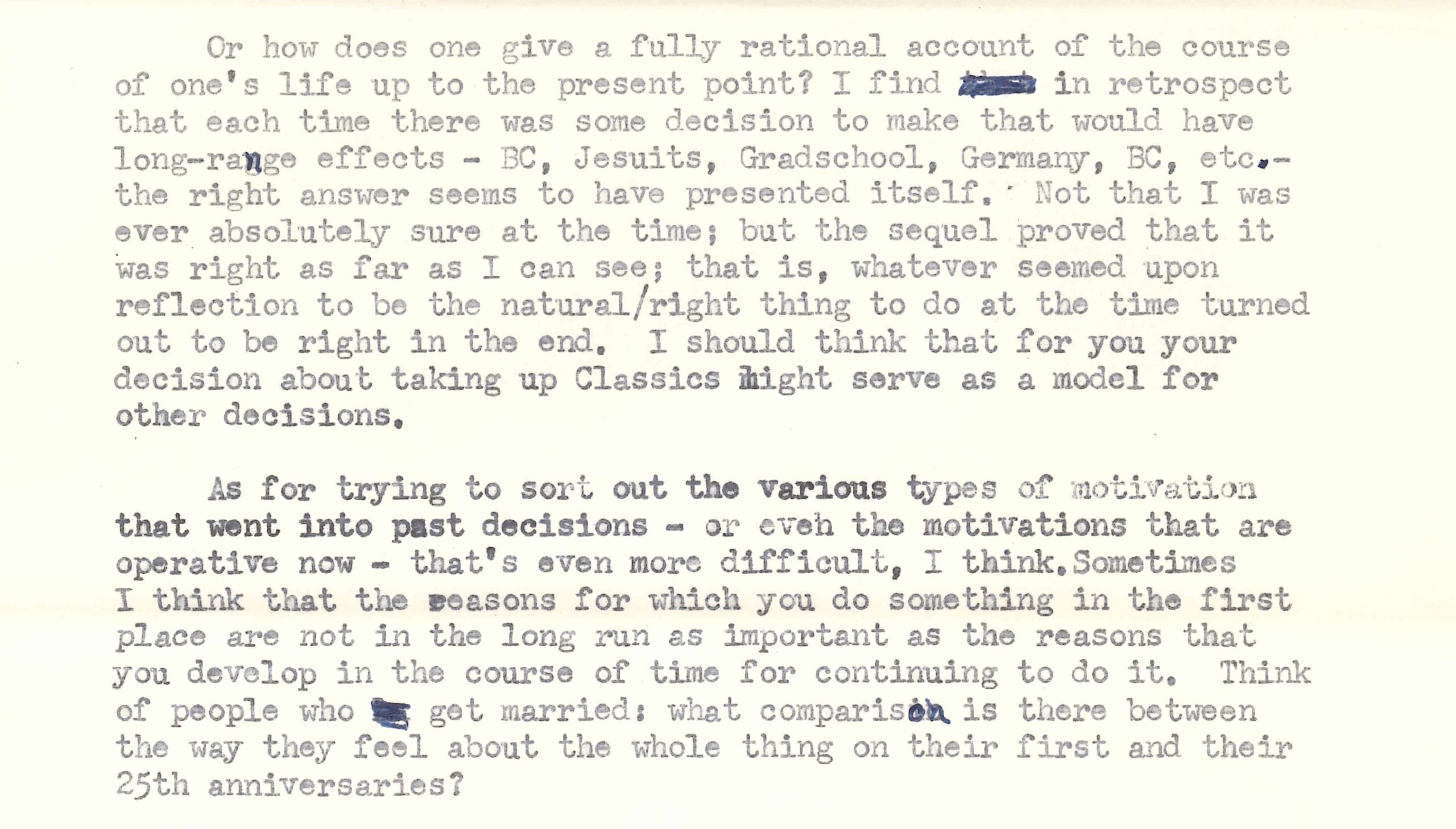
The first was my main ugrad mentor at Boston College (1969-73) and the teacher who introduced me to the Greek Bronze Age. David Gill, S.J. had studied at Harvard, completing his Ph.D. under Sterling Dow on Greek Cult Tables. Dow, mainly a classical epigrapher and historian, had developed an interest in what were then called Minoan inscriptions after the Ventris decipherment of the Linear B script in June 1952. As a consequence, Gill’s two-semester ancient Greek history course spent many weeks on Aegean prehistory, during which I reported on what then was early scientific research on the volcanic eruption of Thera. Actually, I contracted mononucleosis that semester and by the time I recovered, Gill suggested that instead of writing up a report, I deliver a whole class lecture on the readings I had done. I agreed at first, thinking that this would be easier. Then I realized I had to present a 50-minute lecture to an audience of about 65 students, most of whom I did not know. I was so terrified I memorized the entire talk. How I avoided a relapse into exhaustion illness I do not know.
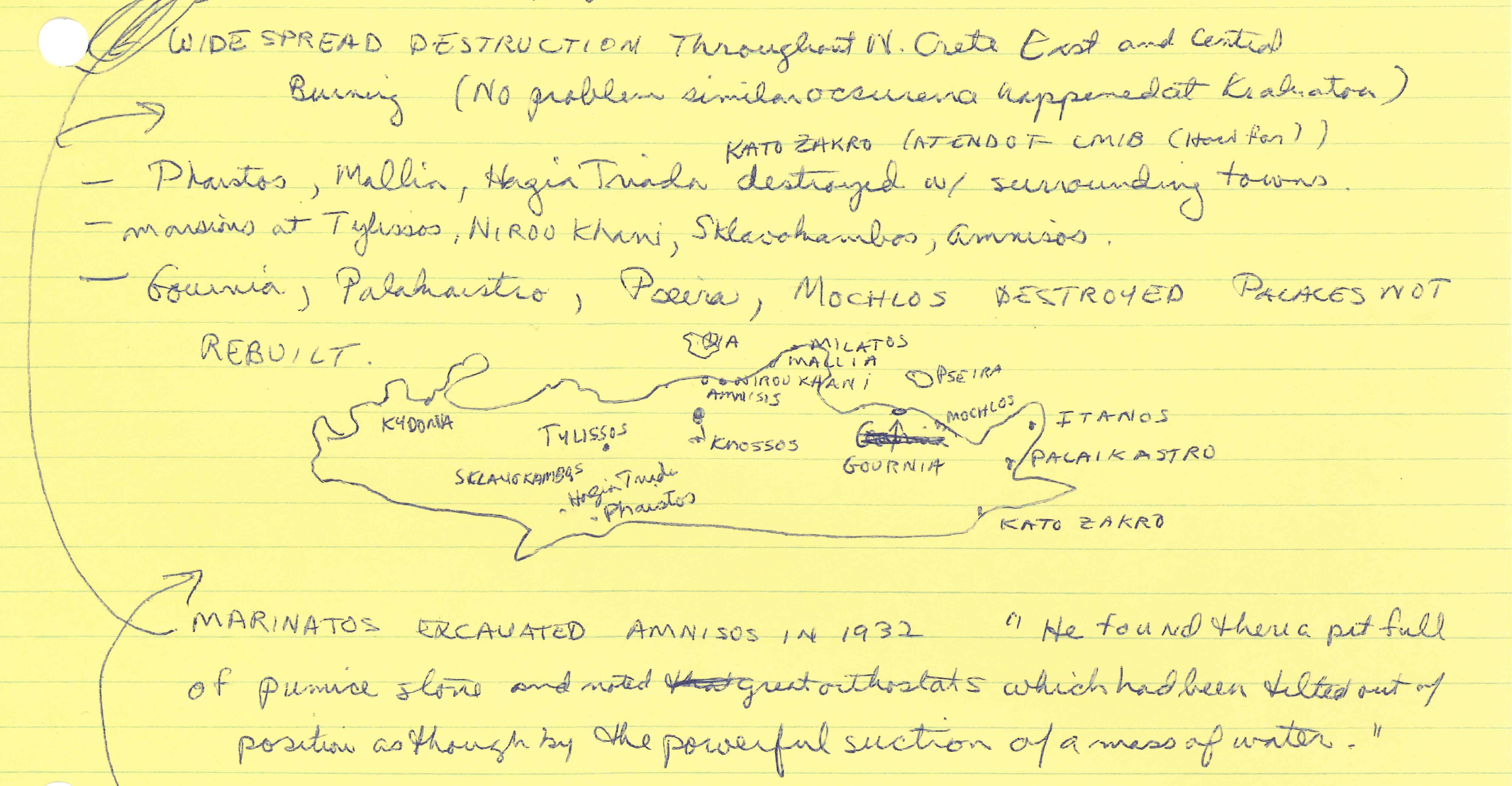
In Gill’s class we also read William McDonald’s inspiring classic Progress into the Past (1967). Right now I am using it in AHC 378 History of Greek Prehistory. Another example of Gill’s ingenuity with regard to making up course work now comes to mind. In spring of my freshman year (1970), we missed many weeks because of the general student strike sparked in part by government lies about the bombing of Cambodia. In order to make up for those missed weeks over the summer, Gill set me to translate large parts of Vergil’s Aeneid. I have my doggerel English poetic version somewhere in notebooks.
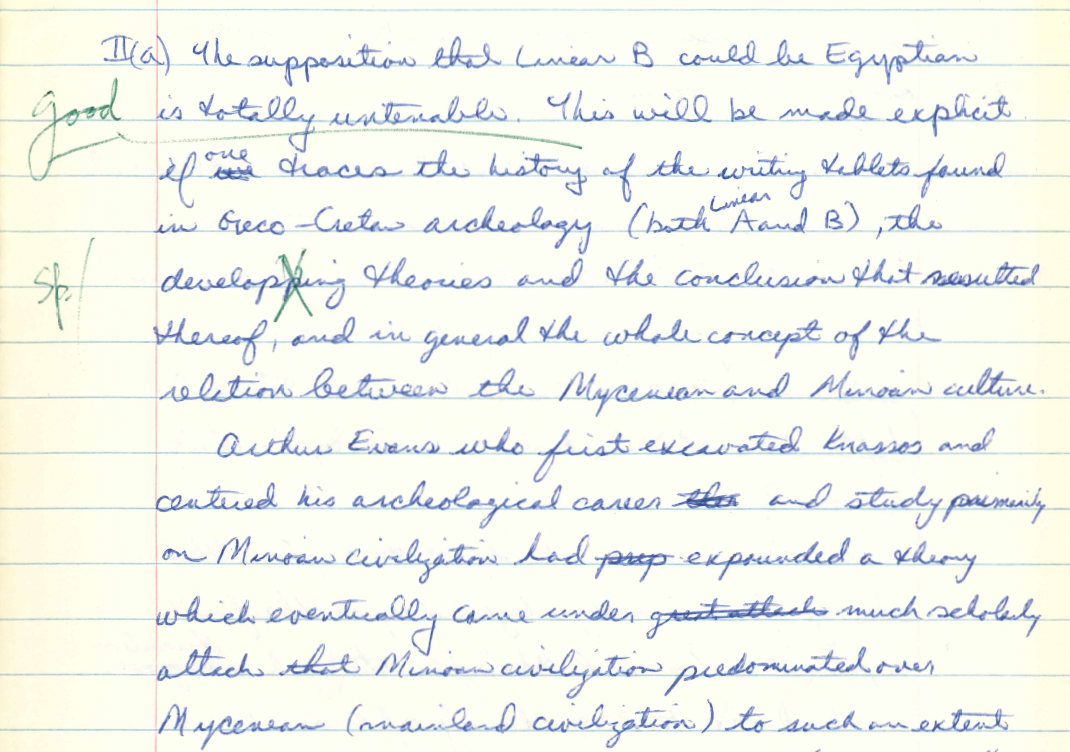
Looking back now over a half century, what was most special about Fr. Gill was that, like Fr. Tom Bermingham who was later a revered colleague of mine at Fordham University (1980-86), Gill had internalized Matthew 5-7. This part of the gospel of St. Matthew contains the Sermon on the Mount, the Beatitudes and the Lord’s Prayer. But it also contains prescriptions, straight from the mouth of Jesus and yet nowadays forgotten or ignored, about how to conduct yourself when doing good unto others, including even making charitable donations. In strict accordance with Jesus’s advice, neither David nor Tom ever drew attention to their active commitment to the poor, the needy and the forgotten in our society. Their behavior is consistent with a behavior of that all but extinct species in our age of hyper-capitalism. I refer to the anonymous donor. Here is what Jesus says in Matthew 6: 1-4:
Be careful not to practice your righteousness in front of others to be seen by them. If you do, you will have no reward from your Father in heaven.
2 “So when you give to the needy, do not announce it with trumpets, as the hypocrites do in the synagogues and on the streets, to be honored by others. Truly I tell you, they have received their reward in full. 3 But when you give to the needy, do not let your left hand know what your right hand is doing, 4 so that your giving may be in secret. Then your Father, who sees what is done in secret, will reward you.
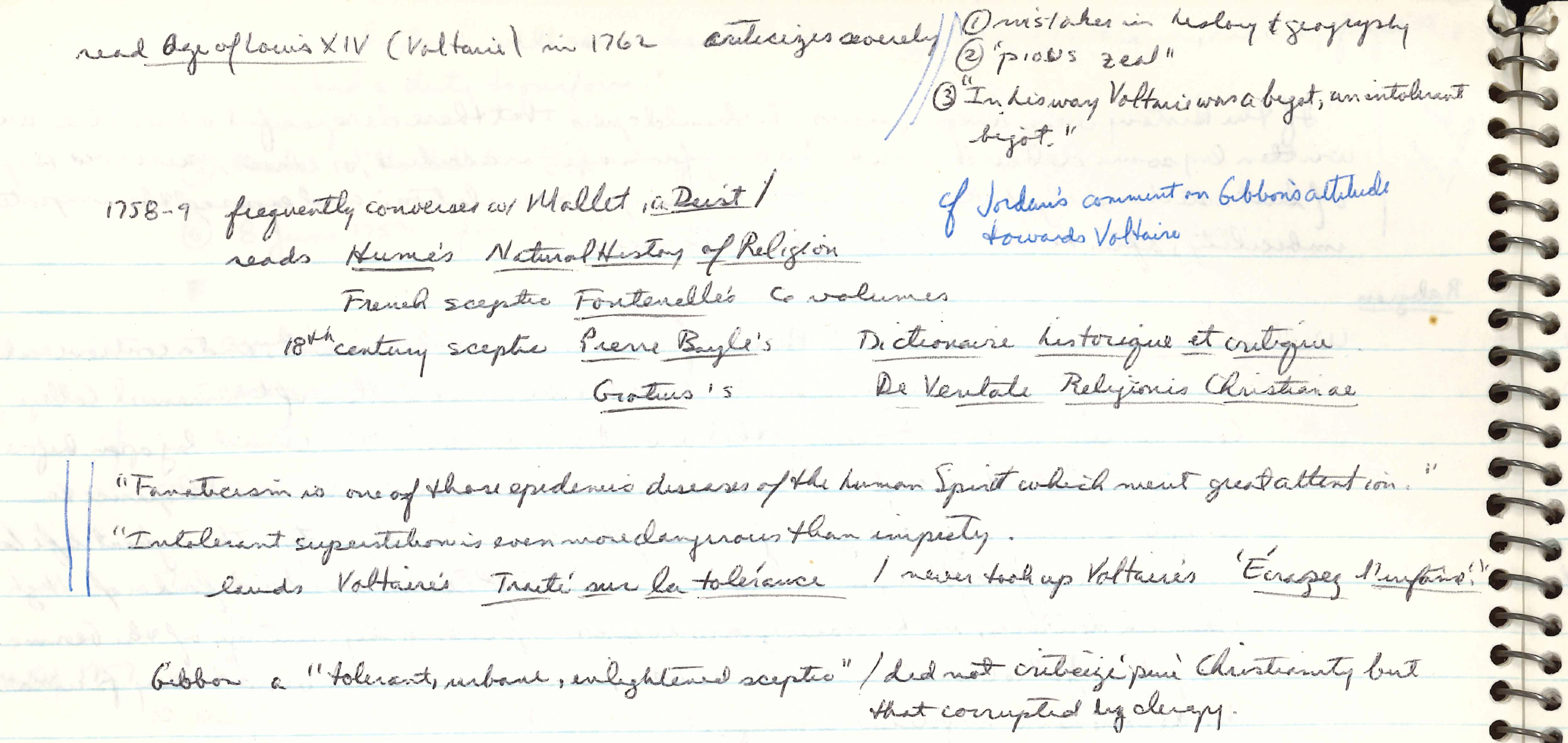
In the classroom and in the great tutorial seminars he conducted for us, Gill was focused on scholarly matters. In my senior year, Gill and four of us students read through Grote’s History of Greece during the fall semester and Gibbon’s Decline and Fall of the Roman Empire in the spring semester. We met weekly on Wednesday evenings for dinner at the Jesuit house and then two hours afterwards of discussion of the reading at hand. This was the first time I became aware that one could “be an intellectual” in the normal course of life and not just in the classroom: at the dinner table or afterwards over sherry or for that matter anywhere at all.

Eight years later while teaching at Fordham University, I got to know Tom Bermingham, S.J. Bermingham had become famous for his scenes in the movie The Exorcist where he played a role as president of Georgetown University offering advice to Father Damien Karras, the young priest who has to grapple with the demon possessing the young girl Regan MacNeil while himself having a crisis of faith. Bermingham was also expert on the subject of exorcisms and had served as a mentor to fabled—in my mind now infamous—Penn State University football coach Joe Paterno. What is remarkable about Bermingham, too, is that he would fit in teaching a course on Homer with his holy work of settling newly arrived Cambodian refugees in ‘bad’ neighborhoods in the South Bronx and shepherding them in their adjustment to American culture. Their adjustment was almost always successful because of Tom Bermingham’s ingenuity and indefatigable work as ‘good shepherd’ on their behalf. None of that work gets in Bermingham’s extensive Wikipedia profile. Like Gill’s work, it was done “off the record.”
This poem by Father Gill I think speaks well to the souls of both of these remarkable human beings whom I am very glad to have known in my early days. I am sure they reinforced my inclination to work at different times with veterans, with poverty-level adults trying to go back to school, with youths and parents confronting violence and to devote so much time to addressing educational and political problems and general social norms and values in my twenty years of serious public intellectual writing. I can still feel the invitingly conspiratorial way Tom Bermingham would talk, while dragging on a cigarette, about his movie work and about Homer, and on rare occasions about his refugees, their hardships and successes. “Did you ever consider this, T?” I can still hear Dave Gill’s clear and comforting voice, offering advice by posing questions that I would take away and think about. Both men left with me a residue of goodness that has always warmed me and provided a flickering light “in the dark and cloudy day.” They are proof to me of Viktor Frankl’s contention that happiness, in our modern sense, cannot be pursued, but is itself the rare residue of working hard to do good in and of itself.
David Gill, S.J.: In My Own Words. 1992
https://epublications.marquette.edu/conversations/vol2/iss1/14/
“ I’m a Jesuit in the university,
a teacher, a scholar, a humanist
trying to study and teach history
from the point of view of the losers
rather than the winners,
the poor rather than the rich,
the peasants rather than the princes.
I think the modern Jesuit, and Christian,
is challenged to take a leap of faith
and believe that God is to be found
not only in the beauties of the divine
and human creation but also in the lives
and sufferings of the poor and outcast
members of the human race.
As a teacher, as a scholar in the humanities,
and as a Jesuit, I pursue an understanding
of what Dostoyevsky’s Father Zossima calls
‘active love’ – severe and terrifying,
entailing hard work and tenacity,
but close to ‘the miraculous power of the Lord.’ ”
David Gill SJ Lecturer in Classics
Then Rector of the Jesuit Community College of the Holy Cross
Now retired
For more of Tom Palaima’s story, both professional and personal, visit his recently updated faculty profile page.
Updated on March 24, 2023 by Garrett R. Bruner. garrettbruner@utexas.edu
January 20, 2023
Honoring Yves Duhoux: A Tribute
du-o-u-ka-te do-ro di-do-si mu-ke-no-ro-ko
proposed by
Tom Palaima Anna Panayotou-Triantaphyllopoulou Carlos Varias García
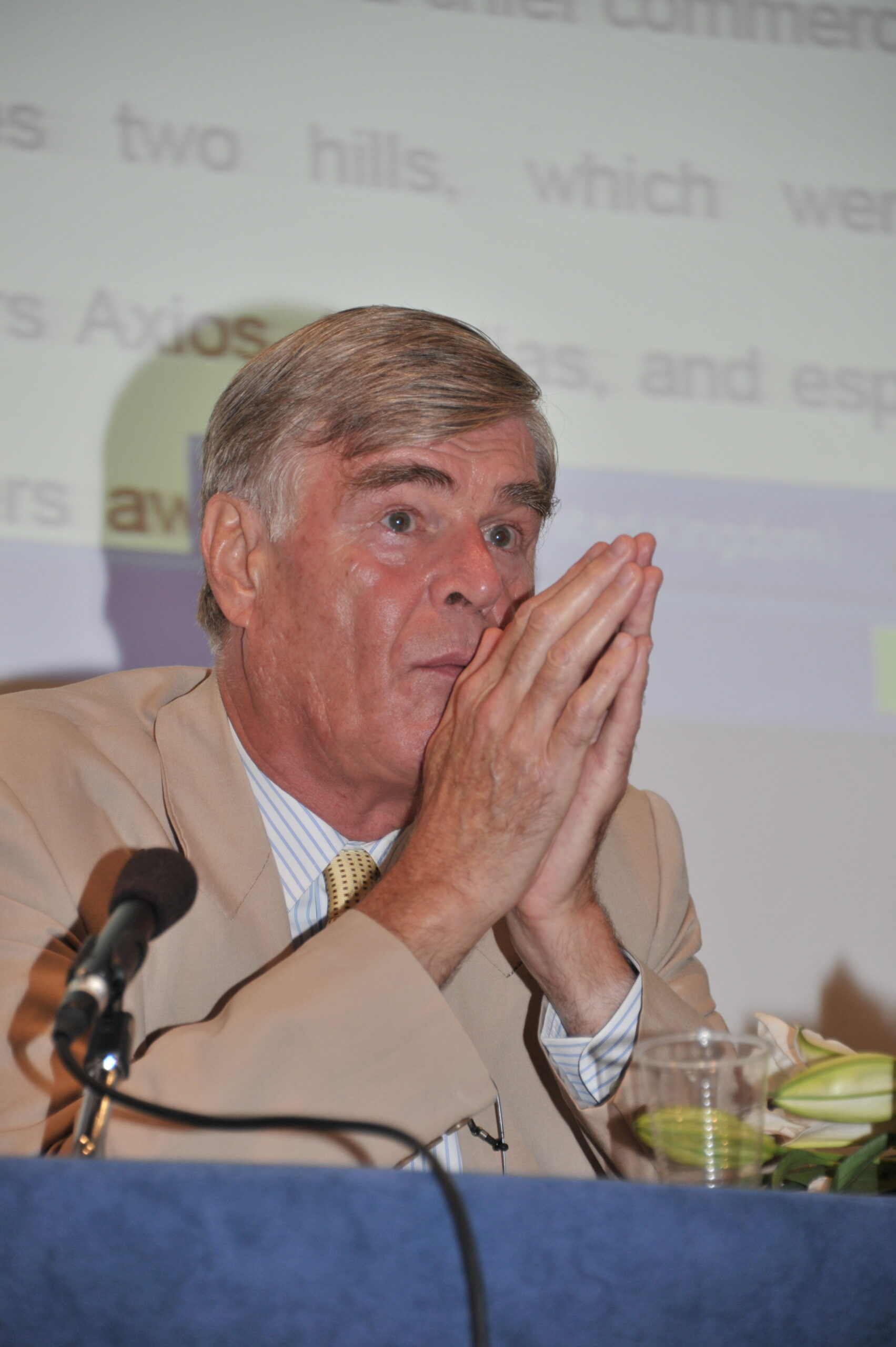
Yves Duhoux was born during the Second World War in 1942. He now has eighty years of life behind him and fifty-five years as a published scholar in Greek, especially Mycenaean studies broadly defined, and Eastern Mediterranean scripts. For ‘two entire generations’ of scholars, as Maurizio del Freo puts it, Yves has been a mentor and a guide. His influence began to be felt in Mycenology with his first entry in Nestor, his classic study: “Le group lexical de didōmi en mycénien,” Minos 9:1, 1968, 81-108. His bibliography now numbers 473 items and counting.
We have gathered here what Alberto Bernabé calls a ‘collage’ of reminiscences from the community of scholars who work on Aegean scripts and languages and prehistory. Our accounts all speak to the wide and deep influence Yves Duhoux has had on our collective and individual scholarly work for over fifty years.
This collection does not just look back, but it looks ahead.
Carlos Varias Garcia, Anna Panayotou and Tom Palaima thought up and proposed this on-line tribute in October 2022, not only to be a fitting reminder of the magnitude of Yves’s service to our scholarly work and the contagious nature of his ever-present and literal enthusiasm, collegiality and reverence for the life of the mind, but also to get us thinking about problems that Yves has worked on that might be good topics for papers when we meet in Spain in 2025 at the next Mycenological colloquium.
It has been a pleasure to shepherd these contributions into the form they have here. We give our collective thanks to PASP INSTAP archivist Garrett Bruner for making all this happen on-line.
Garrett knows Yves well, having archived the substantial correspondence Yves and Tom Palaima have maintained since the 1980’s. And Garrett at the very end of 2022 told Tom that, when he first started working in PASP in 2017, Joann Gulizio said to him that the best place to start on Linear B is Yves Duhoux and Anna Morpurgo Davies, A Companion to Linear B. Garrett began with Ruth Palmer, “How to Begin?” Companion volume 1, 25-68 and to this day continues to recommend it to all PASP archives assistants as fundamental reading. Garrett is grateful for the guidance this companion trilogy has given him and all students of Aegean scripts and cultures.
A full bibliography of Yves’s published scholarship edited by Anna Panayotou is found at the end of the individual tributes to Yves and his work.
When Mycenology we review
Back to nineteen fifty-two
All roads lead back to or through
Our Belgian comrade, Yves Duhoux.
He shows us what we thought we knew
Still has problems to pursue
And ψευδὴς δόξα to undo
Our wise professor, Yves Duhoux.
INDIVIDUAL REMINISCENCES IN ALPHABETICAL ORDER
Francisco Aura Jorro on Yves Duhoux
El Prof. Yves Duhoux, el hombre alto y bueno que sabe de micénico (y de otras muchas cosas)
De entrada, debo decir que me parece excelente la idea de quienes han urdido este modo de homenaje a nuestro colega, amigo y, por lo que a mí respecta, maestro.
Supongo que una parte, sino la mayoría, de las contribuciones con las que se quiere honrar su figura han optado por resaltar sus logros filológicos en el micénico y, más en general, en el griego antiguo. Tendrán mucho y bueno que decir, porque mucho y bueno es lo que ha hecho Yves.
Por mi parte, prefiero resaltar una de las muchas facetas, todas buenas, de la personlidad del Maestro. Su bondad. Y de ello ofrezco el ejemplo que sigue.
Era la tarde del 3 de mayo de 1995, se celebraba el X Coloquio Internacional de Micenología, en Salzburg, un principiante leía, en español, su contribución, cuyo texto en francés, previamente a su lectura, se había repartido; entre los asistentes. Según iba leyendo el comunicante, de vez en cuando, levantaba la mirada y veía, con preocupación, como el Prof. Duhoux iba haciendo anotaciones sobre el texto repartido. Los nervios del ponente iban a más. En su atribulada opinión, las notas del Prof. Duhoux no podían ser otra cosa más que correcciones al contenido del texto. Acabada la lectura, con la corespondiente cortesía por parte del auditorio, el Prof. Duhoux, levantándo su alta humanidad, se acercó sonriente y felicitó efusivamente al ponente, a quien entregó el texto de la comunicación en el que lo que había corregido, pacientemente, era su francés. Como todos habrán podido sospechar, el sujeto era yo.
Gracias Yves, una vez más, por tu amistad y generosidad.
Paco.
Francisco Aura Jorro
Professor of Ancient Greek Language and Literature Emeritus
Universidad de Alicante
Federico Aurora on Yves Duhoux
I have not yet had the fortune to meet Yves Duhoux in person, but my first meeting with his work was when I was a student, when I read his Introduction aux dialects grecs anciens (back then in its Italian translation) and his Le verbe grec ancien: Éléments de morphologie et de syntaxe historiques. Later, his many articles on the Mycenaean language and his anthology for the first volume of the Companion to Linear B: Mycenaean Texts and Their World that he edited with Anna Morpurgo Davies, have become frequent readings in my ongoing work of linguistic annotation of the Mycenaean texts. And in this work, of course, I always try to keep in mind Yves Duhoux’s methodological recommendations from the opening chapter of the Companion’s second volume (Interpreting the Linear B records: some guidelines) – and to practice them with controlled flexibility, as he puts it.
Federico Aurora
University of Oslo
John Bennet on Yves Duhoux
I first met Yves Duhoux in person in April 1988, at the colloquium on ‘Problems in Decipherment’ held in Madison, WI to honour Emmett L. Bennett, Jr, who had recently retired from his academic post. With promptness more characteristic of Yves than of either of his co-editors, the proceedings appeared the following year in the BCILL series. As a then-junior faculty member, I was flattered to be invited to co-edit the volume with Yves and Tom Palaima, and realise now, in retrospect, that this generosity and encouragement to early-career scholars is typical of Yves. The last time I met Yves in person was 30 years later, in December 2018 in Durham, UK, at a small colloquium on Linear B. Sadly on that occasion Yves suffered a fall on newly fallen snow, broke his hip and spent rather longer than anticipated in Durham. Many of us would have struggled to recover, but it is testimony to Yves’ optimism and strength of spirit that he bounced back and we now have the opportunity, almost exactly four years later as I write these words, to wish him many happy returns on his 80th birthday!
Yves’ scholarly output is prodigious. The Nestor database lists 125 works, reaching back to his first Minos article published in 1968, a turbulent year in Europe.
Like all his Mycenological colleagues, I continue to receive pdf versions of his most recent publications via email, further testimony to his characteristic generosity and productivity. His greatest contribution to our field is arguably the three-volume Companion to Linear B, co-edited with another outstanding figure, the late Anna Morpurgo Davies. These three volumes have probably done more to engage scholars outside the ‘inner circle’ of Mycenaean Studies than any other English-language publication. Only the much-anticipated New Documents in Mycenaean Greek is likely to supersede it when it appears next year.
The Companion is an enduring testament to Yves, truly a ‘towering’ figure – figuratively and literally – in our field.
Χρόνια πολλά!
John Bennet
University of Sheffield
Alberto Bernabé on Yves Duhoux
Mi contribución a este improvisado “collage” de testimonios para glosar la personalidad de nuestro extraordinario colega, con el que he tenido el honor de coincidir en varias ocasiones, y al que aprecio profundamente, no va a referirse a su incuestionable aportación a los estudios de micenología (que se manifiesta, por ejemplo, en las múltiples ocasiones en que es mencionado en la segunda edición del Diccionario Micénico que preparamos), ni a su cordialidad (que lo lleva a insistir siempre en que le hable en español). Voy a referir un suceso en el que estuve presente, que refleja con claridad la profesionalidad de Yves, el respeto a sus colegas y, en general, su carácter. Durante un pequeño coloquio celebrado en Durham, en diciembre de 2018, caminábamos de noche por las pendientes y resbaladizas calles de la ciudad, cubiertas de agua y hielo tras una reciente nevada, cuando una joven se vino tambaleando cuesta abajo e impactó en Yves, enviando su alto cuerpo al suelo. Cuando nos acercamos para ayudarlo a levantarse, sentado como estaba en la acera nevada y apoyado en un automóvil, nos advirtió con enorme serenidad que no podía levantarse y que podía ser una lesión seria. Mientras se organizaba la petición de ayuda profesional, en lugar de quejarse o maldecir, como habríamos hecho cualquiera de nosotros, Yves, pensando en los demás, antes que en sí mismo, lo primero que hizo fue señalarnos dónde estaba la comunicación que debía presentar al día siguiente, para que alguien se la leyera. Creo que no cabe mejor definición de su actitud científica y su personalidad.
Alberto Bernabé
Profesor Emérito. Universidad Complutense
Margarita Buzalkovska-Aleksova on Yves Duhoux
I first met in person Yves Duhoux on the Mycenaean Colloquium in Ohrid in 1985. I had just delivered for public presentation my MA thesis ‘Prepositions and prefixes in Mycenaean Greek’ and I had already known him from his book Aspects du vocabulaire économique mycénien (cadastre – artisanat-fiscalité), 1976. While consulting the rich bibliography for the thesis, as a young scholar I found this work more easily comprehensible because of the strictly precise analysis of the Mycenaean documents and consequently the most logical conclusions that were coming out of it. When I heard the presentation of his paper at the Colloquium, it was so intriguing and interesting that I wished to read the final version of it instantly myself. And that impression or feeling remained with me after Yves’s papers at all the following Colloquia. His papers have been very inspirational to me leading me to more work and reexaminations.
Yves has also never missed to share by e-mail, with us, his colleagues and friends, a lot of his valuable papers immediately after being published in many eminent journals, for which generosity we are deeply indebted to him.
The devotion of Yves Duhoux as editor (together with Anna Morpurgo Davies) in the field of Mycenology is shown in his painstaking work on the three precious volumes of A Companion to Linear B: Mycenaean Texts and their World I (2008), II (2011) and III (2014), companion volumes that are essential for every scholar and student in the field of Mycenaean Studies. Besides having the initial idea for this tremendous source book and the huge responsibility for editing the volumes, he also contributed his own text (Chapter 9) in the first volume: ‘Mycenaean Anthology’ (243-394) comprising the precious results of his study of many subjects concerning the Mycenaean Civilization as a whole.
Thank you, Yves Duhoux!
Margarita Buzalkovska-Aleksova
Professor Emeritus, Institute for Classical Studies, University of Ss. Cyril and Methodius
A Tribute To Yves Duhoux by Brent Davis
I welcome these well-deserved expressions of appreciation, admiration and gratitude for Prof. Yves Duhoux, for his lasting work, and for the inspiration he has given to countless students and colleagues. As a specialist in the scripts of the Bronze Age Aegean, I would like to pay particular attention and tribute to his remarkable contributions toward our understanding of the undeciphered members of this family of scripts, and of the languages that underlie them.
Those of us who work in this field know its character: these scripts are relentlessly stubborn about giving up their secrets, while at the same time the field itself (by its nature) tends to attract all manner of wild-eyed enthusiasts and would-be decipherers. As a result, the study of these scripts through much of the 20th century consisted of a barely-controlled free-for-all, marked by unhinged hypotheses, deplorable methodologies, and almost no established standards in place for sifting the wheat from the chaff. This grievous situation began to change in the late 1960s with the work of Elizabeth Barber and David Packard, but Duhoux was the seed around which a new crystal of lasting sanity began to form in the 1970s. From the beginning, his work changed the paradigm completely, and he brought a welcome order to the chaos.
In May 1948, Alice Kober, whose work on Linear B was so instrumental in Ventris’s decipherment of that script, gave a lecture at the Yale Linguistics Club in which she asserted that anyone who aspires to decipher a script without the benefit of a bilingual text must be willing to inhabit a land of “form without meaning”, and to inhabit that land for as long as it takes—in other words, to be willing to find ways of extracting information from the signs and inscriptions themselves, without any idea what those signs and inscriptions might mean. Kober put her words into action by using a brilliant combination of linguistics and logic to produce her Linear B “triplets” and phonetic grid, thus revealing aspects of the morphology and phonology of the language underlying the script, and paving the way for Ventris’s eventual triumph. Today, for those of us struggling to study (and perhaps someday to decipher) the still-undeciphered members of this family of scripts, Duhoux has acted for decades as our Kober, pioneering and pointing the way by revealing aspects of the languages underlying these scripts through a dazzling admixture of linguistics and logic.
Some of the work that he has produced in this field was published almost half a century ago, yet it remains as current and as relevant as it was on the day it first appeared. He has created, for example, impressive comparative studies aimed at determining whether different undeciphered Aegean scripts encode similar languages, such as ‘Les Langues du Linéaire A et du disque de Phaestos’ (Minos 18, 1983), or ‘Eteocypriot and Cypro-Minoan 1-3’ (Kadmos 48, 2009). He has given us the definitive monograph on the Phaistos Disk (Le Disk de Phaestos, 1977), and has demonstrated beyond doubt that the undeciphered inscription on the Disk contains the most ancient known example of the systematic use of rhyme (‘L’écriture et le texte du disque de Phaistos’ in Proceedings of the 4th Cretalogical, 1980).
But perhaps his linguistics-based analyses and assessments of Linear A shine most brightly as wonderful exemplars of the advances in the study of an undeciphered script that can be achieved by rigorously inhabiting Kober’s world of “form without meaning”. Examples abound, such as ‘Une analyse linguistique du linéaire A’ (in BCILL 14, 1978); ‘Le Linéaire A: problèmes de déchiffrement’ (in BCILL 49, 1989); ‘Variations morphosyntaxiques dans les textes votifs linéaires A’ (Cretan Studies 3, 1992); ‘La langue du linéaire A est-elle anatolienne?’ (in Antiquus Oriens, 2004); or ‘Linéaire A ku-ro, “total” vel sim.: sémitique ou langue “exotique”?’ (Kadmos 50, 2011). Many of these works have achieved legendary status because of the impeccably rigorous way in which he constructs and argues them, and because of the utterly convincing way in which he uses the script and inscriptions themselves to tease out the morphosyntactic characteristics of the underlying language(s) without ever stepping into the snare of trying to identify the language itself. In fact, he teaches us precisely how to contribute something meaningful to the study of this script (or any undeciphered script) despite the absence of an identification of the underlying language, and this makes his work and the methods he teaches more valuable than diamonds. For me, reading his work was a revelation: I saw at once that this admirable scholar had found the right way forward and was mapping it out for us, and I and many others in this field now do our best to follow in his footsteps.
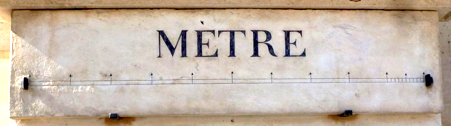
In the late 1790s, following a resolution by France’s Convention nationale, a number of marble plaques displaying the Mètre Étalon (‘Standard Meter’) were mounted at the most frequented spots in Paris to encourage the use of the new metric system. Most are now gone, but one venerable example still remains on the façade of the Ministry of Justice in Place Vendôme. For those of us who have devoted our lives to the study of the undeciphered scripts of the Bronze Age Aegean, Duhoux has become our Mètre Étalon: he is the standard against which we measure our own work, and his principles and methodologies, proven invaluably productive over time, are the ones we have adopted as our own and are now passing forward to the generation that comes after us. For this, we all owe you the deepest debt of gratitude, Professor. Longue vie à vous!
 Dr Brent Davis
Senior Lecturer in Archaeology and Ancient Egyptian
School of Historical and Philosophical Studies
University of Melbourne
Maurizio Del Freo on Yves Duhoux
It gives me great pleasure to contribute to this initiative in honor of Yves Duhoux, as it allows me to thank him personally both for the valuable contribution he has given and continues to give to the study of the Aegean and Cypriot scripts and languages of the 2nd and 1st millennium BC and for the affability and kindness he has always shown in our personal relations. My reading of his written scholarship, starting with Aspects du vocabulaire économique mycénien (1976), as well as the conversations I have had with him afterwards, were together an important source of inspiration for my research, especially in relation to the issue of the Mycenaean land registers. Personally, I consider his entire scientific output to be an example of lucidity and accuracy. I firmly believe that each of his scholarly contributions is essential to our field for three characteristics: (1) a correct framing of the problems, (2) a critical evaluation of the existing hypotheses and (3) the innovative ideas Yves puts forward. With his research and scientific production Yves has contributed to form two entire generations of scholars in our field. For this he deserves our deep gratitude together with the heartfelt wish that he can continue to dedicate his talent and ingenuity to us for a long time to come.
Maurizio Del Freo
Dirigente di Ricerca
Istituto di Scienze del Patrimonio Culturale
Consiglio Nazionale delle Ricerche
Roma
Cassandra Donnelly on Yves Duhoux
On the occasion of his 80th birthday, I wanted to thank Yves Duhoux for his contributions to the study of Aegean Scripts and provide him with a sense of how his work is impacting me as someone in the most recent cohort of new doctors. Yves Duhoux has been with me throughout my years as a graduate student and into my first year as a doctor, though we have never had an opportunity to meet. His works are foundational, accessible, and on subjects that are a little off-the-beaten path in Aegean scripts, which makes them of particular interest to me. The first introduction I had to Duhoux was in my first semester as a graduate student, when Tom Palaima instructed me first thing to read through the Companion to Myceanean Greek, vol 1. Even with an advisor as supportive and knowledgeable as Tom and in a program as specialized as PASP, the Companion was absolutely essential to introducing me to the field’s conventions and scholarship. He is exemplary in his role as editor and collaborator.
Subsequent to my early years as a graduate student, Duhoux’s individual scholarly contributions have become integral to my work on Cypro-Minoan. His works on Cypro-Minoan are invaluable for their clear documentation and presentation of evidence. His unflagging cataloguing the number of signs and words in Cypro-Minoan led to the identification of the few underlying grammatical patterns in the script that we have. Duhoux stands out to me for the way he consistently situates script and inscriptions in their diachronic contexts and for the way he weaves in multiple strands of evidence from the archaeological, to the literary, and mathematical approaches to decipherment. He is to be congratulated and celebrated for his high-quality scholarship and his contributions to the study of Cypro-Minoan that will surely live on.
Dr. Cassandra Donnelly
Postdoctoral Researcher, ComPAS Project
University of Cyprus
Elena Džukeska on Yves Duhoux
Professor Yves Duhoux’s work in the field of Mycenology and Greek philology has always been an inspiration and a guide for me. All his writings are without exception examples of methodology, true scholarship and profound insight for us to follow. His achievements are valuable contributions not only to the study of Greek language and Aegean scripts but to the study of history of language and script in general. We are indebted to him for his exceptional work and I hope and wish that we will be able to welcome new projects and studies from him and learn from him for a long time to come.
Elena Džukeska,
Professor of Greek and Latin language at the Institute of Classical Studies, Faculty of Philosophy, “Ss. Cyril and Methodius” University in Skopje
José Luis García Ramón on Yves Duhoux
Hay dos trabajos de Yves Duhoux que me han impresionado desde el momento en que los leí.
Por una parte, su estudio de las diferencias entre el Lineal B de Creta y del continente (Ohrid, 1985) sobre la base de una decena de “éléments de comparation”: un trabajo modélico por su claridad y por la precisión de su análisis, que solo cabe lamentar, en mi opinión, … que Yves no lo haya actualizado y ampliadoa la luz de los nuevos textos, también de otros centros, publicados en los últimos decenios: no pierdo la esperanza de que vuelva sobre el tema quizá en Madrid 2025.
El segundo trabajo, « La syntaxe mycénienne: à propos de la notion de ‘faute’” (Atti Roma 1968) hace ver, sobre la base de casos procedentes de diferentes centros, que formas casuales contrarias a lo esperado reflejan “simple yuxtaposition de termes, non accordés syntaxiquement … ” y, menciona, entre otros, el caso de ka-ra-e-ri-jo, me-no en Cnoso: es, en mi opinión, la mejor explicación — como es la de John Chadwick ( “Error and abnormality”, 1958) para las incoherencies sintácticas en las tablillas de la serie D– de Cnoso. Una aproximación en esa línea a los casos en que el contexto o la función de la forma en la tablilla son tan transparente que hace innecesaria la desinencia, se habría evitado la proliferación de pretendidas explicaciones morfológicas para formas que no las necesitan.
Margherita Jasink on Yves Duhoux
It is a pleasure and an honor for me to have the opportunity to express my grateful admiration for Yves Duhoux, a great scholar I have had the pleasure of knowing at various meetings and conferences. His studies on Mycenaean history, philology and linguistics constitute a classic fundamental reference. They have been an inspiration for many scholars, among whom I certainly include myself. I particularly like to remember a meeting with Yves in Florence during a conference dedicated to historians and Linear B, on the occasion of which I felt very proud to present a work with, at my side, Yves Duhoux on one side and Pierre Carlier on the other. Although now distant in time and place and part of the past, this is for me a very beautiful memory of a great researcher and a lovable character.
Margherita Jasink
José Miguel Jiménez Delgado on Yves Duhoux
No es fácil expresar en pocas palabras la influencia que los trabajos del profesor Duhoux han tenido no solo en mi producción científica, sino en la de varias generaciones de micenólogos, helenistas e historiadores. Mi interés por los textos micénicos fue siempre lingüístico y en sus trabajos encontré la conjunción de un profundo conocimiento de la lengua griega y de una estrecha familiaridad con los textos micénicos que siempre he pretendido alcanzar, con éxito relativo. Su producción, que continúa creciendo sin interrupción, es tan extensa que es difícil elegir un título como especialmente relevante sobre los demás. Con todo, no puedo resistirme a recalcar la utilidad y maestría de su antología micénica en el Companion to Linear B, donde se condensan todas las vertientes del estudio de esos textos, la epigráfica, la lingüística y la filológica. Tampoco puedo dejar de reconocer la generosidad del profesor Duhoux, siempre dispuesto ayudar a los que empiezan, a compartir sus ideas y a facilitar los materiales que se le soliciten, dentro del más puro espíritu de Gif. Por último, Yves Duhoux es una persona afable y educada, muy agradable en el trato, como he podido comprobar en alguna ocasión en la que he coincidido con él y en la que, además, descubrí que habla español con gran soltura. Espero que podamos disfrutar de su compañía y de su ciencia todavía muchos años más.
José Miguel Jiménez Delgado
Associate Professor of Greek Philology
University of Seville Spain
John Killen on Yves Duhoux
The Late Anna Morpurgo Davies, who collaborated with Yves in more than one venture and of whom Yves wrote a moving obituary in Minos 39, once told me that of Yves’ many talents there were two that she particularly admired: the great clarity of his writing and his entrepreneurial skills. (Anna was thinking here of Yves’ initiative in launching the volumes in which they collaborated as editors: the splendid Companion to Linear B (3 vols 2008, 2011, 2014) and, earlier, Linear B: a 1984 Survey (1985), the proceedings of the Mycenaean section of the FIEC Congress in Dublin.
I first met Yves in the 1970s, when he came to work with John Chadwick in the Mycenaean Epigraphy room in Cambridge, then, in its old location in the Mill Lane overlooking the Mill Pond. We have kept in friendly contact ever since, and it is always a pleasure to receive Yves’ New Year card (now in digital form) with its delightful drawings of the family cats.
Before Yves arrived in Cambridge, he had published an excellent article on ‘Le group lexical de didōmi en mycénien’ (Minos 9), and about the time of his visit followed this with two admirable discussions of ideograms: the first in Kadmos 14 on *168 and *181, the second in Minos 15 on *146, *160, *165 and *166. Shortly after came the publication of Aspects du vocabulaire économique mycénien (1976), in which amongst other topics Yves discusses land tenure and ‘industrial’ production under the ta-ra-si-ja system. So impressed were Anna Morpurgo Davies and I by Aspects that we decided to invite Yves to write chapters on these two topics for Documents³ (now New Documents). In response, Yves has written two excellent chapters in impeccable English and with the clarity of exposition that Anna so admired.
Since the 1970s, Yves has been the author of a great stream of stimulating publications on a formidable range of topics, ranging from Linear A to the LH/LM III-AB inscribed stirrup jars. He has also been an invited participant in all Mycenaean colloquia since Chaumont (1975). It is difficult to think of many scholars working on our subject matter who are as deserving as Yves to be honored by his colleagues.
J. T. Killen
Evangelos Kyriakidis on Yves Duhoux
Yves has always been a kind-hearted, polite, engaged scholar, someone who that enjoyed a good debate, someone passionate about the world of ideas. Extremely hard working and prolific, he has seriously impacted linguistics and the Aegean scripts. I remember Yves having coffee with other colleagues in Canterbury and enjoying these great, simple things in life: the dim English sun, the conversation, the friendship. A great scholar, a loyal friend, a passionate thinker. Thank you, Yves, for who you are to all of us in the fields of Aegean scripts and linguistics.
Evangelos Kyriakidis
University of Kent
Hedvig Landenius Enegren on Yves Duhoux
Professor Duhoux was very kind to me when I moved to Belgium with my family and continued my research there in the early 1990s. I used the university library at Louvain-la Neuve often. During this time Yves Duhoux introduced me to statistical methods applied to Linear B material. Although I eventually chose to use a different statistical approach in my doctoral thesis on the personal names in the Knossos tablets, his methodology was key to my exploring the topic at all! I am indebted to Yves for this and for his wide range of expertise in matters Linear B!
Hedvig Landenius Enegren
Michael F. Lane on Yves Duhoux
There are giants on whose shoulders some stand, while others will never even measure up to their knees. Prof. Duhoux is such an intellectual giant, and I belong to the latter, toddling category, ever reaching up for assistance. What is there that I have not taken and used from the hand that offers so much and such variety? The grammar, morphology, and phonology of Greek from the Bronze Age to the Classical Period? The position of Mycenean Greek among cognate dialects and Indo-European languages more broadly? The identity of origins of languages of Bronze Age and Iron Age Crete? The linear scripts of the Bronze Age Aegean and Cyprus, and their descendants?
Yes, all the above. But that for which I am most grateful is the meticulous attention he has devoted to the technical terminology of Mycenaean palatial economic administration especially early in his career but also again in recent years. This ranges from the major categories of landholding—ki-ti-me-na, ke-ke-me-na, and ka-ma—to the reflexes of *deH3– ‘giving’ in Mycenaean Greek and their contextual meanings, to such terms for the division of manufacturing labor as o-pa and ta-ra-si-ja that have been the subject of productive lines of economic historical inquiry lately.
Prof. Yves Duhoux’s work has not simply been among my inspirations further to explore the relationship between land allocation and proportional tribute (and distributions), a topic internal to the Linear B archives and the subject of a chapter in his germinal Aspects du vocabulaire économique mycénien, but it has also encouraged me to see whether the scribes’ observations can be modeled and operationalized in archaeological field investigations.
Thank you, Yves, if I may, for the inspiration and impetus you have given me at the start of my career as a scholar.
Michael F. Lane
University of Maryland, Baltimore County
Susan Lupack on Yves Duhoux
I often say to my students that the work that I and all of those in my Linear B cohort do today is only possible because of the work that was done before us. We are standing on the shoulders of the giants of our field (or sometimes I feel more like we are trying to climb up onto those shoulders!) – and Yves Duhoux is definitely among those giants. I remember when I was first working on the land tenure section of my thesis. I was nearly overwhelmed by the different terms found on these tablets, and the seemingly endless possibilities of what they could signify. But the one who shone a light through those endless possibilities was Duhoux. I returned to his definitions – and the sensible reasoning that he provided for them –again and again. In particular, I kept his 1976 Aspects du vocabulaire économique mycénien close at all times. And today, I still consult that book – as well as the numerous other publications that he has put out since then – but I can’t help highlighting Aspects du vocabulaire économique mycénien because of how foundational it was for my own work.
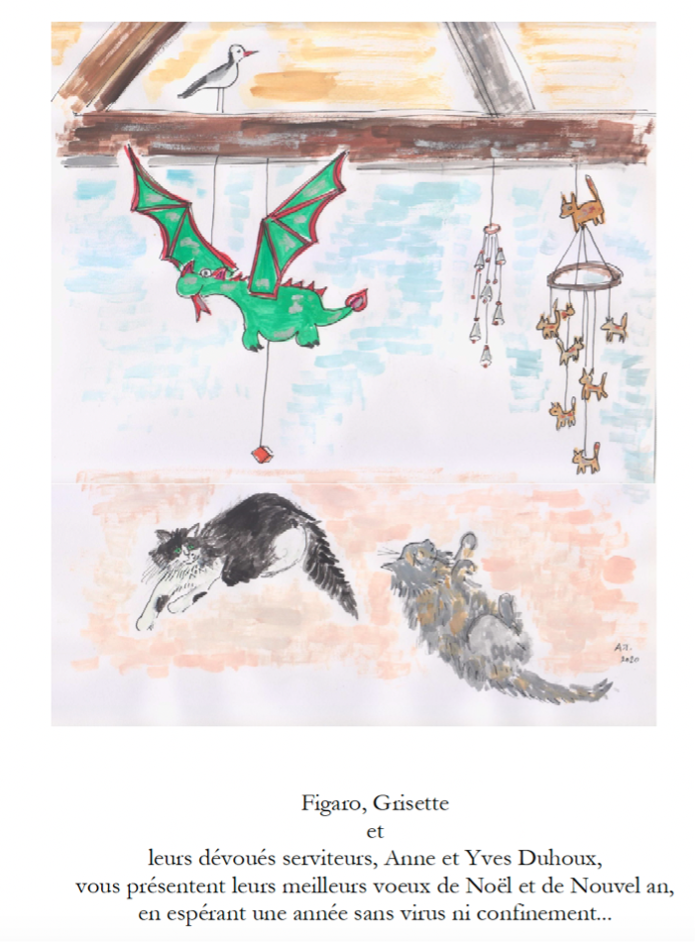
May I also relate that because of my impression of him as one of the giants – and his physical demeanor did nothing to dispel this image – I was somewhat in awe of him at the first conferences that I attended. This is perhaps why it meant so much to me when I heard that he had made a very generous remark of praise to Tom about me and the other PASPians who were presenting at that time. From then on, my appreciation of Duhoux as a person grew, an appreciation that is renewed every year with the receipt of one of his whimsical Christmas cards featuring his cats Figaro and Grisette. I save them! And I’d like (if it seems appropriate to the editors) to revive the one from 2020 for us all here. It lifted my spirits quite a bit when I saw it. So, I’d like to say, Thank you Yves, for all that you’ve thought, put down in writing, and edited for our field – and thank you as well for the playful kitty Christmas cards!
With my warm regards,
Susan Lupack
Senior Lecturer of Greek and Roman Archaeology
Director, Bachelors of Archaeology
Co-Director Perachora Peninsula Archaeological Project
Macquarie University
Torsten Meißner on Yves Duhoux
It was a very cold winter’s day in, I think, February 1986 when a new book arrived at the Sprachwissenschaftliches Institut of the University of Bonn, the title of which was “Linear B: a 1984 survey”, edited by Anna Morpurgo Davies and Yves Duhoux. Just having started out as a freshman, and never having heard of this enigmatic but intriguing sounding “Linear B” before, I picked up the book; the first article in it was “Mycénien et écriture grecque”, written by Yves. I read it and was fascinated, in fact, captivated. At the time, the young undergraduate found the clarity of exposition that so much was and is the hallmark of Yves’ academic writing, particularly helpful. The next chapter was Anna’s “Mycenaean and Greek Language”, and I devoured that, too, and the entire rest of the book. In fact, the following day I ordered my own copy. This was my first book on Mycenaean, and it sits on my bookshelf to this day.
A lot has happened since, and over the years, as an undergraduate, graduate and post-Doc I came to appreciate not just the clarity but the magisterial authority behind it that made this clarity possible, the sheer sense of what was said, and the fine attention to detail, be it on matters Mycenaean, Linear A or Eteocretan. It was only 20 years later, at the Rome colloquium, that I finally met Yves in person, and it was a great pleasure to discover that he speaks with the same clarity as he writes. Many other happy occasions were to follow, and I will never forget discussing a broad range of topics, from word division in Linear B to the Prix Ysaÿe, with him. Over the last 35 years or so Yves has been a guiding light for me in the study of the Aegean scripts and languages, and for this I am eternally grateful. Ad multos annos!
Torsten Meißner
University of Cambridge
José L. Melena on Yves Duhoux
It was during my last year of studies at the University of Salamanca (1969) when I first made the acquaintance of Yves Duhoux. From 1962 onwards, i.e. at San Sebastian High School, I was very interested in Mycenaean script. During this time I read articles in Minos and knew that Ruipérez was its editor. I went therefore to Salamanca in 1965 to study Classical Philology in the hope to be eventually trained in the subject of Mycenaean Greek by Professor Ruipérez. “Mycenaean Language” was, scheduled to be taught in my fifth year (1968-70). However, Ruipérez moved to the University Complutense at Madrid in 1969. But by a simple twist of fate, I ended up with an assistantship to Ruipérez in Madrid. The rest, as they say, is now history.
During my academic courses (1965-1970), I independently did sporadic readings of the issues of the periodical Minos which was easily available in the bookstores at Salamanca. In this way I had the pleasure of reading Yves Duhoux’s paper in Minos 9 on “Le groupe lexical de didomi en mycénien” and learning a lot about the right method for approaching a philological analysis in Mycenaean. I also came to know that Yves was working on a PhD dissertation on Le vocabulaire économique mycénien under the joint direction of Professors Lejeune (Paris) and Maniet (Louvain).
A few years later we coincided in sharing space in Minos 13, 1972, where my first Mycenological paper «On the Knossos Mc Tablets» was followed in the issue by his «Mycénien e-ke-qe / e-ko-si-qe». Yves read my paper and wrote me with his ideas supporting my view that the goat logograms on the Mc tablets represented not living animals but their hides or skins. This was the beginning of a friendship that for me has been and still is a most valuable, unfailing gift.
Since I was not invited to join the Mycenaean Colloquium at Chaumont in 1975 (for participants and photos see in academia.edu Rudolf Wachter, Colloquium Mycenaeum 1975 at Chaumont sur Neuchâtel [Switzerland]) which Yves was attending, our first physical meeting was delayed until the next Colloquium at the Zoo Park of Nuremberg in April 1981. We have met as friends since then at every Colloquium on Mycenaean Studies except when I failed to attend.
Leaving aside the material published over the years in Minos which I carefully read while editing the journal, I have been an enthusiastic follower of Yves’s writings since the 1976 publication of his PhD diss. Aspects du vocabulaire économique mycénien: Cadastre, artisanat, fiscalité, which became for me a landmark in our studies as was his Le verbe grec ancien: Éléments de morphologie et de syntaxe historiques of 1992 in the realm of Greek morphosyntax (2nd revised and augmented edition in 2000). I liked at once his way of treating the different subjects. On the other hand, his monumental joint edition with the late Anna Morpurgo of the A Companion to Linear B: Mycenaean Greek Texts and their World. 3 volumes, Peeters, Louvain, vol. 1: 2008, vol. 2: 2011, vol. 3: 2014, granted him a golden place in the History of the Mycenaean Studies. There is no subject in our realm left untouched by Yves Duhoux and his contributions remain indispensable when approaching any question. This will continue to be so in the future.
Nevertheless, the high level of Yves’ scientific production actually pales when we compare it to the magnitude of his kindheartedness. In late August, 2003, four members of our family (including our two sons) died in an aircraft crash. This accident blew up our lives and my wife, daughter and myself remained dismantled for many years. The sad ambiance did not allow any activity except for survival living. While my other Belgian friend and colleague chose to be deaf during these years, Yves was continuously at my side encouraging me to restart working, especially on fulfilling the commitment I had made to produce a contribution to the Companion on the subject of Mycenaean Writing.
As can be well understood, it was extremely difficult to attempt to launch a paper on this large scholarly subject in view of the lasting effects of the unbearable sorrow felt by my wife and me. I delayed year after year to do it. But Yves never gave up and finally he offered to travel to Vitoria in order to work alongside me in writing my contribution. At last, I managed to write an enormous highly technical piece, some two hundred pages. It was accepted and praised by Anna and Yves, who undertook the equally enormous work of correcting and polishing the material. I finally reached the goal in volume three but only because I could stand on the shoulders of these two giants.
Many thanks, Yves, for being my long-time loyal and constant friend.
José L. Melena
Professor Emeritus
University of Basque Country, Spain
Stephie Nikoloudis on Yves Duhoux
Having Professor Duhoux at the frontline of Linear B scholarship affords me the opportunity to learn from an excellent scholar whose probing questions improve my work and whose collegiality makes me feel welcome among elite scholars who have paved the way for so many of us. Clarity characterises his contributions, in print and in person. Everyone knows that what he has to say will be sound and significant. My research benefits enormously from his work, for which I thank him wholeheartedly!
Stephie Nikoloudis
Lecturer and Coordinator, Greek Studies
Department of Languages and Cultures | School of Humanities and Social Sciences
La Trobe University
Marie-Louise B. Nosch on Yves Duhoux
Professor Yves Duhoux’s scholarship has guided and inspired me ever since I started studying Linear B. His works were my entry into the Mycenaean world. For my master thesis in a French University on Mycenaean craftsmanship, it was his 1976 monograph Aspects du vocabulaire économique mycénien (cadastre –artisanat –fiscalité) that guided my studies and interpretation of the Linear B tablets, especially the section on artisanat. Here I learned both a French and a Mycenaean Greek technical vocabulary of craftsmanship, apprenticeship, occupational names and tools. His monograph is still one of the best and most comprehensive studies of Mycenaean society — and especially the section on artisanat. Many studies have since 1976 approached Mycenaean taxation and landholding but crafts as an economic, social and technical part of society is best treated in Aspects.
My interests in textiles gave me the opportunity to study two other seminal papers, Duhoux, “Idéogrammes textiles du linéaire B *146, *160, *165 et *166,” Minos 15 (1974) 116-132, and Y. Duhoux, “Les idéogrammes *168 et *181,” Kadmos 14 (1975) 117-124. Here Yves Duhoux aimed at identifying textile types, by comparing logograms, textile terms, iconography and archaeology. A challenging task and even a riddle. In some ways, I have tried to continue solving this riddle and fulfilling the task that Duhoux established; and it is not a coincidence that I very often quote these two papers in publications, because they have set the agenda and defined the challenges. Textiles in Minoan and Mycenaean societies are still so challenging and enigmatic to us, 3500 year later.
I have especially appreciated Yves Duhoux’s multidisciplinary approach: founded on philological grounds, informed by paleography, and with a sense practique of what is feasible and realistic. Thank you, Yves, for these many gifts to me and to all students of the Mycenaean texts.
Marie-Louise B. Nosch
Professor at the University of Copenhagen
Royal Danish Academy of Sciences and Letters
Tom Palaima on Yves Duhoux
One of the more extraordinary emails, in a positive sense, that I have ever received was sent by Yves Duhoux on March 25, 2009. It reads:
Dear Tom,
I have not got your chapter yesterday, as promised.
I resolve then to do what I swore a few weeks ago; I will come to Austin and stay as long as needed to get your chapter.
Since I am retired, I have all my time free and any period is convenient.
Tell me, Tom, the best time for you.
Ever yours,
I had sent to Yves Duhoux in late March 2007 a MSW file of 6,620 words for what was a chapter on the history of palaeography of Aegean scripts for a handbook then called Linear B: A Millennium Survey. That planned volume has since morphed into the extraordinary 3-volume A Companion to Linear B (2008, 2011, 2014) that is much praised by many contributors to this Tribute as the essential study that it is.
Yves viewed my 2007 text as a down payment on what he envisioned to be a much more systematic and comprehensive survey of the history of the study of the Linear B texts (and also when pertinent the Linear A and the Cretan Hieroglyphic texts), the writing upon them and the writers of the texts and how they were organized. Typical of Yves, he wanted a truly critical assessment of the current state of palaeographical studies and identification of past and current problems and some proposals for ways forward. He wanted the use of writing by Minoan and Mycenaean palatial centers to be CAT scanned and then diagnosed within the context of the contacts that Minoan and Mycenaean cultures had with one another and with the surrounding high cultures of the eastern Mediterranean, Anatolia, Mesopotamia, the Levant and Egypt.
I had promised in March 2007, when I was teaching as a Fulbright Professor at the Universidad Autónoma de Barcelona to try to satisfy his vision, but my promise in two years had not been realized.
I replied on March 29, 2009,
Your disappointment must be as keen as this kind offer, which I will gladly accept, if it is needed.
Let us see how things go between now and May 1.
I have been overwhelmed by other concerns. For one, I was given the opportunity to write a feature piece for the Times Higher Education on Barack Obama as a speaker and his political impact. That was something I had not planned and that I could not very well turn down, given the disastrous course of American politics for the 8 years under President Bush.
So the time I had originally allotted during spring break (March 15-22) for finishing the palaeography chapter went into writing the 5000-word THE piece which will appear next Thursday, April 1. Then the free time in this last week (March 23-27) went to the editorial changes in the THE piece.
When I say free time, I mean the time besides my two new courses, my service as Graduate Studies Chair of my department and on its executive committee, my work on UT’s faculty council, grading graduate exams, meeting with prospective Religious Studies faculty, doing faculty reviews, and this weekend going on a boy scout hiking campout with my son’s troop.
I do not have fully free time.
Way led onto way and delay led to further delay. Finally, the ever gracious and wondrously patient Yves followed through, first proposing, “I guess that about ten days in Austin will be enough to help you to finish your chapter about scribes, scribal hands and palaeography.”
Yves did come to Austin in the summer of 2009. Building upon the basic text of 2007, we did work together every day for ten days in the mornings and afternoons. I wrote in the morning and gave to Yves what I had written. While I wrote in the afternoon, he reviewed what I wrote in the morning. I gave him the afternoon’s work and he gave me his advice on my morning’s work: what topics to take up more fully, what explanations needed illustrations, and where my thoughts might be reconsidered. I worked on these at night and we followed the same pattern the next morning.
The whole experience was exhilarating and led to it being possible in mid-to-late October 2009 to polish and finalize meticulously the 104-page chapter of 34,155 words with 254 itemized references and 51 text figures. It gives a full and then up-to-date history of Linear B palaeography and its importance for making sense of the texts that we possess within the broader scope of writing traditions and literacy in the surrounding ancient world. I have the feeling, however, that Yves would have been happy to spend another ten days doing still more.
In this one case, his devotion to scholarship impelled him to fly across the Atlantic Ocean and then a further half continent to Austin. (See herein Melena on Duhoux, last full paragraph.) His savvy understanding of my temperament and scholarly habits reaches a level known by perhaps three or four other Mycenologists. Yves’s devotion to the good of the field and selfless encouragement of my own work at a time that was also full of personal troubles are remarkable enough to record here in this tribute.
I recently had two occasions to refer to the summer of 2009 and to thank Yves profusely. One was at the end of co-editing with Carlos Varias Garcia and Julián Méndez Dosuna TA-U-RO-QO-RO: Studies in Mycenaean Texts, Language and Culture in Honor of José Luis Melena Jiménez (Harvard University Press Hellenic Studies 94) in summer of 2022. The other was when finishing co-editing with Robert Laffineur Zoia. Animal-Human Interactions in the Aegean Middle and Late Bronze Age (Peeters: Aegaeum 45) in summer 2021. To both of these volumes Yves contributed finely crafted studies.
I wish to close with my great thanks to Yves for using his normal precise methods to analyze clearly (in the sense of breaking up into component parts) the theories proposed by other scholars, particularly during the controversies surrounding the interpretation of the Thebes tablets during the decade 1996-2006 and beyond.
Three of Yves’s articles published in 2006 stand out for their breath-taking scientific integrity and clarity: “La soi-disant “triade divine” des tablettes linéaire B de la rue Pelopidou (Thèbes),” “Animaux ou humains? Réflexions sur les tablettes Aravantinos de Thèbes,” and “ADIEU AU MA-KA CNOSSIEN: Une nouvelle lecture en KN F 51 et ses consequences pour les tablettes linéaire B de Thèbes.” These articles helped me then and still now to remember that attaining δόξα ἀληθής ‘true opinion’ about ancient texts as complicated as many of those written in Linear B are usually takes time, patience and perseverance. Interpreting Linear B texts requires meticulous attention to the fine details of the inscriptions per se. We have to assemble the fullest data directly or indirectly relevant to the issues at hand. We have to survey what other scholars, past and present, have proposed about almost each and every word or ideogram. We have to develop and modify our own ideas as our understanding of past and current theories and the implications of the pertinent data dictate.
These are the principles that Yves Duhoux has perfected over a half century of tireless scholarship as a philologist, a linguist, an historian, and a humanist acutely sensitive to the human experience in the distant past and the present.
Many thanks, Yves, for who you are and what you have accomplished as a scholar and as a teacher of other scholars.
Tom Palaima
Armstrong Centennial Professor of Classics
Director, Program in Aegean Scripts and Prehistory
The University of Texas at Austin
Ruth Palmer on Yves Duhoux
I wish to thank Yves Duhoux for many things over the decades: his rigorous scholarship and the extraordinarily large range of topics he covered, his A Companion to Linear B Vols 1-3, generosity in sending his new publications, personal presence and not least the charming holiday drawings of home and cats that arrived regularly at the end of every year.
In my scholarship I have drawn most directly upon his work on landholding (Aspects du vocabulaire économique mycénien, 1976) and Linear A. His work illustrates in the best possible way the relationships between the words and the logograms in Linear B tablets. Analysis of patterns in the formats, numbers and signs for things on the tablets go only so far; the correct identification of the forms and meanings of the words unlocks the full potential of the information on the tablets.
The works I consult most frequently and give to my students are the volumes in the series A Companion to Linear B, and its predecessor Linear B, a 1984 Survey, edited by himself and Anna Morpurgo-Davies. Chapter 9, “Mycenaean Anthology” in Vol. 1 contains most of the tablets which are mentioned in two of the more recent popular handbooks in English: Davis, J. (ed) 2008, Sandy Pylos, and Shelmerdine C W. (ed) 2008, The Cambridge Companion to the Aegean Bronze Age. Duhoux’s chapter presents all the information needed for a novice to understand each tablet: physical form and condition, archaeological context, epigraphic hand, facsimile drawing, transcription, transliteration, translation and commentary. No other source does this. In Vol. 2, Chapter 11, ”Interpreting the Linear B tablets: some guidelines” sets necessary parameters for interpreting the tablets. It offers essential advice for beginners, notably to use the latest editions of the tablets, examine the contexts carefully and evaluate the interpretations critically.
But I learned the most about how to organize and illustrate examples when writing my chapter for Vol. 1: Ch. 2, “How to Begin?” For this task, I was fortunate enough to have the resources of the Burnam Classics Library at the University of Cincinnati. As editor, Yves gave constant feedback on the components of the chapter and we went through seven or eight drafts of the illustrations before coming up with the most informative formats. I am grateful for his patience with my contribution and look forward to the next volume of the Companion to Linear B.
Ruth Palmer
Associate Professor
Department of Classics and Religious Studies
Ohio University
Anna Panayotou-Triantaphyllopoulou on Yves Duhoux
In 1986, I met Yves Duhoux for the first time, at Pont-à-Mousson, Nancy, during the “Première rencontre internationale de dialectologie grecque”, organized by Cl. Brixhe et R. Hodot. Since then we have met in various conferences on Greek linguistics and Aegean or other substratum scripts, held in Europe or in the USA. He has always been actively participating in numerous international congresses. Yves has offered us not only new topics and original ideas and approaches, but his observations during discussions are always polite, helpful and to the point. As a person, I remember him as always friendly and unfailingly courteous towards the novices, the young participants in those meetings. During the agitated 4th International Colloquium on Ancient Greek Dialects held in Berlin in 2001, Yves was among those who managed to take control of the situation with calm, dignity and clear honesty and good faith. His actions then helped to ensure a future for this series of colloquia.
Since 1993, when I first organized my courses on the history of ancient Greek dialects at the University of Cyprus, Y. Duhoux’ book Introduction aux dialectes grecs anciens figures among the basic bibliography. Despite its age, this study is still a concise, well informed history of ancient Greek dialects, from Mycenaean times till the formation of the Koiné. For almost 30 years, my students have benefitted not only from this book but also from Yves’s numerous contributions on a wide range of topics, from Greek (especially Mycenaean Greek) to his numerous, fundamental contributions on epigraphy of pre-Greek scripts and languages.
From my own first articles onwards, I have profited enormously from Yves Duhoux’ inspiring “œuvre savante”. And more, much more than this, for more than 30 years I have been honored by his friendship, his benevolent attitude and his ever-ready generous help on occasions too numerous to list here.
Thank you, Yves, for your mind, your heart and your spirit.
Anna Panayotou-Triantaphyllopoulou,
Emeritus Professor of Linguistics,
University of Cyprus
Massimo Perna on Yves Duhoux
Ho avuto l’occasione di incontrare per la prima volta Yves Duhoux nel 1989 in occasione del colloquio di Liegi, Phoinikeia Grammata, il mio secondo convegno internazionale, dove presentavo una comunicazione sulla più antica tavoletta in cipro-minoico da Enkomi. Dopo la mia comunicazione, a tavola, Yves Duhoux si complimentò per la mia relazione e per me, che a quel momento ancora non ero laureato, quelle parole furono di grande incoraggiamento.
Negli anni successivi durante la preparazione della mia tesi di laurea, il suo contributo del 1989 sulla lineare A nel volume Problems in Decipherment, da lui edito assieme a John Bennet e Tom Palaima è stato il punto di partenza per la comprensione delle problematiche di questa scrittura minoica.
Analogamente, durante la preparazione del mio dottorato sulla fiscalità micenea il suo volume del 1976 Aspects du vocabulaire économique mycénien: Cadastre, artisanat, fiscalité è stato un importante riferimento per orientarmi nel dedalo dei termini del vocabolario economico miceneo.
Nella sua recente recensione del primo tomo del Corpus della scrittura sillabica cipriota edito da A. Karnava e da me ho molto apprezzato il garbo e la competenza del suo giudizio. Sono quindi molto lieto di pubblicare questo mio ricordo a testimonianza della mia stima.
Massimo Perna
Centro Internazionale per la Ricerca sulle Civiltà Egee “Pierre Carlier”
Oristano (Sardegna)
Vassilis Petrakis on Yves Duhoux
I have had the good fortune to meet Yves Duhoux on a few formal occasions. The first one was on 21 March 2015, on the first day of a Cambridge conference that focused on the relationship among Aegean (and Cypriot) writing systems. On its inauguration, he made the observation that this was the first day of the spring, an observation that everyone else in the room apparently missed, but the Bronze Age man would never do. During and between sessions, we had long talks over cups of coffee or tea. Yves was always kind and encouraging, giving generous advice and open to discuss a different viewpoint. Although this was our first meeting in person, Yves Duhoux was already a close acquaintance as the author and editor of works, including important monographs, that easily rank easily among the most valuable in our field.
His scholarship displays rare treasured gifts. He is hands-on, addresses problems clearly and attacks them directly. He is also extremely rigorous in his method. We are thankful for these two attributes of his work, because they form a formidable background to the third characteristic of Yves Duhoux’s work: his courageous choice of subjects, of topics demanding exactly the kind of methodological integrity, breadth of knowledge and meticulous attention to detail that he has made his signature modus operandi. Whatever the topic, Yves has never been superficial. Although he is not an archaeologist, he would have been an excellent field researcher: he never leaves any stone unturned.
His second monograph, published in 1977, focused on what Emmett Bennett once termed “the equivalent of the skull and crossbones on the bottle of poison” (“The 3 R’s of the Linear A and Linear B Writing Systems” Semiotica 122 [1998], 139-163, at p.139) and what Michel Lejeune, examiner of Yves’ dissertation at Louvain calls it in the very preface he wrote for this monograph “un engin dangereux”: the Phaistos Disk. This work proved him a sober, systematic scholar able to address a topic most would avoid, elegantly crafting an excellent monograph and helping the rehabilitation of this important inscription into Aegean epigraphy. Much later, he would return to this notorious inscription, to offer calm advice on “How not to decipher the Phaistos Disc” (American Journal of Archaeology 104:3 [2000], pp.597-600).
This has since been a recurring feature of his work. He picks up topics that appear unpromising, based on scanty evidence, even some that are dangerously seductive, topics that few -if any- of us would suggest for seminar papers or dissertations: Eteocretan, Linear A, Cypriote writing, non-Greek Aegean and Cypriot languages, scribal training, word-division, verb morphology, syntax and, perhaps most startlingly, the “beginnings of Greek science” approached through an analysis of elaborate arithmetic terminology employed by the Linear B ‘scribes’ (his article in Kadmos 52 [2013], pp.53-68) or a re-interpretation of the Keftiu of the ‘Islands of the Great Green’ in the Egyptian texts as residents in the Nile’s Delta (the subject of his 2003 book titled Des Minoens en Égypte? “Keftiou” et “les îles au milieu du Grand Vert”, coinciding with the same cautionary note raised on the very same year by the late Claude Vandersleyen in the Oxford Journal of Archaeology 22:2 [2003], pp.209-212). He offered sober and wise advice on method of interpretation in Mycenaean texts, and he did so in typically open manner -a mode we might begin to call ‘Duhouxian’- in his own contribution to the second volume of the Companion to Linear B that he co-edited with Anna Morpurgo Davies (2011). In this particular article he confesses: “I genuinely feel that in [a fresh] examination the LB records should be looked at as if we were the first to study them” (italics original). These words are honest, because the scholar who wrote them has done exactly that throughout his long and successful career.
Thank you Professor Duhoux, Yves, for being the scholar you are. May there be many more years of active participation at the helm of those events and works that shape the discipline which you have chosen to serve in such a uniquely creative way.
Vassilis Petrakis
National and Kapodistrian University of Athens
Rachele Pierini on Yves Duhoux
Yves Duhoux was the first Mycenologist I met in person. After my MA, I started proactively seeking advice on how to pursue a PhD in Mycenaean studies. I reached out to Europe-based Mycenologists whose work was closely aligned with the career path I chose to pursue, that is Mycenaean linguistics and philology. Duhoux replied very kindly to my message and invited me to spend a day in Leuven.
He welcomed me in his office and devoted his day to me. He started the conversation by sharing some of his own memories of when he was himself in my position and received advice from the scholar who would later become his mentor, the rightly legendary Michel Lejeune (one of the Mycenologists that I have always admired the most). Duhoux shared several anectoda and personal experiences. A very fond memory of our meeting is the moment in which Duhoux shared with me one the pieces of advice from Lejeune that Duhoux took to heart and has always followed: “You can’t be a Mycenaean linguist without being a philologist, and you can’t be a Mycenaean philologist without being a linguist. Duhoux’s eyes and voice were speaking volumes about how deeply he admired and respected his mentor and, also, how proud he was to share this with someone who was about to embark on the Linear B journey.
The rest of the day delighted me with even more surprises, and not only from an academic perspective. Duhoux treated me like a peer and a colleague—something I was not used to at that time. He invited me for lunch, in a very nice place with great food, and presented me with several offprints.
I left the meeting with new insights into my PhD studies. Actually Duhoux inspired me with the topic for my PhD thesis and discussed with me my ideas on the next concrete steps and actions to take to achieve my goals. On a more personal note, Duhoux set the bar high for future in-person meetings—or, perhaps, this first meeting just paved the way for all the beauty and profound humanity I have come to experience in meetings with other fine Aegeanist colleagues.
Rachele Pierini
University of Copenhagen
The Saxo Institute
Centre for Textile Research
Juan Piquero on Yves Duhoux
I had the honour of meeting Professor Duhoux personally at the Copenhagen Colloquium in September 2015. I was part of the Spanish ‘camarilla’, as he wittily called us (we still use the joke in Madrid…). A few years earlier I had begun to read his works on Greek language, Aegean scripts and, above all, on Mycenaean lexicography, the subject of my PhD Dissertation. Of all of his over 125 published books and articles, I would like to highlight his book Aspects du vocabulaire économique mycénien (cadastre – artisanat – fiscalité), Amsterdam, 1976. This work was a point of reference for me and remains a source of inspiration in my ongoing studies on the Mycenaean lexicon. This is a good occasion to thank Duhoux for his teaching from afar. He is a shining light in the scholarly skies when we look northward from Madrid.
Juan Piquero
UNED (Universidad Nacional de Educación a Distancia) Madrid
Cynthia W. Shelmerdine on Yves Duhoux
The University of Texas at Austin and Bowdoin College
Yves Duhoux and I first met, I think, at the 1985 meeting of CIPEM in Ohrid. He has been a good and friendly colleague ever since. But in 1985 he was already in my particular pantheon of Mycenaean experts, thanks to his 1976 publication Aspects du vocabulaire économique mycénien–especially parts 2, “L’artisanat,” and 3, “La fiscalité.” I frequently needed to consult this work on various topics, including my own paper for Ohrid on industrial activity at Pylos. But Aspects was difficult to find then, as indeed it still is. When I finally tracked down a copy, it gave me not only the specific information I was hoping for, but also general wisdom about method in Linear B studies–things like how to approach ambiguous evidence, how to push beyond it and when to refrain from doing so. Yves has been giving master classes in this kind of wise scholarship ever since, for example in articles about tablets from Thebes, and in studies of individual texts for the Companion to Linear B that he and Anna Morpurgo Davies so generously organized. I have tried to follow his example, and have benefitted enormously from his work even when I’ve disagreed with him about something. I thank him for his good company, both in person and on the page.
Cynthia W. Shelmerdine
The University of Texas at Austin and Bowdoin College
Philippa Steele on Yves Duhoux
I first met Yves when I was a young scholar, conducting a PhD on Cypriot languages and worrying a great deal about all matters related to decipherment. At this time I had the good fortune to attend a small conference organised in Canterbury, where Yves and I happened to be the first to turn up to the initial reception. I may have been a little star struck, but I realised quickly from that initial conversation that I was in the company of a true gentleman and generous scholar — and a little later in the evening I had the pleasure of listening to Yves and (the dear and much missed) Anna Morpurgo Davies reminiscing on their experiences of the early days of Mycenaean scholarship. Yves’s work on the many problems surrounding decipherment efforts, especially for scripts such as Linear A and Cypro-Minoan, has been hugely influential on my own thinking and provided me with a great amount of inspiration over the years. Most of all, I will always be grateful that Yves has always been so supportive of my own endeavours, sharing his research and thoughts generously, and contributing to conferences I have organised with great enthusiasm. We are all the richer for the incredible contributions Yves has made to Aegean scholarship and to our international Mycenological community.
Philippa Steele
Senior Research Associate, Faculty of Classics, University of Cambridge
Senior Research Fellow, Magdalene College, Cambridge
Helena Tomas on Yves Duhoux
In 2004 I completed my DPhil at Oxford (supervised by Prof. John Bennet). The thesis was titled Understanding the Transition from Linear A to Linear B. In it I undertook a detailed analysis of vocabulary from Haghia Triada, the largest deposit of Linear A tablets known so far. In my analysis I relied a lot on the studies by Yves Duhoux, who in several of his publications tried to detect possible morphological features of Linear A language (such as possible prefixes and suffixes). I followed his steps, but then turned to more general observations on Linear A vocabulary from Haghia Triada. I was frequently warned by the late Prof. Anna Morpurgo Davies (one of the examiners for my dissertation) that one needs to be cautious about applying Linear B phonetic values to matching Linear A syllabic signs. We are still unsure that this is a justified method. Yet Yves Duhoux bravely adopted it, and possibly did indeed detect some prefixes and suffixes in Linear A . He encouraged me to adopt the same method in the analysis in my thesis.
Even from this introductory paragraph, readers will understand that Yves Duhoux inspired me in a scholarly manner. This was also obvious from his comments on my presentations at various conferences. He was always very kind. Even in cases when my arguments were weak, he encouraged me to approach them from a different angle; sometimes he even proposed a better path for further study. Since I was a timid public speaker, his gentle and kind nature of commenting on my presentations gave me courage for future appearances at conferences, especially the Mycenological colloquia held every five years.
On a more personal note, I always found Yves to be very pleasant company, most of all at conference dinners. He was always a perfect gentleman. I especially treasure the memory of dinner during the 2006 Cretological Conference in Chania. We were seated at the same table. Yves created a very jovial atmosphere. And as soon as the traditional Cretan music started we were all on our feet, dancing in a circle, The rest of the conference participants followed our example, so we became a crowd of dancers with Yves in the middle. I even got a compliment from him that my skirt looked very Minoan. Well, Crete is still there, and I am sure that Yves would be happy to be a lead dancer again. All we need is a conference.
Helena Tomas
Professor of Archaeology
University of Zagreb, Croatia
Carlos Varias García on Yves Duhoux
I met Yves Duhoux in the Mycenological Colloquium held in Salzburg in May 1995. He was for me one of the essential pillars of Mycenology and Greek Linguistics, without whose works it is impossible to study anything in both fields; his seminal Aspects was the work that I used the most for my doctoral thesis on the Mycenae tablets (1993), which, without it, I would not have been able to do. With this memory in my mind, I had my first meeting with Yves expectantly. He immediately asked me a linguistic problem on a tablet from Mycenae (Ue 611.v.1): the generally accepted interpretation of a-ke as the verb ἄγει ‘(he/she) leads’ runs into the difficulty that the objects of this verb are not people or living creatures, but food. I didn’t know what to answer him at that moment (perhaps he rightly thought that I was not good, having done my thesis on the Mycenae tablets…). But his question prodded me, and in the next Mycenological Colloquium (Austin 2000), I gave a paper in which I proposed to interpret a-ke in that Mycenae tablet as ἄγει ‘(he/she) transports’, probably in a cart, the recorded food, as the verb ἄγειν appears twice in the Iliad with wine (from Lemnos) as direct object (Il.7.467-471).
It is this incessant inquiry into unresolved questions or questioning of debatable traditional interpretations, with impeccable philological rigor, a feature present in all the Yves Duhoux’s works. These are as essential in research as in teaching, where they are a didactic model of how to explain any basic topic of Greek linguistics to students (e.g., Le verbe grec ancien or the chapter “Interpreting the Linear B records” in the second volume of A Companion to Linear B, which he has coedited). Merci beaucoup, mon cher Yves, pour ton immense et fondamentale contribution à la mycénologie et à la linguistique grecque, et pour ton amitié et ton support durant toutes ces années et à l’avenir.
Carlos Varias García
Associate Professor of Greek Philology
Department of Sciences of Antiquity and the Middle Ages
Universitat Autònoma de Barcelona
Jörg Weilhartner on Yves Duhoux
When I talked to Yves Duhoux for the first time (at the Mycenological conference in Rome in February 2006), I was first struck by his size and then by his kindness and command of words: a true grand seigneur!
Both as an author of articles and as an editor of books, he set new standards within our field. From the many papers he wrote and which I have studied with great interest and passion I would like to highlight: “Aux sources du bestiaire grec: les zoonymes mycéniens,” which appeared in the conference volume Les zoonymes, Actes du colloque international, Nice, 23-25 Janvier 1997. In this paper Yves gave a meticulous compilation as well as a well-balanced interpretation of the whole evidence of animal names as well as other names and designations formed by terms of animals in the Linear B corpus, long before Human-Animal-Studies came to be en vogue in Aegean archaeology. Like many other papers, this one serves as a model of method and a source of inspiration for me. I really look forward to receiving a lot more emails in the future which announce a nouvelle publication by Yves Duhoux.
Jörg Weilhartner
University of Salzburg
Roger D. Woodard on Yves Duhoux
While I have not yet had the opportunity for the tête-à-tête with Professor Yves Duhoux to which I have long looked forward, I have drunk often and deeply at the wellspring of his sagacity. I think perhaps first and foremost of his masterful three-volume reference work A Companion to Linear B, co-produced with Anna Morpurgo Davies, which has been such a rich source of knowledge and understanding in recent years. But I was benefiting from the guidance of Professor Duhoux long before the appearance of those volumes. Among prized works in my library is his 1983 Introduction aux dialectes grecs anciens, to which I have returned time and again for structural insights. And his kind sharing of numerous offprints over the years has been an ongoing source of enjoyment.
Kudos to you Yves Duhoux and best wishes for continued success,
Roger D. Woodard
Andrew van Vranken Raymond Professor of the Classics
University of Buffalo (The State University of New York)
The BIBLIOGRAPHY of Yves Duhoux
The publications of Yves Duhoux span five and a half decades and number as of this tribute 473 items. They include books, articles and book reviews. Here, we highlight the books he has authored or edited. For a full list of Yves’s publication, please use this link: DUHOUX PUBLICATIONS.
Aspects du vocabulaire économique mycénien (cadastre – artisanat – fiscalité), (Amsterdam, A.M. Hakkert: 1976), 202 pp., ISBN 9025607128.
Le disque de Phaestos (archéologie – épigraphie – édition critique – index), préface de M. LEJEUNE (Louvain, Peeters: 1977), vii-95 pp., ISBN 2801700649.
DUHOUX (ed.), Études minoennes I. Le linéaire A (Louvain, Peeters: 1978), 191 pp., ISBN 2-8017-0101-7.
L’étéocrétois. Les textes – la langue (Amsterdam, J.C. Gieben: 1982), viii-335 pp., ISBN 9070265052. Prix Joseph GANTRELLE (Philologie Classique) de l’Académie Royale des Sciences, des Lettres et des Beaux-Arts de Belgique (1984).
Introduction aux dialectes grecs anciens. Problèmes et méthodes. Recueil de textes traduits (New Leuven, Cabay: 1983), 111 pp.
MORPURGO DAVIES – Y. DUHOUX (eds.), Linear B: A 1984 Survey. Proceedings of the Mycenaean Colloquium of the VIIIth Congress of the International Federation of the Societies of Classical Studies (Dublin, 27 August – 1st September 1984) (New Leuven, Cabay: 1985), 310 pp.
Introduzione alla dialettologia greca antica, (Bari, Levante: 1986), 182 pp.
Introduction aux dialectes grecs anciens. Problèmes et méthodes. Recueil de textes traduits (Louvain – Paris: Peeters, 1987)
DUHOUX – Th.G. PALAIMA – J. BENNET (eds.), Problems in Decipherment (New Leuven, Peeters: 1989), 216 pp.
Le verbe grec ancien. Éléments de morphologie et de syntaxe historiques (New Leuven, Peeters: 1992), 549 pp.
DUHOUX (ed.), Langue et langues. Hommage à Albert MANIET (New Leuven, Peeters: 1998), 289 pp.
Le verbe grec ancien. Éléments de morphologie et de syntaxe historiques, second edition, revised and augmented (New Leuven, Peeters: 2000), 561 pp.
DUHOUX (ed.), Briciaka. A Tribute to W.C. Brice (Cretan Studies 9), (Amsterdam, Adolph M. Hakkert: 2003), 358 pp.
Des Minoens en Égypte ? “Keftiou” et “les îles au milieu du Grand Vert” (New Leuven, Peeters: 2003), IV-300 pp.
DUHOUX – A. MORPURGO DAVIES (eds.), A Companion to Linear B. Mycenaean Greek Texts and their World (New Leuven, Peeters: 2008), vol. I, xii + 448 pp. ISBN 9789042918481.
DUHOUX – A. MORPURGO DAVIES (eds.), A Companion to Linear B. Mycenaean Greek Texts and their World (New Leuwen, Peeters: 2011), vol. 2, viii + 343 pp. ISBN 978-2-7584-0116-2.
Le mycénien (Paradeigmata. Recueil d’Inscriptions Grecques Dialectales I), (Nancy, A.D.R.A – Paris, de Boccard: 2013), 138 pp., ISBN-13 : 978-2-913667-37-2.
DUHOUX – A. MORPURGO DAVIES (eds.), A Companion to Linear B. Mycenaean Greek Texts and their World, vol. 3, vii + 292 pp. (New Leuven, Peeters: 2014), ISBN 978-90-429-2932-6.
Updated on January 20, 2023 by Garrett R. Bruner. garrettbruner@utexas.edu
December 14, 2022
Visit Report, Autumn 2022
by Catherine Pratt
Assistant Professor, Department of Classical Studies
Western University, Canada
What a busy, yet very productive, time I had at PASP, the University, and Austin in general! Visiting Austin started out as a three-week stop along a route of visits planned for our fall sabbatical, but turned into a two-month adventure in October and November. My husband, Charles Stocking, our daughter, Stella, and our bulldog-mix, Bhima, spent our time in Austin divided between PASP, The Stark Center for Physical Culture and Sports, and the many natural and historical wonders of the city.
My objective was to attack the PASP offprint collection in search of new material for a publication on “The Economy of the Bronze Age Aegean” to be published as a Cambridge Element, which is a short form, digital first publication of 20,000-30,000 words, within the series The Aegean Bronze Age, edited by Carl Knappett and Irene Nikolakopoulou. The monograph I published with CUP in 2021, Oil, Wine, and the Cultural Economy of Ancient Greece: From the Bronze Age to the Archaic Era, gave me a head-start but there were still some gaps I wanted to fill and intriguing questions I wanted to try and answer. Western University in Ontario, Canada, where I hold a position of Assistant Professor of Greek Archaeology, had awarded me with a Faculty Research Development Fund grant for just this purpose. The Linear B texts were one of the first places I wanted to dig for data on specific commodities, so PASP was the perfect place to do that.
Of course, the archival materials, like the Kober, Ventris, and Bennett manuscripts and correspondence were interesting and exciting to see. And I will take this moment to thank PASP’s archivist, Garrett Bruner, for taking the time to do a short “show-and-tell” for me. Ventris’ letter announcing his success in identifying Linear B as Greek was a highlight, along with Kober’s famed cigarette boxes. Pictures of both these will now appear in all of my lectures having to do with Linear B! However, it was the more mundane material at PASP, the offprint and book collections, that were the most useful for my particular research. Especially the offprints, collected by Emmett Bennett throughout his tenure as editor of NESTOR. Having everything in one place and organized by author (for the most part), increased the speed at which I was able to find relevant data and the discovery of many articles and chapters I would not have found using a “normal” library catalog. Offprint collection finding aids and SMID (Studies in Mycenaean Dialect) databases accelerated the research process, assisting me to find what I needed within the short window of time I had at PASP. I was surprised to find that there were many offprints of pieces I had never come across before—even working at the ASCSA Blegen Library for many years. Needless to say, I scanned many years worth of hard-to-find offprints that I know will go a long way in helping me write my current project.
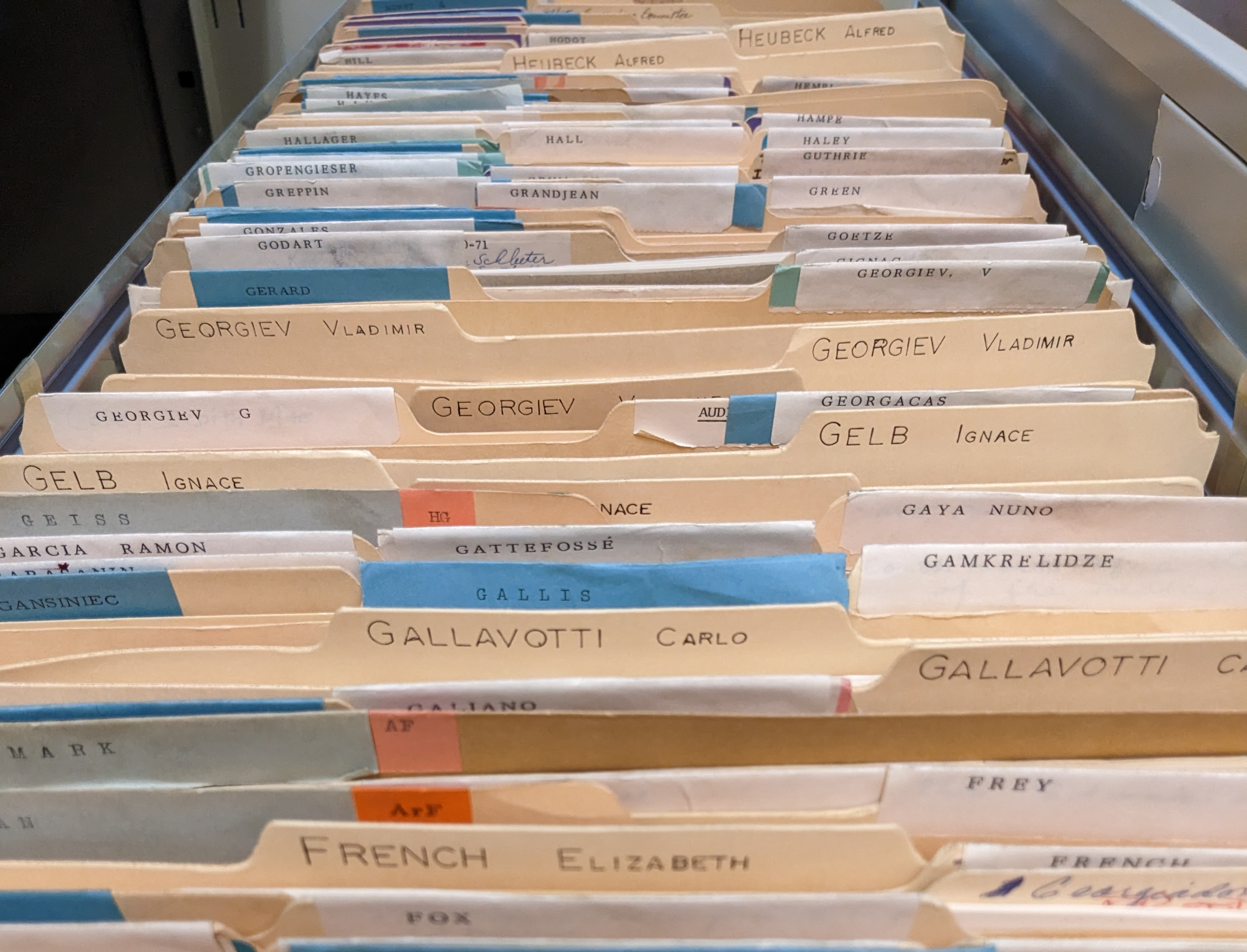
But the PASP archive wasn’t the only highlight of my time in Austin. We were fortunate enough to take a trip out to the small town of Bastrop and visit Tom Palaima at his absolutely gorgeous home. We then walked into town together to visit a bookstore and have some delicious catfish for lunch. Stella had never had catfish before, but she found yet another thing she will willingly eat (anyone reading this with kids will know what a blessing this is)! Discussions with Tom were another important aspect of my time at PASP. He is such a font of information it is hard to keep up and I always had my notebook ready to jot down the citations, suggestions, and scholars he recommended.
In addition to PASP, I also got to know the faculty and graduate students in the UT Classics Department. Alex Walthall and I had been fellows together at the Harvard Center for Hellenic Studies in 2017, so it was great to see him and his wife, Lauren, again, as well as their new addition to the family, Poppy. Stella and Poppy had a wonderful time gardening together! I also had a chance to get to know Rabun Taylor and Adam Rabinowitz, two interesting and fun scholars. They saw a bit of my work during a talk I presented as part of the AIA chapter lecture series. Alex was able to squeeze me in on November 2nd and I spoke about “Oil and Wine as Cultural Commodities: from the Late Bronze Age to the Archaic Era.” It was there that I was introduced to the amazing graduate students of the department. After that lecture, we shared two group lunches and a few individual meetings where I got to know their individual research interests and was able to answer some questions they had about Bronze Age archaeology, the access of material in Greece, and the scholarly field in general (which is often one of landmines, as we all know!).
All-in-all it was a great trip, full of stimulating discussions, useful research, and very good barbeque. In search of the best meat we went to Terry Black’s, the Original Black’s in Lockhart, and Smitty’s Market (also in Lockhart). We’ll have to save Franklin for next time!
Updated on December 14, 2022 by Garrett R. Bruner. garrettbruner@utexas.edu
November 11, 2022
Personal and PASPian Perspectives on Mysteries Revisited : Alice Kober, John Franklin Daniel, Michael Ventris and Emmett L. Bennett, Jr. as Founders of Scientific Research on Aegean and Cypriote Scripts
by Tom Palaima
Robert M. Armstrong Centennial Professor of Classics
Director, Program in Aegean Scripts and Prehistory
In December 1946, in a clear sloping hand, on super-thin post-war paper, Kober wrote Sir John Myres: ‘I must confess, strong as the statement sounds, that I would gladly go to the ends of the earth if there were a chance of seeing a new Linear Class B inscription when I got there.’
—Alison Fell, The Element -inth in Greek (2012) p. 3.
During my recent research, seminar and lecture stint at University of Copenhagen’s Centre for Textile Research in September 2022, I had stretches of time completely to myself for the first time in many years. In my reading and thinking, I came across Henry James’s summing up of the world in which he and now we live:
“Life is, in fact, a battle. Evil is insolent and strong; beauty enchanting, but rare; goodness very apt to be weak; folly very apt to be defiant; wickedness to carry the day; imbeciles to be in great places; people of sense in small, and mankind generally unhappy.”
And just today in looking up a source concerning the condition of people who are poor in our country, I found, in an op ed piece I wrote in late December 2018, this quotation from Jeff Dietrich’s little-read book Broken and Shared: Food, Dignity and the Poor on Los Angeles’s Skid Row in which he sums up succinctly and insightfully the life of Jesus:
The story of Jesus “is not a success story; it is, rather, a failure story. Jesus was betrayed by his best friend, denied by his lead disciple, deserted by his followers, and ridiculed by his once-adoring crowds.”
It is almost impossible in these days of unfettered capitalism to communicate what crystalline pure devotion to modest and unassuming lives of the mind scholars like Alice Kober and Emmett L. Bennett, Jr. had and how that devotion sustained them and gave their lives a central posited purpose. They had egos, but they were sublimated to the greater good of their chosen field of research and the goals that they set within it. They were scholars through and through and aware of their deep responsibilities to other scholars, past, present and future, and to the societies in which they lived, and especially to their students.
This is why devoting a display to the meticulous and voluminous work notes and scholarly correspondence of Alice E. Kober in Australia’s Macquarie University History Museum’s exhibit on Mysteries Revisited, From Ancient Codes to Comic Culture is reverent and heartwarming and important. These materials, which are not only Kober’s Lebenswerk, but arguably the very essence of her life, at several crucial points could easily have been lost forever.
In the ten years (1973-1983) I worked closely and often in the two offices that Kober’s eventual closest collaborator Emmett L. Bennett, Jr. occupied at the University of Wisconsin Madison, I never even saw the boxes in which Kober’s materials were stored. Kober shortly before she died on May 16, 1950 told her brother that when she died her scholarly papers and notes should go to Emmett L. Bennett, Jr. This included what was in her house in Brooklyn and some materials in the University of Pennsylvania Museum that were there because of her and John Franklin Daniel’s dream of setting up an Aegean scripts study center. His death in 1948 at the age of 38 snuffed out the candle of their dream.
Kober, with whom her mother was pregnant when they came to Ellis Island in 1906, knew the hardships of a newly arrived immigrant family trying to make a life in their new world. She lived abstemiously throughout her life. To attend Hunter College and excel at everything except physical education, and then obtain a Ph.D. at Columbia University and win a teaching position at Brooklyn College must have seemed to her and her mother a true dream come true. Attainments beyond fantasy for Alice in the Old World. She did her utmost to be a dutiful daughter to her mother and to be a fully helpful colleague and an inspirational and supportive teacher (teaching a 5:4 course load, overseeing undergraduate clubs and even learning Braille and then typing exams in Braille for Brooklyn College students).
In my thirty-eight years of knowing and eventually truly loving Emmett Bennett as a second father, not just as a Doktorvater, and even caring for him, when he was in his eighties, as I did my own father, for an extended period here in Austin, I never heard him utter a single word of complaint about anything. Utterly remarkable. Pun unintended, but there it is, and Emmett would have appreciated it.
Occasionally Emmett would be annoyed by yet another ill-informed or misguided attempt to ‘read’ Linear A or the Phaistos Disk, but even then, his written demonstrations of the errors of their ways were just that. And in speaking to me, he stuck to pointing out their flaws in establishing and reasoning from the essential data. His teaching manner was not for everyone, but it was perfect for me. Exploring perplexing problems together. Delighting in new perspectives. Truly caring about precise details. And suffering the fool writing this gladly.
Music, walking (when he could no longer safely bicycle) and observing the day-to-day world around him, working NY Times crosswords and Manchester Guardian cryptic crosswords—both of which amused him for phenomenally short periods of time most days, pondering and often resolving problems with Mycenaean texts, and occasional personal interactions with colleagues, students and friends—mostly one and the same—occupied his days in his later years. He was disarming and cared not for any academic politics or gossip, old or new. He was kind and considerate, open-minded and tolerant, albeit wedded to his love of classical and choral music (including church music despite his atheism) and Gilbert and Sullivan. Graduate students who helped him on and off campus truly fell in love with him, too. My son’s mother did not hesitate for even a split second when I said that I would like for us to name our only child Emmett. I am grateful to her for that. Our son, after a spell of going by one of his simpler middle names, once he was in college and now as an adult goes exclusively by the name Emmett. He makes a name for himself now as an artist and musician, intuiting relationships between electricity and the spirit in his work The Church of the Electric God, recently on exhibition in New York.
Emmett L. Bennett, Jr. (b. 1918) expressed a true fondness for Michael Ventris (b. 1922), pointing out that they shared the same birthday (July 12) four years apart. And Emmett spoke of how in Michael’s last year of life (1956) at the first Mycenological Colloquium at Gif in April 3-7, they shared and commiserated with one another about some of the same significant personal problems and dilemmas. Yet he never once expressed any disappointment that Michael had gotten to the Everest of decipherments first. Nor did he speak critically of the means Michael used to get there. Not even a hint of a single sour grape.

Their shared passion was truly shared. It made them what Diogenes Laertius preserves for us as friends in the Aristotelian sense of the term: ‘one soul residing in two bodies’ (μία ψυχὴ δύο σώμασιν ἐνοικοῦσα).
So much for two of the three legs of the decipherment and central PASP tripod.
We are speaking here of the third, and perhaps the sturdiest and most supportive leg, Alice E. Kober (1906-1950). In her adulthood, Kober had two soul mates of whom we know. From age twenty-six right up to the week before she died at age forty-three, Kober’s life was largely given over (after completing her Ph.D. in 1932 on color terms in Greek poetry) to her early announced objective (when graduating from Hunter College in 1928) of ‘deciphering Linear B’, to which she devoted every spare moment in her busy days of teaching at Brooklyn College and caring for her own aged mother.
The two soul mates, with whom Kober corresponded and cautiously brainstormed, during the last decade of Kober’s too brief life, were Johannes Sundwall in Finland (1877 – 1966) in his sixties into seventies at that time and John Franklin Daniel III (1910 – 1948) at University of Pennsylvania. As we have mentioned, Daniel’s tragic early death put paid to their plans to establish a center for research in Aegean and Cypriote scripts at University of Pennsylvania. For the depths of their shared interests and Daniel’s strong championing of Kober in an age when women in academia had a very tough time of it, see the wonderful write up by PASP’s own Cassandra Donnelly, the world’s current expert on Cypro-Minoan script, on the CREWS Web site.
Eventually Kober and Bennett developed a strong and mutually beneficial rapport and worked fully cooperatively toward solving the complicated problem of establishing a standard signary of characters of the script—no easy task especially when the tablets themselves were not available for autopsy—that would allow for publishing the texts of the Knossos and Pylos tablets soundly and in a way that would be useful to scholars worldwide.
Impediments and obstacles were many. These included the devastated economic conditions in all countries of the world except the USA and especially in post-war England, which was losing its empire and had suffered the destruction of a million homes during the German Blitz of 1940-41. The resources of the Clarendon Press at Oxford were extremely limited and this made this eminent academic publisher reluctant to abandon truly outdated sign lists devised by Sir Arthur Evans. The continuing civil war in Greece kept museum collections closed and made travel dangerous until 1950. The general unconcern of the scholarly world in inscriptions that had kept their secrets to themselves for so long and that were thought, widely, to have nothing to do with the Greek language made focusing on Linear B professionally foolhardy. As an aside to the last: I was warned by four prominent scholars at the American School of Classical Studies in my first fellowship year (1976-77) that doing a dissertation on Linear B would be a death knell for my future career—it nearly was.
Kober, with her many years of acquiring diverse ancient languages in summer linguistic institutes, held to her firm conviction that no sound work could be done until the standard sign system and any regional or chronological variants were established and as many accurate texts as possible were correctly transcribed according to this system. Accordingly, she did her utmost during her last four years of life to help Sir John Myres complete the edition of the Knossos tablets that Sir Arthur Evans had started and entrusted upon his death to his (Myres’s) care. Kober was adamant that they should make every revision that her and Bennett’s increased knowledge of the script and tablets dictated. This was not to be in her lifetime and really never was to be in the history of Linear B scholarship.
Scripta Minoa II when it appeared in 1952 was not up to date. Yet its drawings and photographs and much of its surrounding information formed together a significant scholarly advance. But it was a text of the 1930’s and not the 1950’s.
Susan Lupack, senior lecturer, Department of History and Archaeology at Macquarie University, has written here an account of the exhibition clearly and understandably partly out of gratitude for our long years of mentor-student interaction. Our relationship now, too, has been transformed into friendship and has also engendered my own sense of wonder at her tremendous and diverse achievements as a teacher, scholar, field archaeologist, parent and highly principled human being. She speaks of Garrett Bruner and me making the Kober portion of the exhibition at Macquarie University in Australia come to be.
Sensu stricto she is not wrong. We are the immediate causes. Garrett and I spent long hours selecting materials and then investigating how to pack and ship them. They are irreplaceable. Eventually I spent hours and hours at a forbidding DHL ‘office’ in the Austin airport freight area trying to figure out how we could safely and economically ship our precious materials to Australia in such a way that they would not get hung up in customs and that their contents would not require opening and inspection, which would have been disastrous. DHL has no category for archival papers. As I discovered to my regret, any use of the term ‘value’, as in ‘of historical value’, immediately kicks in ‘insurance’ concerns by DHL and parallel concerns about customs authorities. Fortunately, I had learned from my postal worker father to wrap packages so that they could survive a nuclear detonation, a tidal wave, sinking in the ocean or an attack by alligators or birds of prey.
But there is a long list of PASP archivists over a thirty-year period and thirty-six years of PASP graduate and undergraduate assistants who have worked on all facets of PASP’s activities and especially on preserving and making available to the larger world—now even substantially electronically—the correspondence and research materials of Alice Elizabeth Kober and Emmett Bennett and Michael Ventris and their many collaborators.
The archivists, who have worked energetically and painstakingly and with true devotion and commitment over the last thirty years, are: Elizabeth Sikkenga (who also revived and served as chief editor of SMID from 1994-1999), Christy Costlow Moilanen, Sue Trombley, Zachary Quint (né Smith), Sarah Buchanan (2014-2016) and Garrett Bruner (2017-2022). They all benefited directly or indirectly from funding from the Institute of Aegean Prehistory (INSTAP). By this I mean that INSTAP funds freed monies that were used to pay them for their services and purchase archival storage materials.
I remember Sue Trombley coming into my office crying from kind-hearted devotion when she discovered that Alice Kober, in cutting a Christmas-time invitation card down to a size appropriate for serving as a section separator in her cigarette-carton files, had made sure that the cartoonish drawing of Rudolph on its reverse side would remain intact and include the very tip of his red nose. Garrett Bruner is an impeccably trained and functioning specialist and a deeply learned humanist. I literally view him as a soul mate who understands that preserving and promulgating the PASP research archives is a sacred task in the long history of humanistic studies, especially in these days when universities are corporate training grounds and the study of the liberal arts has divorced itself from its roots in monasteries and monastic colleges like those at Oxford and Cambridge and now operates entrepreneurially and justifies its existence in terms of greater career dollar earnings.
Special recognition also should be given to graduate assistants like Dygo Tosa, who is now a full-time Latin teacher and teacher-leader of vision and support at Springfield Honors Academy in Springfield, MA. Dygo included archiving among the many jobs that he accomplished over several years. He literally kept the PASP ship sailing during a period of several years that were typhoon-like in overwhelming my own life’s ship. Graduate students—and a few undergraduates—have studied and precisely described all kinds of materials, both single items and discrete batches. They have also developed simultaneously a deep sense of obligation to keeping the wonderful resident spirits of all the scholars directly or indirectly present in PASP alive.
Students who worked in PASP the last four years will have to stand for those stretching back another three decades:
Kevin Lee (Spring 2018 to Summer 2018), Zoé Thomas (Fall 2018), Cassie Donnelly (Fall 2019), Michele Mitrovich (Fall 2019), Erin Brantmayer (Spring 2020), Jared Petroll (Spring 2020 to Spring 2021), Nicole Inskeep (Summer 2021 to Fall 2021), Maija Gierhart (Fall 2021), Amber Kearns (Spring 2022), Nicolas Larimer (Spring-Summer 2022), Autumn Greene (Fall 2022), Anthony Bronzo (Fall 2022).
In particular, I would like to mention a few early birds from the 1980’s and early 90’s: Jean Alvares, whose recent book explores the notion of the ideal in the Greek and Roman novel; Yuri Weydling, who retired in 2018 after 28 years of teaching Latin at the Baton Rouge Magnet High School in Baton Rouge, LA; Bruce LaForse, who is retiring in May 2023 from teaching Classics and ancient history at Wright State University; Philip Freeman, who did an M.A. on Linear A, and is now, many books later, Fletcher Jones Chair/Professor of Humanities at Seaver College Pepperdine University; and Kerri Cox Sullivan, who is now Publications Research Editor for the Sardis expedition at Harvard and did final production editing on the highly complicated Festschrift for José L. Melena in 2022.
Two writers who researched the life of Alice Kober, contributed valuable information and materials about her to the PASP archives and then wrote extraordinary books deserve special and conspicuous mention. The first is poet, author and artist / sculptor Alison Fell (1944 – ) (see also: https://literature.britishcouncil.org/writer/alison-fell). The second is author and former New York Times obituary writer Margalit Fox. They both came to understand Alice deeply and to love her. They both have done much to bring her back to life. They have given us Alice as a human being who had strong personal feelings about her life and work and an absolute commitment to those who were entrusted to her care as students or who trusted in her for her scholarly help.
In The Element -inth in Greek (Sandstone Press 2012 ISBN 10: 1908737026 ), Alison Fell uses the devotion of her central character Ingrid Laurie to Kober and her life’s work to take Ingrid from the UK to fictional versions of PASP and Sue Trombley and me in Austin, Texas and eventually to Crete where Ingrid’s knowing what Kober knew becomes crucial to bringing the events that are at the core of the narrative to a proper resolution.
Alison Fell’s writing is really first-rate and accurate in using close observations to construct characters from real-life models and to interweave doings in the present with events from Kober’s life and letters and her part in the marathon-length race to decipherment. You, as reader, learn things you should know about Kober and her inner self.
Alison also tracked down lots of what we know about Alice’s family’s first twenty years in New York and just missed by months being able to read Alice’s doctor’s files concerning the precise medical diagnosis of the illness that killed her.
Most endearing to me of all was Alison’s refusal to change her title, which preserves and celebrates the title of Alice’s unpublished monograph on the subject of pre-Hellenic loan words in the Greek lexicon, even though, as she reports, “every publisher balked at the title! Sandstone also wanted to change it to The Element … but of course I refused, and they conceded.”
Do read The Element -inth in Greek by Alison Fell and other books, poems and novels she has written or edited in her distinguished career.
The second writer is Margalit Fox, who worked with the Kober archives exhaustively and worked hard to get things right and tell Alice’s story to the world. Her book speaks for herself as well as for Alice and is extremely generous in its acknowledgments including to Alison Fell and invaluable UT staff members of the time like Matthew Ervin and Beth Chichester who not only made the trains run on time but kept them and their tracks in good repair and prevented the engineers and conductors from being driven mad by the kind of bureaucracies that gave birth to the Aegean linear scripts. Do read, too, The Riddle of the Labyrinth: The Quest to Crack an Ancient Code (Ecco Press 2013).
But most of all, if you are in Australia, go see Mysteries Revisited, From Ancient Codes to Comic Culture.
Finally and sincerely, Garrett’s and my great thanks to Dr. Martin Bommas and Dr. Josephine Touma for reverently handling and displaying the Kober materials and understanding the human dignity and grace that lie within them. And thanks from Emmett, Michael, Alice and John, too.
Updated on November 11, 2022 by Garrett R. Bruner. garrettbruner@utexas.edu
November 7, 2022
Linear B Down Under: An Exhibit on Decipherment at Macquarie University, Sydney
by Susan Lupack
Senior Lecturer of Greek and Roman Archaeology
Director, Bachelors of Archaeology
Macquarie University
Co-Director Perachora Peninsula Archaeological Project
I cannot tell you how incredibly excited and proud I am that some of the most significant artefacts documenting the decipherment of Linear B are now on display in the Macquarie University History Museum as part of an exhibit entitled Mysteries Revisited, From Ancient Codes to Comic Culture, And all this is thanks to Tom Palaima, Director of the Program in Aegean Scripts and History (PASP), who made it happen.
The artefacts include letters between Alice Kober, Emmett Bennett, and Michael Ventris, three of the main scholars whose painstaking work led to the discovery that the Mycenaean script called Linear B actually represents an early form of Greek. The objects that speak volumes though are the two cigarette cartons – Lucky Strike and Chesterfields – that contain Alice Kober’s meticulously written cards—her own hand-made filing system that is equivalent to one of today’s data bases. Their presence reminds us of the time and energy that Alice Kober devoted to discerning patterns in the strings of signs – patterns that would enable Ventris to take the leap to finally see the sense of the words those patterns represented.
The exhibit was first conceived of as a commemoration of Champollion’s decipherment of Egyptian Hieroglyphs, the 200th anniversary of which falls in 2022. But the theme led naturally to decipherment in general, and Martin Bommas, the Director of the Museum, knowing my research involved the interpretation of the Linear B tablets, asked if I would like to contribute something on the decipherment of Linear B. My answer was of course a very enthusiastic, “Yes!” And immediately I started to think how incredibly wonderful it would be if we could actually exhibit some of the artefacts that are housed in the archives of PASP. I first asked Martin and the Museum’s Manager, Josephine Touma, if this would be supported by the Museum, and the answer I received was an equally enthusiastic, “Yes!”
This led to my reading through the extensive online archives of letters that have been curated by the archivist of PASP, Garrett Bruner, so that I could choose a coherent set of letters to tell the story of the decipherment. Garrett also suggested some of the better pieces that are now included in the exhibit – his close knowledge of PASP’s collection proved invaluable in choosing the most effective pieces for the exhibit. He also provided our Museum exhibitions team with a high-resolution image of Alice Kober, which was then blown up so that it now stands as the centrepiece of the exhibit (Fig. 1), bringing a nice counterpoint to the image of Champollion two cases away.
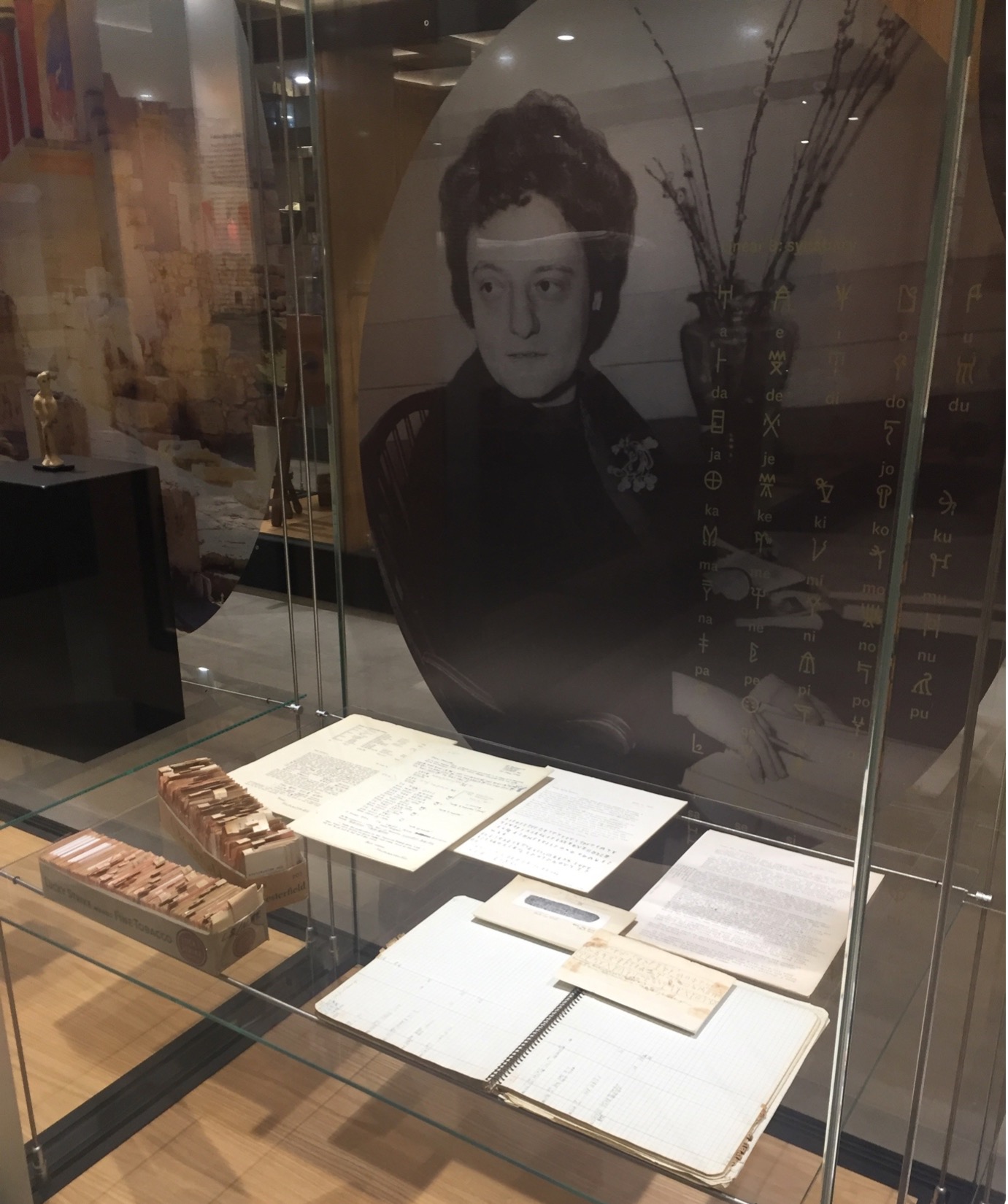
The method of packing and shipping of the precious archival materials was worked out between Josephine Touma, Manager of the Macquarie Museum, and of course Garrett, who made sure they would make the journey safely. When the objects arrived at Macquarie, Martin very kindly called me to ask if I would like to unpack them with him – he knew how much these objects meant to me. I have to tell you that I was so overwhelmed when I was opening the packages that my hands were shaking and I felt close to tears! We filmed the event for Tom and Garrett, and you can witness my excitement as well!
One of the best things about this exhibit is the extent to which we’ve involved students in its creation. For instance, the text accompanying the objects was written in a joint effort by myself and one of my Master’s students, Sara Fioretti, who is working on Mycenaean trade with southern Italy. Other students in our Department of History and Archaeology are researching and writing blog posts that will be accessible via QR codes posted on the cabinets. For one of these blogs, Emeline Clarkson, one of my undergraduate students, recently interviewed me, asking questions about the history of Linear B and what we have been able to learn from it.
Before closing this post, I want to thank Tom once again for being so generous as to allow these incredibly significant and unique objects to fly across the world to be viewed for the first time outside of the US here at Macquarie. The effect they have on the Museum’s visitors is palpable. I’ve seen people’s faces transformed with fascination, and one student exclaimed, “I feel chills!” The handwriting on the letters, the cigarette cartons with their handmade index cards – these things bring the people behind the decipherment to life in a way that no written account could. Thank you, Tom!! And thank you to Garrett as well!!
Updated on November 7, 2022 by Garrett R. Bruner. garrettbruner@utexas.edu
October 28, 2022
Tom Palaima in Copenhagen, September 2022
by Tom Palaima
From September 4, 2022 until September 22, 2022 Tom Palaima was a Visiting Scholar / Guest Researcher within Rachele Pierini’s Marie Curie project Trans-PLANT (in collaboration with Marie-Louise Nosch), hosted by the Center for Textile Research (CTR https://ctr.hum.ku.dk/) and the Saxo Institute (https://saxo.ku.dk/) at UCPH (University of Copenhagen).
Tom was doing his own research work on (a) Mycenaean textual interpretation; (b) problems with palaeography in the Linear A and Linear B and Cretan Hieroglyphic scripts; and (c) scholarly correspondence among and between Carl Blegen, Sir John Myres, Alice Kober, Emmett L. Bennett, Jr., John Chadwick, Jean-Pierre Olivier, and Johannes Sundwall, among others. He was also rereading slowly, like sipping fine wine, Kurt Vonnegut’s Slaughterhouse-Five.
Tom also offered an advanced seminar for specialists over three-plus days September 12-14 with four 90-minutes sessions each day. In attendance were Rachele Pierini (CTR UCPH Denmark), Marie-Louise Nosch (CTR UCPH Royal Danish Academy of Sciences and Letters Denmark), Vassilis Petrakis (National & Kapodistrian University of Athens, Greece), Jörg Weilhartner (member of the Mycenaean Aegean Research Group at the Institute for Oriental and European Archaeology (OREA) at the Austrian Academy of Sciences, Vienna, Austria), Matthew Scarborough (Department of Nordic Studies and Linguistics UCPH Denmark postdoc on Connecting the Dots project for reconfiguring the Indo-European family tree and specializing in Greek, Armenian and Indo-Iranian) and various members of CTR. Personal obligations and circumstances prevented Hedvig Enegren (Belgium; see also https://bmcr.brynmawr.edu/2010/2010.05.10/), Massimo Perna (Università di Sassari, Centro Internazionale per la Ricerca sulle Civiltà Egee (CIRCE) at Oristano, Italy) and Ester Salgarella (Cambridge University, UK) from participating.

He also gave a public lecture at the Danish Institute for Advanced Study in Odense on the morning of September 7: “Bob Dylan as Poet of Feeling”. That lecture was recorded and is presented here:
In the afternoon he led a course-related discussion seminar on “The Killing of a President: Bob Dylan’s ‘Murder Most Foul’.”
On September 13, as dj, he played selected Bob Dylan songs at the cafe/bar and cultural platform Sorte Firkant Blågårdsgade 29 in Copenhagen.
The CRT Copenhagen University sessions were designed to cover on successive days the following general topics or issues:
1. Day One: Epistemology
A. Vn 130: perfume manufacture or pottery production? We were examining the development of ideas about this tablet from Leonard Palmer in the 1950’s-60’s to its virtually being ignored for a long time. It is not treated in Shelmerdine The Perfume Industry of Mycenaean Pylos 1985 nor in either edition of Docs 1956 or 1973. It was identified and interpreted as a pottery production text (Galaty Mycenaean Palaces 1999 and Rethinking Mycenaean Palaces 2013) according to a proposed hypothesis of the key heading term (o-ze-to) by Leonard Palmer (The Interpretation of Mycenaean Greek Texts 1963). Palmer’s treatment of ze was proved phonologically impossible and Palmer himself rightly repudiated this interpretation.
The current valid interpretation of Vn 130 is as a text dealing with perfumed oil production as proposed by Palaima (“Pylos Tablet Vn 130 and the Pylos perfume Industry” 2014) with support from Melena and Peter Warren. The problem is that Galaty’s ‘interpretation’ of this key text is widely read in the general literature in explicating and reconstructing the pottery manufacture industry in palatial Messenia.
The key question raised here is the following: How do Mycenological specialists best mitigate the widespread impact of the use of a faulty interpretation, as fewer and fewer specialists deal with the texts firsthand and general works like the three Companion volumes edited by Duhoux and Morpurgo-Davies (Companion to Linear B: Mycenaean Greek Texts and their World, Bibliotheque des Cahiers de l’Institut de Linguistique de Louvain [BCILL] 2008, 2011, 2014) have to be extremely selective in what texts they treat?
B. The heading of the Ta series and the meaning of te-ke. We explored yet again whether it is appropriate to reject that in this context te-ke can have the meaning ‘buried’. Proponents of maintaining this interpretation make it the Palmer-Duhoux-Palaima thesis with modifications of Palmer’s interpretation over time. The materials listed hereon are no longer considered burial goods per se, but rather paraphernalia to be used in putting on a commensal ceremony.
In regards to te-ke in particular, most interpreters overlook carefully worded language in the latest edition of the LSJ and in the view of John Chadwick. They also apply a rule derived from and developed for Greek historical, mainly literary, documents and apply it without considering specialized contexts both to Linear B texts and to Roman imperial tomb inscriptions.
C. Objects and numbers in the Pylos Ta series. A careful reading of each tablet of the Ta series and how and why the ‘scribe’ of these texts entered information as he did and for whom he did so. Comparison with the various transcriptions of the texts historically and recently. We discussed the ramifications of our understanding of feasting ritual and practices and tied in recent work published by Blackwell and Palaima (2020 and 2021) and forthcoming work by Blackwell, Morton and Mahoney. We pointed to the rich literature on the Ta series, especially now Rachele Pierini, Alberto Bernabé and Marco Ercoles Thronos: Historical Grammar of Furniture in Mycenaean and Beyond (Pàtron Editore: Bologna 2021) with very full references.
D. Epistemological problems with key place names: a-pu2 pa-ki-ja-ne pa-ki-ja-na pa-ki-ja-ni-ja and other place names. These pertain to problem points addressed, but still not fully resolved in how to approach the rendering of place names potentially non-Indo-European in origin and how these are to be linked to place names preserved in Homer and attested among later Greek toponyms widely used or in later Greek lexicographical or geographical studies.
2. Day Two: Palaeography
A.-B. Sir Arthur Evans and K.D. Ktistopoulos.
C. Tn 316 and the Ta series.
D. General considerations of palaeography (dating) and tools (phylogenetics, relative chronology, linguistics, find spots, RTI imagery). Pylos and Knossos tablets. Various palaeographically grounded publications (Bennett, Kober, Olivier, Palaima, Godart, Driessen, Skelton, Perna, Petrakis, Greco, Karnava, Firth, Salgarella, Schoep, Montecchi, Donnelly, Steele, Ferrara.)
3. Day Three: Correspondence among the principals working on the decipherment and the techniques they employed using Emmett Bennett as the node who a. did much to establish sound texts; b. shared material with Kober; c. gave sober and helpful criticism and even developed a strong rapport with Michael Ventris at a time when Ventris was uncertain about what direction(s) to take and later until September 7, 1956; d. from 1947 into the early 2000’s helped with careful primary publications, including the early iterations of transcriptions of the Knossos tablets and the pre- and post-decipherment publications of tablets from Pylos and Mycenae. Bennett’s correspondence with John Chadwick is especially illuminating as is his editing of Nestor, the latter capturing his playful spirit.
There was much constructive give and take among all participants. We reached a general consensus that discussion meetings like these centered on specific problems within an atmosphere of open exchange of ideas were essential to the health of Mycenology and work on Aegean and Cypriote scripts generally. Otherwise the fields break down into self-contained fragments and run the risk of perpetuating insular and isolated ideas and schools of interpretation.
This is very much in keeping with the design and spirit of MASt seminars. These quarterly on-line seminars began on the Harvard Center for Hellenic Studies Classical Inquiry web site early in 2020. They are now changing to the Classical Continuum Open Access Rapid Publication Platform of the New Alexandria Foundation also centered at and supported by Harvard University. They aim at providing a forum for learned presentation of new ideas and rethinking of old problems followed by open and free critical questioning and discussion. See, for example, MASt July 23, 2021 published atypically January 13, 2022.
Tom also gave a talk to members of the CTR and of Copenhagen University on Wednesday afternoon September 14 with a title “Humankind and people of sense in small places” adopted and adapted from Henry James: “Imbeciles in great places; people of sense in small, and mankind generally unhappy.” The general theme of his talk was to stress the social value of serious humanistic research at a time when administrators within universities are taking actions that de-emphasize the importance of the humanities and redirect resources that used to go to studying the humanities.
During his stay Tom also assumed from Marie-Louise Nosch as head of the Danish Royal Academy the royal prerogative to appoint Jörg Weilhartner of the Austrian Academy of Sciences a wanaks of a very special sort:
Palaima te-ke Joerg wa-na-ka-ta
or specifying the outcome in Danish:
‘Joerg er muslingernes konge’.
Updated on October 28, 2022 by Garrett R. Bruner. garrettbruner@utexas.edu
April 10, 2022
Bob Dylan and the Next Generations
Tom Palaima Collects and Presents Opinions and Reactions From Older and Younger Students and Aficionados on the Bob Dylan Concert
by Tom Palaima

As the day dawned with clear skies Texas blue and sunny on Wednesday March 16, 2022, there was excitement in the air for a merry band of thirteen (paging the apostles—did Judas Iscariot have God on his side?) members of the University of Texas at Austin community who were soon to be joined by Professor Richard Thomas flying in from Boston around High Noon (note Dylan’s love of western motifs—e.g., the movie starring Gregory Peck in “Brownsville Girl”) in order to attend the concert of Bob Dylan and his band at the Bass Concert Hall with me.
It would be the sixth time that Richard and I, who both teach courses on Bob Dylan, at UT Austin and Harvard respectively, took in a Dylan concert together. Past concerts, with my reviews where noted, were:
- Austin 2010 https://www.boblinks.com/080410r.html#2
- Akron 2017
- New York Beacon Theatre 2019 December 6 https://www.boblinks.com/120619r.html#3 [see also my review of December 5: https://www.boblinks.com/120519r.html#6 ]
- New York Beacon Theatre two shows November 19 and 20, 2021
Richard, author of Why Bob Dylan Matters and an expert in the poetics of Virgil and Bob Dylan, graciously guest lectures in my UGS 302 course Bob Dylan and Socio-Historical Imagination on his ongoing discoveries in the Tulsa Dylan archives of how Dylan shaped his masterpieces into being.
In our merry band were students from my UGS 302 classes the past three years and from my TC 358 Plan II Junior Honors Seminar on the human creative response, individual and collective, to war and violence. Also part of the group were:
- George Walters, a former award-winning creative senior thesis writer who continues to work with me on interpreting Dylan.
- Antonella Del Fattore-Olson, Distinguished Senior Lecturer in French and Italian, who wrote a Ph.D. dissertation connected to Dylan years ago (1978). Antonella’s sister-in-law Carla Olson was lead singer in Carla Olson & the Textones to whom Bob entrusted covering “Clean Cut Kid” on their album Midnight Mission (1984) before he released it on Empire Burlesque in 1985.
- Garrett Bruner, PASP and INSTAP archivist in the Program in Aegean Scripts and Prehistory (PASP), which I founded at UT in 1986 and have directed for the past 36 years. Garrett is a passionate and learned humanist and a dedicated student of world poetry. Working with him in the PASP archives brings me great joy. His spirit pervades the archives and inspires everyone who has worked in PASP or remotely with its on-line materials.
The students, Melania Dobson; Lucy E. Kulzick; Collin Taylor; Anuj Mocherla; Andrew Vanek; Rachel Williams; Sofia Pratt; and Socratis John Zavitsanos, were drawn to the concert by a wide range of personal, musical and other creative interests. It has been a pleasure to explore with them the wonders of Dylan’s songs in their overall cultural and sociopolitical contexts. We will give their reactions to the concert below.
Most ticket expenses were covered by the Robert M. Armstrong Centennial professorship, for which we are extremely grateful. We thank Bob Dylan’s main office and Debbie Sweeney for facilitating getting the tickets that gave these students a close-up view of Bob Dylan and his band. This was a unique opportunity for students who have seriously studied Dylan’s work from 1957 to the present to see him perform. The two tickets I bought personally went to George Walters and long-time Dylan concert follower and reviewer Laurette Maillet (see her review of the March 16 concert at https://www.boblinks.com/031622r.html). Note that Laurette mistook current UT students for high school students. They were so much older then, but in Laurette’s mind, younger in the here and now.
Most gratifying for Richard and me as teachers of Dylan’s work and genius were the responses of the attendees afterwards. I thank them for permitting me to quote them here, largely unedited.
We talked ahead of the show with fellow Dylanophile Kathleen Hudson who teaches Dylan and other forms of Texas music to her lucky students at Schreiner University in Kerrville, TX, home of the famous folk song festival. Kathleen’s latest book Corazón Abierto: Mexican American Voices in Texas Music (https://www.tamupress.com/9781623499020/corazon-abierto) was just released by Texas A&M Press.
I also include comments from Brandon Eichelberg, a student at the College of Charleston, whom I have been helping a bit with his senior thesis on Dylan’s love songs. Singer and songwriter Joe Goodkin, well known for his song cycles connected with Homer’s Iliad and Odyssey (https://www.thebluesofachilles.com/ and https://joesodyssey.com/home ) and also a regular in performing and discussing Dylan’s song poems in UGS 302 and TC 357, put Brandon in touch with me.
I append two additional recent responses to Dylan’s music from students in my current class who did not attend the concert.
Antonella, Richard, Laurette and I came of age listening to Dylan. The current undergraduate students and George and Garrett are forty to fifty years younger and were taking in and exploring Dylan and his music two generations later. Here are their responses, given alphabetically.
You will see with Mr. Bruner that, to steal and use from Planet Waves, something there is about Dylan’s music that strikes a match in him. I think these reactions offer eye- and ear-witness testimony that Dylan’s song poems are timeless and enduring and speak profoundly to the human experience. Dylan’s songs lead listeners to moments of thought and feeling that they would not come into contact with otherwise. They also offer looks into the hearts and souls of human beings in different times and places trying to live their lives as social creatures.
In the standard set list for the Rough and Rowdy Ways tour, Dylan gets us to meditate about what we and he are doing during our times on earth and what humankind has done during its long and wasted years. The set starts with the 1971 classic “Watch the River Flow” that tells us that sometimes the best thing that we can do is plunk ourselves down and just plain be:
If I had wings and I could fly
I know where I would go
But right now I’ll just sit here so contentedly
And watch the river flow
Mid-set in “My Own Version of You,” Dylan’s own not entirely tongue-in-cheek take on themes explored in Frankenstein, Island of Dr. Moreau and “We Didn’t Start the Fire,” he confronts us with the unrelentingly and immutably miserable history of “man’s inhumanity to man”:
I can see the history of the whole human race
It’s all right there – its carved into your face
Should I break it all down – should I fall on my knees
Is there light at the end of the tunnel – can you tell me please
Stand over there by the Cypress tree
Where the Trojan women and children were sold into slavery
Long ago before the First Crusade
Way back before England or America were made
Step right into the burning hell
Where some of the best known enemies of mankind dwell
Mister Freud with his dreams and Mister Marx with his axe
See the raw hide lash rip the skin off their backs
You got the right spirit – you can feel it you can hear it
Dylan closes by giving us binary options:
I want to bring someone to life – turn back the years
Do it with laughter – do it with tears
And after “Goodbye Jimmy Reed” thumps the bible and proclaims the creed in this lost land of ours, Dylan ends the whole show with “Every Grain of Sand,” conveying his moving existential reflections on what we confront time and again, inevitably out in the world on our own, during the unpredictable journeys of our lives:
I have gone from rags to riches in the sorrow of the night
In the violence of a summer’s dream, in the chill of a wintry light
In the bitter dance of loneliness fading into space
In the broken mirror of innocence on each forgotten face
I hear the ancient footsteps like the motion of the sea
Sometimes I turn, there’s someone there, other times it’s only me
I am hanging in the balance of the reality of man
Like every sparrow falling, like every grain of sand
The set simultaneously exhausts and inspires our minds, hearts and souls with its accumulation of the emotions and viewpoints Dylan himself has had during his years as a master song-poet.
The fourteenth song of the seventeen-song set distills the nature of the aloneness we all feel along the paths of our lives. Straight, pithy, no chaser, Dylan croons the B-side of Frank Sinatra’s first single “Melancholy Mood.” His current band fills in superbly for Harry James and his orchestra.
Gone is every joy
And inspiration
Tears are all I have to show
No consolation
All I see is grief and gloom
Till the crack of doom
Oh, melancholy mood
Listen to “Melancholy Mood”, below
It was the highlight of the fall tour for me and it highlighted the soon-to-be-springtime Austin tour date, too. A small, sparkling jewel Dylan put in his own crown three songs before they turned on the lights.
Garrett Bruner
March 17: I don’t go to concerts much. It’s been years since one. And could be years before another.
So I didn’t have much to bring to this. But I thought Dylan and his band were top notch. What Dylan’s doing at his age, I appreciate — it looked like he was enjoying himself. And despite the setting of a concert hall, I thought the band played very warmly, welcoming as if you were visiting a friend’s backyard.
My ear kept keying on each performer’s instrument at times. And Dylan’s voice and lyrics had their effect. The depths he’s able to sing! I’m still thinking about them, reading afterwards the lyrics I heard or had missed. Quieter songs I liked, for example, “Black Rider.”
“My Own Version of You” also had me reflecting. I have nothing conclusive really to say about it. At times I thought it was the song speaking to the songwriter. Maybe if Pygmalion’s wife had her say. The elusiveness still has me going over what it’s saying though.
(I should add I re-read the same books for years, without really knowing what they mean, so it wouldn’t be unusual for these songs to stick with me in the same way).
“I’ve Made Up My Mind to Give Myself to You” was especially moving. Classic sort of images. Rivers, stars, embodied in the speaker, as traveller, on the move. What was moving about it to me was a vulnerable sense of yielding to someone else. What the traveller misses if there isn’t someone to share experiences with. Similarly, it was good to share this concert with friends here at home in Austin.
March 19: I’m still listening to the songs. This morning listened to all of Rough and Rowdy again. “Mother of Muses” is special, reminiscent of a Pindar ode I love, Olympian 14 (For Asopichus of Orchomenus Boys’ Foot Race ?488 B. C.), one of his compressed invocations, to the Graces. Moving.
March 24: Still listening to Dylan a week later. Never gave him a fair chance before, but he’s won me over since that concert. So, thanks.
I think the best compliment paid to chefs is just if you ask for seconds. I’ve been listening to more and more of Dylan since Wednesday. Thanks Tom, again!
April 2: I’m still somewhat in awe, still absorbing having seen Dylan. What a treasure that evening was! I mean it. I’ve listened to Time out of Mind every day since that concert, and much of Rough and Rowdy Ways, Blonde on Blonde. Anyway. Thanks again!
April 9: Still continuing my odyssey through Bob Dylan’s CDs. Now onto Desire and stunned by the opening track “Hurricane”. Most of all its resonance with the past years of strife following George Floyd’s murder (though the song and Floyd are fifty years apart), the buildup and release of what fury Ronee Blakley’s backing vocals add.
How can the life of such a man
Be in the palm of some fool’s hand
The couplet above (and the conclusion about giving Rubin back the time he’s done) reminded me of the poet Zbigniew Herbert and a line from his poem, From The Top of the Stairs, about those like Rubin Carter who are “hostages of a better future.”
Antonella del-Fattore Olson
Thank you so much Tom! It was an amazing evening.
I will try to find the video in which my sister-in-law, Carla Olson, played with Dylan.
She was in his video 1983 “Sweetheart Like You” pantomime of Mick Taylor guitar https://www.youtube.com/watch?v=PpRKstHl7Y0 . Then he gave her “Clean Cut Kid” to record in the Textones first album https://www.youtube.com/watch?v=LvNpmJS63nQ.
Below my reaction to the concert
Seeing Bob Dylan’s concert last night was very emotional to me. I saw him with my late husband Bob at the Erwin Center in Austin, many years ago (1981?). Bob helped me a lot when I wrote my thesis about Dylan, even longer ago (1978). I shared with Bob the magic reality of Dylan’s songs and his magnificent music made particularly special by the wonderful artists who played him. Bob Dylan was as powerful as he has always been.
Melania Dobson
I really enjoyed the experience of seeing Bob Dylan in concert, and had a much greater appreciation for the performance after taking the course on Bob Dylan. As a whole, you could tell how much respect everyone in the audience had for Dylan and the band; the atmosphere of the audience felt very connected, like a uniting experience that we were all taking part in. This is something felt at other performances, but not to the extent of this show. The performance itself was cohesive, quite seamlessly moving from one song to another, which I really enjoyed, as it allowed for the music to carry the performance along. Which of course makes the set list all the more impressive, as it was able to bring everything together.
Thank you again so much for this opportunity, it gave me so much appreciation for Dylan, his music, and his impact on history, as well as his lasting impact today.
Brandon Eichelberg, commenting on the concert Sunday March 27 in Charleston:
March 28 Just to give you an update on the Dylan concert — It was great! As I said, it was my first time seeing him, which made it all the more enjoyable. He played and sang wonderfully, and I specifically favored “To Be Alone with You” because it was just so interesting hearing an aged Dylan sing one of his younger songs. His whole performance was amazing, but if I had to choose another favorite, it would probably have to be “I Contain Multitudes,” especially since he was smiling throughout most of it. All and all, it was a memorable time!
Anuj Mocherla
It seems that we all got separated on the exit, but just wanted to reach out again and say thank you so much for allowing me to come see Dylan live with you and your students! Dayton has spoken nothing but the highest of praise for your work and the class he took with you and I hope we can meet once more before I graduate this Spring!
Have a great night Professor!
Collin Taylor
I lost you after the show but thank you for the opportunity to see Bob Dylan. I’m still in shock
Andrew Vanek
What was special about the concert was ‘seeing’ Dylan. I greatly admire Shakespeare and Jesus Christ and Homer, but I will never get to see them in my mortal lifetime. That makes seeing Dylan truly exceptional.
I loved the lecture that you organized and helped give at the Union a few years back (University Lecture Series: Bob Dylan: The Next Generation March 21, 2017 with Michael Chaiken, the lamentably late Tom Staley and Caroline Frick https://ugs.utexas.edu/events/uls/spring17-3 and https://www.youtube.com/watch?v=9AClQVnnkVE ) about the Tulsa Dylan Archives.
A major point that resonated with me was how Dylan traveled and kept moving to have inspiration. I remembered that Shakespeare traveled to Italy and all over Europe before he started seriously writing.
Malcolm Gladwell writes about a “crucible” moment that artists and entrepreneurs go through before they produce work of value. I like how these writers’ and musicians’ crucibles were traveling from place to place. Jesus not as much, but you get the picture.
George Walters
Thanks for a night I’ll never forget! I really do appreciate it, Tom! I must say I came away a lot more impressed than I thought I would.
Rachel Williams
Thank you so much for the opportunity to see Bob Dylan! Here are my thoughts after experiencing the concert:
Seeing Dylan in person was truly a special experience, especially as he ages (quite gracefully!) and there are potentially fewer chances to see him perform live in the future.
His voice and presence were spellbinding; it truly did sound like sand and glue as Bowie described. It was one of the best concerts I had ever been to, and I will treasure for the rest of my life that I was able to see one of the greatest musicians of all time in person. I am so grateful to have been able to go, especially after analyzing his works in TC358 (as they related to the Kennedy assassination, people in poverty and landmark injustices in civil rights). It was interesting to hear how his voice captured emotions so precisely.
Socrates Zavitsanos
Thank you so much for the tickets!! Experiencing Dylan live in concert near the front of the venue at Bass was truly unforgettable. I do not know of a single other class at UT that would accommodate students with this kind of rare opportunity. Huge thanks to Bob’s music office as well for reserving the tickets for us in very desirable seating locations. And thank you so much for emailing me and giving me the opportunity to take up on those tickets. Dylan’s performance was truly memorable and the musicians he had alongside him were extremely talented (I was especially amazed by the drummer, Charley Drayton). I’m super glad I could attend and cannot thank you enough. This class was amazing!!
Appendix: Aside comments from two UGS 302 students
Amit Henn
April 5: I want to make sure I produce an awesome presentation this Thursday on “Lonesome Death of Hattie Carroll.” Again, thank you so much for your constant help and support! I’m looking forward to presenting and expressing my newfound love for Dylan’s musical genius.
Megan H. Adams
April 5: I think you are a really great and compassionate teacher. I always get a lot out of your class and wish that it was in person so that I could listen better. I enjoyed working on that presentation and I now know how powerful the song “Blowin in the Wind” is and I learned a lot of things I never knew. Have a good day. Thank you!
Updated on April 10, 2022 by Garrett R. Bruner. garrettbruner@utexas.edu
March 12, 2022
Dylanology I, II and III: Triptych in “Linear B” by N. Samartzidis

Foreword by Tom Palaima
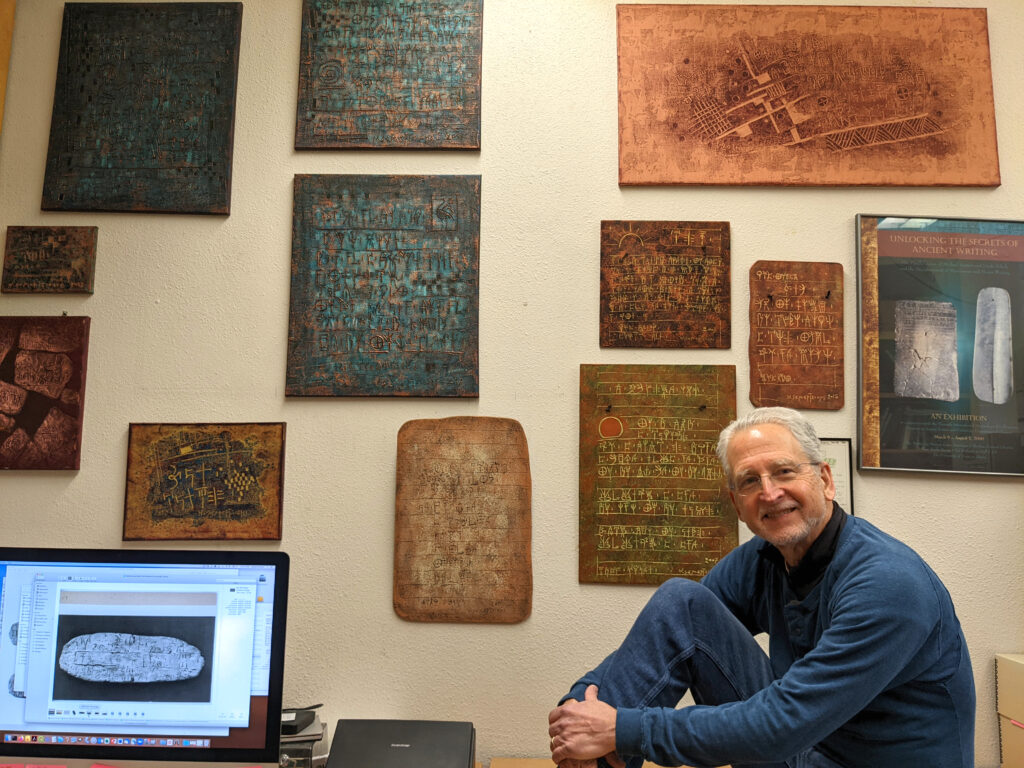
In his gloriously honest essay that follows, my longtime friend and really soul mate—though we have met in person only once for three evenings in May 2007 in Munich where I was helping in a conference for German postdocs on power figures and hierarchies in ancient cultures—Nikos Samartzidis quotes the Greek Bob Dylan, Dionysis Savvopoulos:
“The artist simply learns to observe some small details and understands where a thing is going…”
And indeed artists time out of mind observe the particulars that most of us miss and capture them for us in visual or oral/aural poiemata, literally ‘the end results of the process of making or creating’. And their poetic creations reach into our souls and stir them to the point where we can feel the pulse of the human thing as it has insisted to endure despite the cruelties and misfortunes and the ‘accidents that will’ that seize and shake and redirect again and again all of our lives. They express joys and sorrows, beauty and ugly, kindness and brutality, the seen and the unseen, cold hard facts and hints of ideas and feelings, the remembered and the forgotten. They make us human even when we do not want to be.
Nikos is a great soul like Dylan, like Savvopoulos. His artwork like theirs moves backwards and forwards in time and really obliterates it, using the earliest symbols for capturing human speech in western culture, the Linear B script.
Here he discusses three pieces that present visually κομμάτια και Θρύψαλα from three great masterworks of Bob Dylan.
The PASP Archives are proud to archive and exhibit the artworks of Nikos Samartzidis, which include over thirty paintings on canvas and board, a dozen clay tablets, and linocut prints. All artworks cited by Samartzidis in his study of Dylan are housed and on exhibit in PASP.
Triptych in “Linear B” by N. Samartzidis
Some reflections and comments by the artist
When the idea of making a piece of art based on Bob Dylan’s lyrics was first proposed to me by my personal and scholarly friend Tom Palaima who teaches courses on how Dylan’s music explores human lives and our human condition, I automatically asked myself the question: Which one of his countless songs and lyrics should I include? The answer, of course, was difficult and subjective. In general, as Tom knows, I almost always chose texts from somewhere in the long sweep of three millennia of Greek poetry for my Linear B transcriptions. But there were exceptions as well. My most basic criterion beyond quality was the timelessness of the subject. If I asked 10 different people to tell me what their favorite Dylan songs were, I would probably get 11 different answers. So I decided to transcribe these lyrics that had once been a permanent buzz into my own ears.
I had already transcribed several songs by Greek songwriters. One of my favorites was Dionysis Savvopoulos who had already covered two songs by Bob Dylan in Greek. “All Along the Watchtower” and “The Wicked Messenger” with respective titles “O Paliatsos ki o Listis”, and “Aggelos Exaggelos”. Tom takes up “O Paliatsos ki o Listis” in an article on Dylan’s place in the long tradition of ‘hard traveler’ songs in the Modern Greek Studies Yearbook for 2010-2011.
I had the impression that there was some kind of a parallel world between the two artists. They were born about three years apart. They had both left the university to pursue their dreams. Dylan to meet Woody Guthrie and take up singing in New York city. And Savvopoulos to take up singing in the capital of Greece, in Athens. And they both do it in a similar way. They hitchhike. Dylan is dropped off in a winter snowstorm on January 24, 1961 on the Manhattan side of the George Washington bridge. Dionysis with a truck. That will be the name of his first album, “Truck” (Fortigó). Something that brings both musicians closer to me is that I myself dropped out of school in a youthful crisis and also hitchhiked from Thessaloniki to Piraeus heading for the island of Crete….

The career of both artists, especially Dylan, is more or less well known. For Savvopoulos, some may not know that in 1967 he was briefly imprisoned and beaten for his political convictions by the Greek military junta of 1967-1974. This is where he gets his inspiration and writes his song: “The word of Demosthenes”. [NOTE 1] The authorities of the Greek dictatorship forbid him to work in Plaka anymore (the old historic district of Athens, full of music bars, cafés and taverns). He leaves the country illegally but later he is forced to come back for family reasons….
The next common point that connects the two artists in my opinion is the public recognition that comes after many years. Dylan was awarded the Nobel Prize in October 2016. About a year later, in November 2017, Savvopoulos was named honorary professor of the Philology department of the Faculty of Philosophy of the Aristotle University of Thessaloniki. In his speech at the time, he even referred to the joy he felt when he learned a year earlier about Bob Dylan’s Nobel Prize. “…But also the light of the rhapsodes, Homer and the lyrical poets” said Mr. Savvopoulos and added: “The Swedish Academy feels this light and comes to show it to us, giving the Nobel Prize to a leading troubadour of our time”.[NOTE 2]
Dylan himself had said in his own speech: “Our songs are alive in the land of the living. But songs are unlike literature. They’re meant to be sung, not read”. And Savvopoulos has said, referring to the way he composes his songs, writing both the music and the lyrics at the same time: “The art of singing exists before writing… I belong to an oral culture. Songwriters are related to storytellers, our songs are often stories… ” [NOTE 3]
But where and when had I heard Dylan songs? In my high school years I listened, apart from Greek music, mainly to Simon & Garfunkel, Crosby, Stills, Nash & Young, James Taylor, Joni Mitchell, The Beatles, The Carpenters, Jim Croce and others. I liked ballads and would occasionally scratch a tune myself on my guitar that I was learning at the time. It was the time of the seven-year dictatorship in Greece, that lasted until 1974.
After the fall of the junta, in the time of the so-called “Metapolitefsi”, many things changed in the daily life of the Greeks. One of them is of course the intense politicization, the mobilizations, demonstrations, the struggles of all kinds. In universities, students spend more time in assemblies and on the streets than in class. Parties and concerts are part of everyday life. “Banned” composers like Mikis Theodorakis are being heard again and the circumstances are conducive to new sounds and voices. That’s when I heard Dylan’s songs being played and heard more and more at concerts and political youth gatherings, at parties and “at impromptu” small events on the lawns of the university.
A special event concerning Thessaloniki is the great earthquake in June 1978. Because too many houses were deemed uninhabitable, too many people – those who did not leave the city – lived for many months in tents in parks and squares. I myself lived in a tent on the lawn of the campus. And I remember that after the first weeks, and after the fear of the people had subsided somewhat, there were spontaneous open-air concerts for morale boosting and entertainment. So one night I remember listening to:
“Hey, Mr. Tambourine Man, play a song for me
I’m not sleepy and there is no place I’m going to
Hey, Mr. Tambourine Man, play a song for me
In the jingle jangle morning I’ll come following you…”
played by an amateur student group. And I felt that Dylan’s song described exactly how I was feeling at that moment, before I got completely sleepy and retired to sleep in my tent.
“Blowin’ in the Wind” was already one of my favorite songs. I loved it for the simplicity of the melody and the powerful imagery that the lyrics conveyed. I used to play it myself on the guitar. A song that is always relevant.
As for “The Times They Are a-Changin’,” I found it as almost prophetic. “Prophetic charisma” is also attributed by many to Dionysis Savvopoulos, but he has said: “My songs are not prophetic. The artist simply learns to observe some small details and understands where a thing is going… “[NOTE 3]
But let’s come to the visual arts. I’ve chosen for transcription the three songs I mentioned, some representative verses from each one. The above mentioned and the following:
before it is washed to the sea?
Yes, and how many years can some people exist,
before they’re allowed to be free?
The answer, my friend, is blowin’ in the wind.
The answer is blowin’ in the wind…”
(“Blowin’ in the wind“)
πριν να χαθεί μέσα στη θάλασσα;
Και πόσα χρόνια μπορούν κάποιοι άνθρωποι,
να υπάρχουν πριν τους αφήσουν νάναι λεύτεροι;
Την απάντηση φίλε μου την παίρνει ο άνεμος,
φυσώντας μέ το ακατάληπτο βουητό του…»
In Linear B, the Greek above is rendered:
po-sa, ko-ro-ni-a, po-re,
na, u-pa-re-ke, e-na, qo-u-no
pi-ri, na-ka-te, me-sa, te-ta-ra-sa
ka-i, po-sa, ko-ro-ni-a, po-ro-u
ka-po-jo, a-to-ro-po-i, na, u-pa-ro-ko-u,
pi-ri, to-u, a-pe-so-u, na, e-i-na, e-re-u-te-ro(2),
te, a-pa-te-se, pi-re, mo-u
te, pa-i-re-na, o, a-ne-mo,
pu(2)-so-ta,
me, to, a-ka-ta-re-po-to, qo-u-e-to, to-u
ro-we-ro-to, a-re, ti-si-me-ra-ma
And for The Times They Are A-Changin’:
as the present now will later be past.
The order is rapidly fadin’.
And the first one now will later be last.
For the times they are a-changin’…”
(“The Times They Are A-Changin’”)
όπως το τώρα θάχει γίνει παρελθόν.
Το κατεστημένο αποσυντίθεται γοργά.
Κι αυτός που πρώτος είναι τώρα, μετά θα είναι ο τελευταίος.
Γιατί οι καιροί αλλάζουνε…»
And for this one, the Linear B of The Times They Are A Changin’ is:
au-to, po-u, to-ra, e-i-na, a-ro-ko,
ta, ki-ne, ke-re-ko-ro,
o-po, to, to-ra, ta, e-ke, ki-ne, pa-re-ro-to,
to, ka-te-se-te-me-no,
a-po-su-ti-te-ta(2), ko-ra-ka,
ka-i, au-to, po-u, po-ro-to, e-i-na, to-ra,
me-ta, ta, e-i-na, o, te-re-u-ta(2)-o,
ja-ti, o-i, ka-i-ro(2), a-ra-zo-u-ne,
ro-we-ro-to, a-re, ti-si-me-ra-ma
du-ra
But it is not enough for me to simply translate and transcribe the text in Linear B. I’m looking for a decorative element that fits the theme. The idea came to me almost unexpectedly. Already observing the symbols of the Phaistos Disc, I was impressed by the symbol (02, plumed head) with the head that looks like a hairstyle of the “punk” subculture. For me it was very “up to date” and related to revolutionary music. I combined the head with the body of another symbol of the disc (01, Pedestrian) and with the symbol (12, Shield) that resembles a tambourine as well. So I had the caricature of someone playing a tambourine, coming out from the depths of time. (Maybe from Crete? Where the tradition of the “mantinades” exists to this day?) [NOTE 4]
For the second part of the triptych I was less demanding. I wanted it to be simpler and modest, so that “the tambourine man” would not be overshadowed. But something that coincides with the ancient character of the work. Browsing through Norbert P. Kunisch’s book Ornamente geometrischer Vasen, I chose the symbol for a volute tree, having in mind the image of the wind blowing through the foliage. We hear and do not hear at the same time, repeating the same mistakes. I also added the sketch of a simple spiral that refers both to some kind of labyrinth and to the hope of getting out of it…
Fortunately for all of us, in the last part of the triptych we have something more optimistic: the message that “the times are changing”. It may happen outside of us, but it would be best to be prepared for the changes that are “coming”, hoping that it will be for the good of all. From the same book Ornamente geometrischer Vasen I chose the decorative design that represents a bird, the body hatched, with raised wing, in metope composition. The bird has the ability to fly. In my imagination it replaces time, which also “flies” and leaves without anyone being able to stop it. In the same capacity, however, it announces and brings things with it, things we may not have experienced before, like a good messenger, who finally brings “good news”….
N. Samartzidis,
February 2022
For more Samartzidis paintings housed at PASP, see our online exhibition.
Be sure to also check out Samartzidis’s website, where he exhibits all works.
[NOTE 1] Transcribed by me as: “OLYNTHOS”, 40 X 55 cm, Acrylic on plywood, 2007
[NOTE 3] Writers’ Meetings at IANOS café | Dionysis Savvopoulos | IANOS
https://www.youtube.com/watch?v=CQjXWbbmfTU
[NOTE 4] https://www.explorecrete.com/cretan-music/mantinades.html
Updated on March 12, 2022 by Garrett R. Bruner. garrettbruner@utexas.edu
March 4, 2022
Brent Davis (University of Melbourne): Syllabotactic Analysis of Linear A and Cretan Hieroglyphic
posted by Garrett Bruner
Monday March 7, 2022 • Zoom: https://utexas.zoom.us/j/91807385294
3:00 PM – 4:00 PM
_syllabotactic_analysis_of_linear_a_and_cretan_hieroglyphic.png)
Brent Davis
Senior Lecturer in Archaeology and Ancient Egyptian
School of Historical and Philosophical Studies
University of Melbourne
Victoria 3010, Australia
“Syllabotactic Analysis of Linear A and Cretan Hieroglyphic”
- A syllabotactic analysis showing the likelihood that CH and LA encode the same language.
- A syllabotactic analysis showing the likelihood that LA encodes the same language across Crete.
Brent Davis is author of Minoan Stone Vessels with Linear A Inscriptions. AEGAEUM, 36. Leuven; Liège: Peeters, 2014. xxiv, 421. ISBN 9789042930971
See review: https://bmcr.brynmawr.edu/2015/2015.11.36/
Monday March 7 3PM CST USA Chicago
https://utexas.zoom.us/s/91807385294
In January of 2019, Brent Davis visited UT Classics to deliver remarks on the Phaistos disk and approaches to its decipherment.
Make sure to keep up with all upcoming events of UT Classics by checking out what is scheduled, here:
https://liberalarts.utexas.edu/classics/events/index.php
Updated on March 4, 2022 by Garrett R. Bruner. garrettbruner@utexas.edu
June 11, 2021
MASt@CHS Spring Seminar, April 16, 2021: Summaries and Discussion
edited by Rachele Pierini and Tom Palaima
A PDF download of the 2021 Spring Seminar’s summaries and presentations is linked here.
§1. The presenters for the Spring 2021 meeting were Sarah Morris and Morris Silver (Silver continuing from the winter meeting https://classical-inquiries.chs.harvard.edu/mastchs-winter-2021-seminar/ ).
Sarah Morris shared with us some thoughts based on results of her field project at the site of Methone in northern Greece in the region of Pieria lying roughly between the coast of the Thermaic Gulf and Mount Olympus. She outlined the possible relationship between this site and the Mycenaean texts. She discussed diverse evidence, extending from Homer to ancient Greek geographic literature, also including the archeological evidence at Thermaic Methone and Mycenae in the Argolid to specific entries on the Linear B tablets from Mycenae and Pylos.
Morris Silver presented provocative points treated in the second part of his upcoming monograph, The Purpled World: Marketing Haute Couture in the Aegean Bronze Age. In the last meeting, he focused on the economic and ideological implications of the use of purple in the Mycenaean textile industry for the aesthetics and artistic production of the palaces. In this seminar, Silver presented his interpretation of Mycenaean religious festivals as events to promote the textile industry. Accordingly, he put forward alternative proposals about the circumstances and practices of particular ceremonies.
Following Sarah Morris’s presentation (§§4–11.2), we discussed parallels for Mount Pieria from Greek literature (§12); the critical apparatus of MY Fo 101 (§§13.1–13.5); the dotted sign on MY Fo 101.5 and its palaeographic features in light of a comparison with si, di, and ni as well as implications of its reading for the interpretation of MY Fo 101 (§§14.1–14.7); the connection between geographical areas and professions (§§15.1–15.5); the chronology of the Mycenae tablets (§16.1) and its implications for iconographic motives (§§16.2–16.3) and economic perspectives (§17).
§3.2. The discussion following Morris Silver’s presentation (§§19–37) focused on representations of the horns of consecration (§§38–40) and the Syrian fenestrated axe (§§41–47), with emphasis on the constitutive features of each motif and the comparison between these elements and Silver’s interpretation of particular examples.
§3.3. Specifically, contributions to the seminar were made by
Elena Dzukeska (see below at §§15.1, 15.3–15.4)
Michele Mitrovich (§§38.1–38.3)
Sarah Morris (§40),
Gregory Nagy (§§12)
Tom Palaima (§§13.1–13.5, 14.7, 15.2, 15.5, 39, 42.1–42.3, 45.2, 45.4, 45.7)
Vassilis Petrakis (§43)
Rachele Pierini (§§14.1–14.6)
Kim Shelton (§§16.1, 16.3)
Morris Silver (§§ 17, 45.1, 45.3, 45.5–45.6)
Trevor Van Damme (§§16.2, 46)
Updated on June 11, 2021 by Garrett R. Bruner. garrettbruner@utexas.edu
April 9, 2021
Winter 2021 MASt@CHS report with contributors Michele Mitrovich & Jared Petroll
by Tom Palaima
FSA 2007- MacArthur fellow 1985-90
Robert M. Armstrong Centennial Professor of Classics
Director, Program in Aegean Scripts and Prehistory
We are happy to announce that Winter 2021 MASt@CHS Summaries of Presentations and Discussion edited by Rachele Pierini and Tom Palaima is now on-line.
You may access it and the past Fall and Summer reports at:
The contents of the Winter 2021 MASt@chs session include:
– *a-mo-te-u and related terms and important derivatives ἁρμόζω ‘to join, to fit together’ and ἁρμονία ‘union, order, harmony’ and their implications in historical Greek textual sources (Hesiod and Homer and Sappho)
– textiles and economic power in the Bronze Age Aegean and the Near East and Anatolia
– sea silk and yarn dyed with shellfish purple dye
– kosmos
– Kadmos and Harmonia and the Indo-European and Semitic explanation of Kadmos
– thronos, throna seats and flowers
– Aeolian and Hittite connections with the garment offering in Iliad 6
– up-to-date bibliographies
– links to previous MASt@CHS reports and related papers on Classical Inquiries
– credits to each participant’s contributions (these included UT’s Michele Mitrovich & Jared Petroll).
Discussion touched upon Linear B, Homer, Hesiod, Indo-European, Hittite, Semitic, Aegean iconography, royal purple on display on garments worn by distinguished women at the Biden inaugural, the intellectual history of the concepts of joining and fitting down into historical Greek, and ‘flowers’ representing luxury-purple-dyed garments.
Rachele and Tom are happy that MASt@chs Zoom sessions are an environment where we all are able to discuss highly technical matters in a way that makes them accessible to classicists and beyond; that we can disagree politely for the benefit of others who may see ways clear to solid ground and who will know that all is not set in stone; and that we can demonstrate that good minds are generally those minds that have the deepest doubts, even, or perhaps especially, about their own ideas.
We thank especially Greg Nagy and Lenny Muellner for their initial push and encouragement, and Lanah Koelle, Keith DeStone, Jill Curry Robbins, and Angelia B. Hanhardt for all their help with holding the seminars and then putting the reports and related material up on-line.
We would be remiss not to thank our ‘regulars’: Gregory Nagy, Roger Woodard, Leonard Muellner, Hedvig Landenius Enegren, Vassilis Petrakis, Brent Vine, Sarah Morris, Doug Frame and Georgia Flouda.
For Winter 2021 MASt@CHS the two main topics were:
Topic 1: Mycenaean *a-mo-te-u, Greek ἁρμόζω, and the Ideology of Joining
Presenter: Tom Palaima §§1-8, 13 Discussion §§9-12
Topic 2: Presenting The Purpled World: Marketing Haute Couture in the Aegean Bronze Age – a dialogue with Morris Silver §§ 14-21, 31 Discussion §§22-30
The upcoming Spring 2021 MASt@CHS seminar is scheduled for Friday April 16 10:30 AM-12:30 PM EDT and will feature:
Morris Silver presenting the second and last part of The Purpled World and Sarah Morris talking about The Kingdom of Philoktetes: Archaeology meets Philology in Northern Greece.
Those interested in attending a session or presenting an idea in progress or reconsidering past published ideas, please contact Rachele Pierini at: rachele.pierini@gmail.com.
For the Fall 2020 Seminar see:
https://classical-inquiries.chs.harvard.edu/mast-chs-friday-november-6-2020-summaries-of-presentations-and-discussion/
For the Summer 2020 Seminar see:
https://classical-inquiries.chs.harvard.edu/mast-chs-friday-june-26-2020-summaries-of-presentations-and-discussion/
Updated on April 9, 2021 by Garrett R. Bruner. garrettbruner@utexas.edu
March 20, 2021
Islands of the Blessed
by Nikos Samartzidis
edited by Garrett Bruner and Tom Palaima
Nikos is a painter and artist based in Rüsselsheim am Main, Germany. He renders modern and ancient Greek poetry and lyrics into Linear B and then onto paintings, clay tablets and other media. These works have been exhibited across Germany and Greece since the early 1990s, and more than twenty of his artworks hang on the walls at PASP. Find more on his website here.
καὶ τοὶ μὲν ναίουσιν ἀκηδέα θυμὸν ἔχοντες
ἐν μακάρων νήσοισι παρ᾽ Ὠκεανὸν βαθυδίνην,
ὄλβιοι ἥρωες, τοῖσιν μελιηδέα καρπὸν
τρὶς ἔτεος θάλλοντα φέρει ζείδωρος ἄρουρα.
“…And they live with a carefree heart on the Islands of the Blessed on the banks of the deep-swirling river Okeanos, blessed heroes that they are, and for them there is a honey-sweet harvest that comes to fruition three times each year, produced by the life-giving land…”
Hesiod: Works and Days Translated by Gregory Nagy
Always when I read such texts I think to myself: “What is it like to live under such conditions? Isn’t it boring? Not doing anything?” On the other hand, I have always considered artists, musicians, painters, poets, students, hermits and all those who live for their art, their interests and their personal values very fortunate.
This question has come to the surface again in the last months due to restrictions on the freedom of movement of citizens around the world. What can we do when we have to spend a lot of time indoors?
Fortunately, I did not have to find an answer to that question. My preoccupation with my latest artistic project concerning the connection of the Mycenaean syllabic script Linear-B with the Greek-speaking minorities of Southern Italy, did not leave me time to even think that something is changing. I spent endless hours reading song lyrics, listening to poets from Apulia and Calabria, watching videos about abandoned villages, villages and people hoping for a rebirth of their “Forgotten Language” called Grico or Grecanico.
I was informed about the great work carried out by scholars such as the German Professor Dr. Gerhard Rohlfs, the “Archeologist of words” and the Greek Anastásios Karanastásis. Both of them wrote dictionaries concerning this dialect. Since 2016 there is even a museum in Bova, dedicated to “the promotion and protection of the cultural heritage of the historical-linguistic minority of the Greeks of Calabria”.
(Greek-speaking towns and Villages in Calabria today: Amendolea, Bova, Bova Marina, Condofuri, Condofuri Marina, Gallicianò, Roccaforte del Greco, Roghudi, Roghudi Vecchio. In “Grecia Salentina”: Calimera, Carpignano Salentino, Castrignano dei Greci, Corigliano d’Otranto, Cutrofiano, Martano, Martignano, Melpignano, Soleto, Sternatia and Zollino).
And after collecting enough material, both in texts and audiovisual, I started painting. Previously, however, I had to do a lot of translation work. Because too many texts were not clear enough for me in the original. As a Greek, I could understand let’s say about 50%. To understand the rest I used existing Italian translations. So at the same time I started learning Italian by the Adult Education Centre of Rüsselsheim.

My studio – my “Insula Fortunata” – is located in “MALKASTEN” (“Paint Box”), ten minutes’ walk from my house. This is a local artists’ union that was established by a small group of painters and fans of art in Rüsselsheim right after the war in 1946. The visual artists’ section consists of an exclusive group of painters, graphic artists, photographers, sculptors and calligraphers. Membership is awarded after a thorough portfolio review. The group used to meet weekly to share wine and discuss art and philosophy. These meetings were very good for me and I learned so much from the older members – they were my best teachers. The club regularly organizes solo and group exhibitions. A well-known Rüsselsheim institution, the “Opel Villas”, frequently hosts art exhibits at international level. “Malkasten” organizes companion exhibitions that provide commentary to the main show and take place in the same venues.
In former times even excursions and small trips were planned to the south of France, Greece, Italy etc. In the history of the union there have been artists that have become well known in Germany. At least two of our members won the culture award of the town. The old members always have a story to tell about “the good old times” when they organized the carnival balls every year in the hotel “Adler” and painted the most successful posters for this. But there are young people as well, who look towards the future with hope and new ideas and prefer installations and concept-art.
In 1977 the club was enriched with a second section of all kinds of artisans such as potters, jewelry makers, woodcarvers etc. This gave a new dimension to the activities of the union. They started to organize an arts’ and crafts’ market twice a year in and around the 600-year-old fortress in town: one for Christmas and a big one in summer. They invite artists and artisans from all parts of Germany. It’s a real festival. Musicians play traditional music on old instruments. Nearly everybody wears a costume from old times and visitors have the feeling of being in a fantasy world.
In 1998 an art workshop for children was started. These weekly workshops try to awaken children’s natural curiosity and love for artistic creation.
For the time being there are about 40 members in the union and many guests that are always welcome. They visit “Malkasten” sometimes to exchange ideas, to try their abilities spontaneously or learn more in one of the many workshops. “Malkasten” also provides studio space to some of the members.

Here we should say a few things about our small city. Rüsselsheim, not far away from Frankfurt, is located on the Main river and is internationally known as home of the “OPEL” car manufacturer. The first cars of the company were built here in 1899. With a population of about 65,000 the city houses a branch of the Rhein Main University of Applied Sciences, a theater, a very modern municipal library, a hospital, event spaces, a stadium, a boathouse and many swimming pools. There are also many parks and forests in the surrounding area that make daily life very humane and enjoyable. A climbing park should of course also be mentioned; it is near a Bavarian beer garden. So when the weather is good and I feel like I want to take a short break from my work, I ride my bike and go on excursions in the surrounding forests and rivers or go hiking. This gives me a sense of freedom.
Back to my “Magna Graecia” project. This includes Artworks with Linear-B transcriptions inspired by Poems, Lyrics, Proverbs etc. of the „Grecanici”. The first approach includes about 30 paintings and more are added every week. The transcriptions were made directly from the original texts and not from the Modern-Greek translation. So, a “dying” language of Greek origins meets an ancient Greek “dead” script. I name here just a few of the poets of whom I transcribed a couple of verses, I hope the list will be even longer: Vito Domenico Palumbo, Domenicano Tondi, Franco Corlianò, Salvatore Tommasi, Brizio Montinaro, the brothers Salvatore and Agostino Siviglia, Salvino Nucera, Mimmo Nucera, Bruno Casile, Mastr’Angelo Maesano, Vincenzo Mesiani, Francesca Tripodi, Angela Campi Colella, Pippo Condemi.
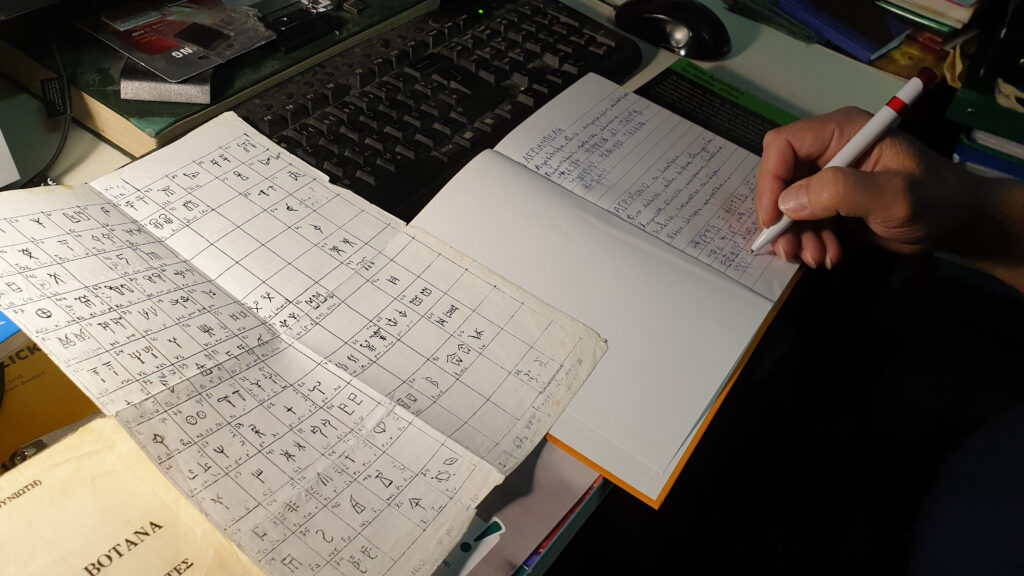
I am very fond of and very happy about this project. I hear the songs from the Grico tradition with their irresistible beauty again and again. They have been famous in Greece as well for many years. However, that is not true for the poets. I find their language – the sound, the pronunciation, the accent – so familiar and sad, as if it comes out from the very heart of the past, a past of a bucolic, rural life in nature that will never return. One more “Island of the Blessed” lost forever? I would like to visit these villages some day, both in Salento and Calabria. Let’s hope my dream will come true. Now that I think about it, in my life I have always sought to find such mythical “blessed islands”.
Maybe all people do the same, each one in a way of their own. One of my first of these was Arvi, on the island of Crete. Later it was Horto, on Mount Pelion, near ancient Spalathra and ancient Olizon. My family too, is constantly one. Later this “Paint Box” was added. And what about a “Music Box”? I love music as well. Maybe more than painting. I believe these “blessed islands” are very near sometimes and tangible. We don’t have to look very far away. But what we need most of all for sure in order to find them is: to be free…
Updated on March 20, 2021 by Garrett R. Bruner. garrettbruner@utexas.edu
February 5, 2021
An Overview of the PASP Archives by archivist Garrett Bruner
Updated on February 5, 2021 by Garrett R. Bruner. garrettbruner@utexas.edu
January 27, 2021
All Bennett Correspondence Now Online – A Report
by Jared Petroll
Introduction
Now online are the remaining items of correspondence from the Emmett L. Bennett Jr., collection at the Texas ScholarWorks (TSW) online repository at our Program and Aegean Scripts directory. These make up a miscellaneous set of approximately one hundred and twenty five items, consisting of correspondence with authors whose last names end with the letters A through M. The correspondence spans the period from the early 1950s up to the mid-1980s and captures the broad range of people with whom Bennett worked throughout his life. Topics span the vast interests of Bennett’s professional life, from the publication of the still chief bibliographical journal for Mycenaean studies and Aegean prehistory Nestor (now published on-line at the University of Cincinnati), to his readings of the Pylos tablets, to the academic year (1958-59) he spent as a faculty member in the department of Classics at the University of Texas at Austin. My specific task (completed remotely due to COVID-19 distancing) was creating and reviewing the metadata to these letters, a task that meant reading through each item and following PASP and TSW guidelines for completing them consistently with our other projects.
Though I was introduced to Bennett’s work and life from other PASP projects and coursework on Aegean scripts, I had mainly related his work to the decipherment of Linear B and little else. While he is known as “the Father of Mycenaean Paleography,” I lacked a full understanding of what went into earning this title; however, working closely with this series of correspondence has helped me to appreciate more fully Bennett’s work on Linear B, contributions up to and after its decipherment, and his serious collaboration with his colleagues.
Letters With Mabel Lang

In this batch, over fifty items of correspondence are with the archaeologist Mabel Lang, who taught throughout her career at Bryn Mawr College. Famed for her work on the Athenian agora and Ancient Greek history, she began her early career assisting Carl Blegen with the publication of then recently excavated material from Pylos, including its frescoes and Linear B tablets. Spanning for about ten years from 1957-1968, most of her items of correspondence concern how her and Bennett were studying and interpreting the new Linear B tablets that were being uncovered in the yearly excavations at the site on Ano Englianos, their thoughts on how fragments joined with each other, and the paleography of signs.
In a letter from Lang to Bennett dated January 31st, 1960 (see above), she describes how the work often included sifting through boxes of tablet fragments, even though some of the items “never had numbers (seasonal) written on them and [were] lumped together in the boxes (which often ha[d] contradictory inscriptions).” Then, like a 5,000-year-old puzzle, they had to fit them together based on their findspots, shape, paleography, sometimes even the wicker-basket markings on the backs. They also had to photograph some of the tablets. Despite these challenges, their attention to detail and appreciation for precise, well-grounded research are manifest in their writings, where they record some of the earliest readings of the Linear B tablets post-decipherment. One sees such dedication below, in a letter from October 23, 1958 from Emmett Bennett to Mabel Lang, where they also begin some of the earliest work in Mycenaean paleography, discussing sign variants and scribal hands to identify which fragments fit with each other:
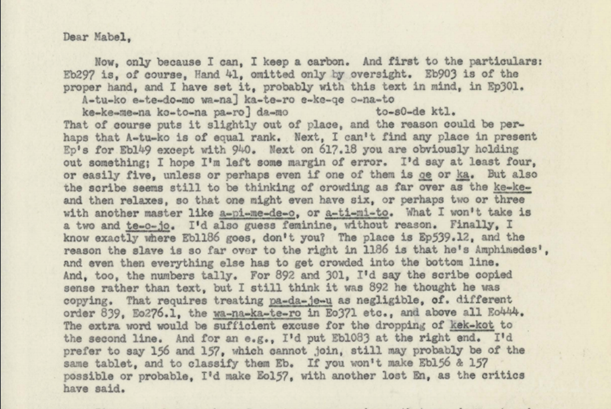
In addition to their research, Lang wrote Bennett about historical moments in their field and the reception of different publications they completed. In their letters, Lang’s style and personality shine through. In one letter, dated August 28, 1964, about the discovery of Theban tablets (see below), Lang exhibits her cleverness, the professor writing that she got away with a very early reading of most of the tablets because “the girl in charge did not know ‘til too late that I could read them.” In another letter, Lang jokes that she thinks Bennett’s ‘Flora Stamps’ are a good trademark that could set a fashion. She admits in the same letter that she has been getting more acknowledgments since the publication, “most notably from John Chadwick, who comments rather most extensively. I suppose he can’t help being slightly condescending: ‘While not agreeing with all your suggestions, I think you have made a good job of the publication.’” Lang’s humor, wit, and persistence in the pursuit of knowledge were refreshing as I read the series, letter by letter, in order to complete this project. They capture Lang’s vibrant personality, opinions and convictions, frustrations and dilemmas, and her sense of humor.
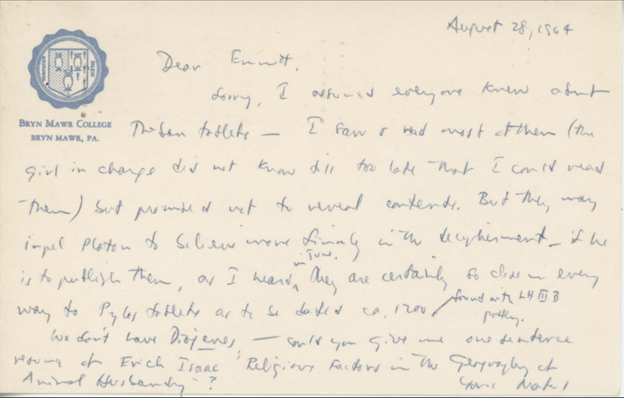
Though Lang was a devoted scholar, traveling the world, she was still involved in inspiring others to pursue archaeology and study. This comes to light in further in a letter dated October 15th, 1965, where an elementary student thanking Lang for being allowed to attend her lecture at a local high school. She provides drawings of their favorite things that Lang talked about, a deer fresco, a throne, and some interesting fresco patterns, and writes that she wishes she could be an archaeologist at Pylos. While we do not have Lang’s reply, one can observe how much of an impact she made on this student in particular and, in extension, her love for inspiring and exciting others about archaeology.
Bennett at the University of Texas at Austin
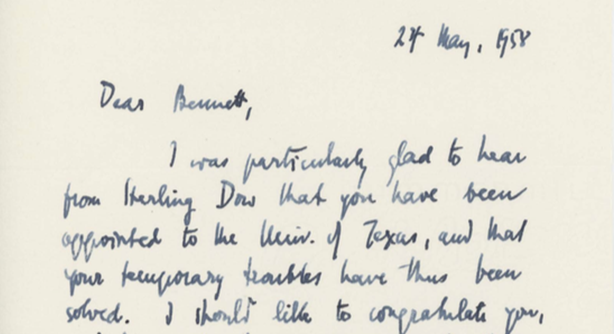
While Lang’s correspondences made up a large portion of the collection, there were other writings as well that document the turning points in Bennett’s life. Noteworthy is a letter from Evelyn Blyn dated October 10th, 1958, congratulating Bennett for his hiring at the University of Texas. His position was brief here, lasting only from 1958 to 1959. Yet, through serendipity, his writings found their way back to the university now in the PASP archives founded by one of his students, Tom Palaima.
Blyn’s letter is not the only one congratulating Bennett. In another by Victor Ehrenberg dated May 24th, 1958, the author writes “I am particularly glad to hear from Sterling Dow that you have been appointed to the Univ. of Texas, and that your temporary troubles have been solved.” The mention of “temporary troubles” concerning his appointment grabbed my attention. What sort of troubles? Making ends meet? I found another letter, from Albrecht Goetze, that reads “It was nice to hear from you and that you have found a new home down there and are continuing your work in Minoan,” the word choice once again: continuing work? Was this ever at risk? Curious, I looked at Lang’s correspondence again and made the connection in a letter from March 12, 1958, advising Bennett on whether he should accept a one-year appointment or a day government position. In it, Lang asserts that he must not “put [him]self in a position where [he] will have to give up Mycenaean for even a couple of years unless there is absolutely no alternative,” and that “a government job taking eight hours a day would seem preferable to a day and night involvement with Roman coins.” While the latter correspondence is likely referencing an employment opportunity aside from the University of Texas, these correspondences seem to suggest that Bennett was facing a transitional period in his career when he moved from Yale to UT and finally to the University of Wisconsin–Madison, seeking a position that would allow him to continue his work, even if a temporary one. This is also confirmed in another letter (dated in the same period, on March 14, 1958) between Carl Blegen to Emmett Bennett, where Blegen advises Bennett on the possibility of shifting careers from Linear B to Roman numismatics. Thankfully, Bennett did not change his interests. His short position at our university might have preserved his career in Linear B, as he soon after accepted a tenured professorship at the University of Wisconsin at Madison as a permanent fellow in the Institute for Research in the Humanities, where he worked for decades on Aegean scripts until his retirement.
Conclusion
These items of correspondence complete the digitization of the corpus of the Correspondence series from the Emmett L. Bennett Jr. collection, started as early as 2012 and continually worked on by former PASP research assistants and archivists up to this day. They join the near 1,000 items from this series already online at Texas ScholarWorks, of letters with figures like Carl W. Blegen, Michael Ventris, Alice Kober, John Chadwick, among many other luminaries.
Working with metadata in this collection has reflected the beauty of the archive in several ways to me. Primarily, it underscored the importance of primary sources in understanding historical figures and their work. In my case, Bennett and Lang’s correspondence helped me understand with much greater depth their tone and voice when collaborating, interpretations of events in their lives, and personalities. It helped me realize that, before working with the collection, I had already subconsciously made assumptions of the type of person that Bennett and Lang would be: aloof though ingenious. Constructing narratives of behavior based on how society and culture present academics to be, humans do this often. It is a dangerous habit, especially for scholars, who examine and communicate the history of the world to the public. Hence, above everything, I learned the importance of psychology in the archives, of those I study and my own. The importance of listening before evaluating, of humanity in academic research.
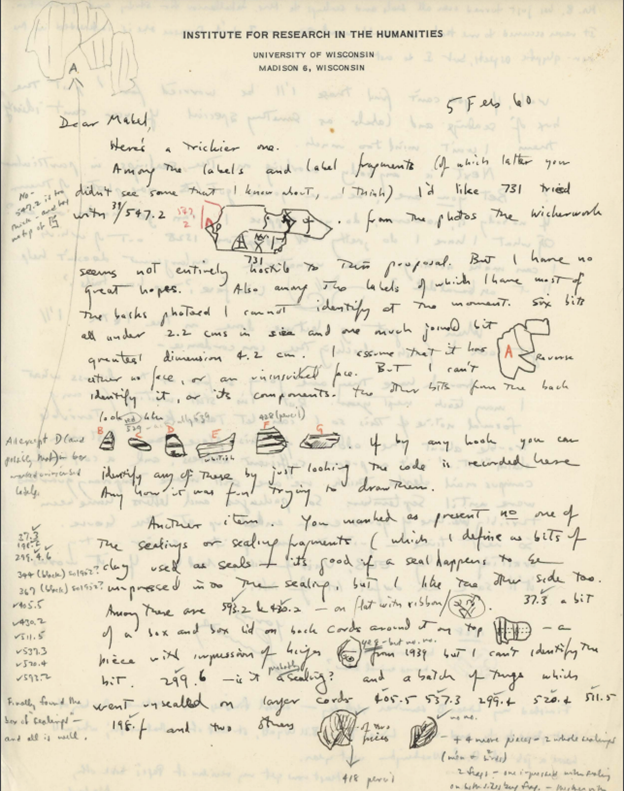
Updated on January 27, 2021 by Garrett R. Bruner. garrettbruner@utexas.edu
November 8, 2020
Journey to Alice – Exploring the blanks of Alice Kober’s life within creative writing
by Regina Dürig
Regina Dürig researched the life of Alice Kober at the PASP archives in the autumn of 2017. She has recently completed her dissertation on that research, “Deciphering the Silence: A Literary Journey to Alice E. Kober”. Regina is a Switzerland based writer and performer, and closely collaborates with the musician Christian Müller in the experimental story & sound duo Butterland and with artists from other disciplines, notably with visual artist Patrizia Bach. Regina is an adjunct professor for creative writing at the Berne University of the Arts/Swiss Literature Institute and is finishing her novel “Federn lassen” which will be published in spring 2021.
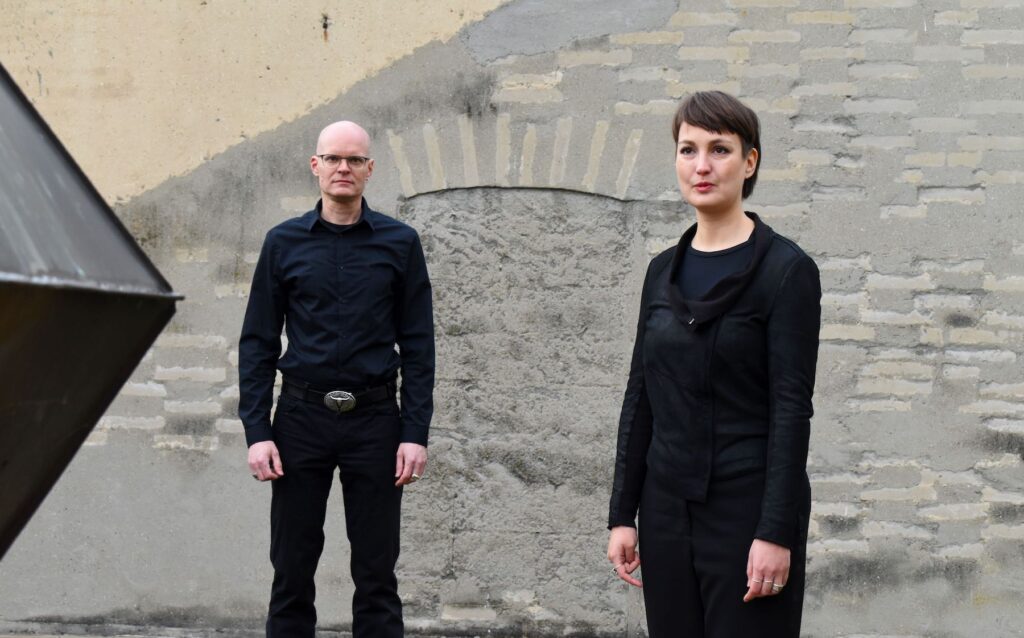
On the last day of my month as visiting scholar at PASP I found a notebook of Alice Kober in which she had pencilled the words (in German): “When grass has grown over all the good things, for sure some camel comes along to eat it all away.” It was a slight shock to me as it seemed these words had been aimed directly at me almost a century ago, clairvoyant and ethereal. Me: the writer who came to Alice Kober’s archive to leave no sheet of paper unturned, to find whatever tiny hints there were in order to get to know her better, to come across stories yet untold. (She must have remembered the saying incorrectly or she varied it deliberately: in the original it’s not “all the good things” but “one bad thing”.)
Warmth & compassion
It took me a long time to truly embrace the fact that I am, indeed, a camel: I am not a classicist, I am not an archaeologist, I don’t even know ancient (or modern) Greek. What am I, then? A writer, that is to say, a person who is good at reading both writing and people. I am cautious and meticulous. In this, I hope, Alice would approve of me, of me searching for her. But I had to invent, I had to guess a lot. And I could feel her frowning on me. For almost two years I couldn’t write at all. Then, after re-reading all the books that mention Alice Kober, her methodology and her achievements, I became angry. Why is her gentle and caring side almost always brushed aside? Why can’t we imagine that a brilliant mind is lodged in the warmth of a compassionate body?
Then, one day in early 2019, I placed my hooves on the keyboard. It did feel clumsy at first, but then I got used to it. I finally was ready to write, stomping furiously, write about all the little details that I had found in the correspondences and also about my imaginations they sparked. It didn’t matter anymore how correct my writing was. What mattered was that it was compassionate, that it acknowledged what can be known and what cannot, that the language itself was taken into account, it’s potential of overcoming habits of ignorance:
“[…] without reducing this gesture [of communicating with another subject] to passing on some information, we must change our way of talking, our use of words—we must be attentive to use words that in themselves conserve life and pass it on instead of passing on only information. We must use a language that remains breathful, alive, sensible.” (Irigaray 2002: 87)
Fragment: The Cat
Alice was that kind of girl that would play hours and hours on her own. The only thing that made her come to me was being hungry or just wanting to eat something. She liked apples cut into pieces. But she hated cut apples when the apple had been peeled. She had this phase, that must have been before school, when she was played at being a cat. But because it was Alice, she was not playing at being a cat, she was a cat. She wouldn’t use any words, she answered in purrs. Ferrie wasn’t too fond of childishness of that kind. After a while he ignored her. She could rub up against his leg for as long as she wanted, but he didn’t pet her, didn’t pick her up, even though Alice was his princess. He’d buy her dresses, so beautiful that I didn’t want her to wear them. So expensive, so delicate. But he insisted. I don’t really know where he got the money from or what he did to get them. Sometimes I thought, well, I don’t grow out of things, I could do with something nice too. But that just didn’t interest him. She was his little doll. I started to worry that Alice would think her father didn’t like her anymore. So I begged her to stop being a cat, to stand up straight, to talk, to smile for Ferrie’s sake. But she looked at me with this cat gaze. You know the way cats look: with their little triangular heads tilted, the way in which you have no idea whether they understand what you are saying and just don’t care, or if they really have no idea what you want from them. When Ferrie went off to work, I put a little bowl of cream on the kitchen floor. I couldn’t let the child starve, could I? She did it for so long, it must have been several days in a row, not answering, not blinking, that I began to think she had suffered a concussion or something or had gone deaf. Things happen faster than one might think inside those little heads, and I took her to our neighbour who had been a doctor back home. Alice would climb up to the fourth floor on all fours. She would lick the backs of her hands while neatly sitting on the doormat. Mr. Cramer examined her, but she wouldn’t answer him with words either. He said that Alice was fine, but that she was a cat now and the only advice he could give me was to adjust her diet. At least once a week she needed to eat a mouse or bird or a rat. He asked me if I had traps in the house and I said yes. He said: “Try to catch them alive, cats like to play with their prey before they eat them.” This was too much for my poor little Alice. She stood up with an awfully grim look on her face and said: “You can’t be a doctor if you can’t tell the difference between a girl and a cat.”
Then she walked home with me and has remained my little girl ever since.
Writing within
Roland Barthes stated in his 1967 article “From Literature to Science” (in which he was addressing the debate of what was being taught at universities and what wasn’t) that science and literature are, while sharing certain methods and aims, fundamentally different in their way of approaching language: “science speaks itself; literature writes itself; science is led by the voice, literature follows the hand; it is not the same body, and hence the same desire, which is behind the one and the other.” (Barthes 1967: 5)
While science needs and depends on language, it does not take place in language itself; science uses language to communicate the ideas or facts found with other instruments. It doesn’t question language. This means that literature “is alone today in bearing the entire responsibility for language; for though science needs language, it is not, like literature, within language.” (Barthes 1967: 5). I read this thought as a logical utopia, which does not mean all research must be writing, but writing must, if one follows the simplest means of science, namely logic, be or become part of the discourse in the sciences. What Barthes demands of language is self-confidence and subversiveness, right up to the disintegration of the essential concepts of our culture:
“Language is the being of literature, its very world: all literature is contained in the act of writing […]. Ethically, it is solely by its passage through language that literature pursues the disturbance of the essential concepts of our culture, ‘reality’ chief among them. Politically, it is by professing (and illustrating) that no language is innocent, it is by employing what might be called an ‘integral language’ that literature is revolutionary.” (Barthes 1967: 5-6)
As a trained and published writer, I follow the hand when I write, and also in doing research (writing my PhD thesis about the exploration of Alice Kober’s archive) I have a writer’s body. This is to say, my aim is to establish an in-between-space which encourages thinking and working within the language, balancing or expanding the writing into a dialogue with texts falling in Barthes’ category of science.
Obviously, time has passed since Barthes’ statement of the separation between science and literature, and today we see many approaches which strive to bring them closer together (autoethography, for example, or more artistically driven approaches to language based research). But the question still remains: How can those two bodies meet without destroying the world “which is proper to each one”? (Irigaray 2011: 112)
Fragment: Asleep
Alice was the kind of child that never liked going to bed, apart from at family parties. When we had my sister over with her children and everything was loud and a mess, Alice would, after eating as much cake or marillenknödel as we could give her, silently disappear. You’d never see her leave; at some point you’d just notice that you hadn’t seen her in a while. Her cousins were making jokes about Alice, but she didn’t mind. She would put on her nightgown, brush her teeth, comb her hair and curl up in bed, no matter what the time of day. I couldn’t get her out, not for anything in the world. And a part of me didn’t want to get her out: a part of me enjoyed that, for once, it was effortless to get her into bed. From her youth, she just wasn’t tired. Not like other kids who want to stay up to play or be with the adults but, in fact, are so exhausted that they finally fall asleep sitting at the table or tying their shoelaces. No. Alice was wide awake. Later on, as a school girl, she would lie down without making a fuss. When she was younger, bedtime was the only thing that made her cry. She didn’t cry when she fell, she didn’t cry when Willie hurt her in his clumsiness or rage, she didn’t cry when she didn’t get what she wanted. When I went to bed, she was almost always still awake. I’d ask her what she was doing and she said she was sleeping. This was said completely truthfully. She thought that lying in bed and being bored was actually what sleeping was. I don’t know what thoughts went through her little head for all those hours. I don’t know how much she slept, because I myself am a good sleeper. Ferrie was too. I don’t know where she got it from. When she was six or seven and her teeth started to fall out, she’d spend the nights wiggling them. She did it even with teeth that weren’t quite loose, she’d just decide on which one was next. She seemed to like the pain that came with it. Alice was the kind of child you never really worried about, but you wondered a lot. Where did all those ideas and habits come from? I still have no idea. Not from us, most certainly, and not from other kids, because she didn’t like to be with them. The only one she liked was a boy from the neighborhood who was a bit slow. She was very gentle with him and talked to him a lot. When I asked her what they were talking about, she of course refused to tell me.
Being an anarchivist
In his 2015 article “AnArcheology for AnArchives: Why Do We Need— Especially for the Arts—A Complementary Concept to the Archive?” Siegfried Zielinski unfolds his concept of the ‘anarchive’, a term he has coined to describe artists’ archives—stacks of works, references and material organised in a way that follows personal principles, work-process-logic or available space, rather than externally accessible systems.
“They [anarchives] do not, however, lay claim to leadership. Nor do they claim to truthfully know where things come from and where they may be headed to. The origin is and remains a trap. Anarchives do not follow any external purpose; they indulge in waste and offer presents. Basically, they are indebted to a single economy, that of friendship. And friendship, as Georges Bataille would have it (1971), is characterized by an acute feeling of strangeness in the world, which we occasionally share with others.” (Zielinski 2015: 122)
While the Kober papers at PASP are absolutely organized, the concept of the anarchive resonates with my research insofar that I was the prefix of anarchy in the archive: I used it for my own logic’s sake, I restructured the items in my memory and in notes to serve my process and purpose. I, as an artist, became an anarchivist amidst the neatly labelled boxes. I, too, am indebted to the economy of friendship, whose currency is my “own strangeness in the world”. My mindset, with which I immersed myself in the Kober archive, was from the beginning gentle and attentive, but not uncritical, not uncritical of myself, too, of my own position. What drew me to Alice was her strangeness in the world in which I saw my own strangeness, although mine takes a different shape.
The idea of the anarchive recognises the value of alternative propositions, of simultaneity, and the absence of power. I, as an anarchivist, did so in my own work too. I followed my own thoughts and the inspirations I got from the material. I allowed myself to get lost, to lose or deliberately misplace ideas and preconceptions.
Fragment: Curious and Tired
It was a perfect spot: slightly cooler air, and some shrubs smelling of a tangy shade of green and a rock smoothly washed out by the millennia into the shape of a recliner. Alice went up there every night while the others had their after-dinner drinks, smelling of fire inside and out. She took a book with her, but never opened it. It was more a prop for the others to not question her, let alone follow. Her muscles were so sore from kneeling, bending and digging that her body felt like one of these collapsing donkey toys, held together with hot wire instead of numb elastic. There were so many stars up there, it looked almost like a mistake. Alice enjoyed drifting away a little, the wind still dry from the heat covering her like a blanket. From time to time laughter from the camp or shrieking voices, someone answering a coyote in the distance. It took a while until the steps she heard really reached her, became a part of reality. Unstable steps, sliding, little rocks leaping off.
“I’m fine,” Alice said into the darkness. The steps stopped.
“Good, good,” said an exceptionally deep voice, giving away who was climbing up the slope. “We were wondering if we could bring you to join us? At least for the last evening?”
“Thanks, but I’m fine, really.” Alice didn’t get up, but placed the book in her lap in a way that suggested she had just put it down. “I’ll be down there in a minute.” Now Marcello stood in front of her, the legs of his trousers covered in red dust.
“The moon is bright, but not that bright,” he said, pointing at her book. “Why are you avoiding us?”
“I just don’t like groups, that’s all. Nothing personal. Besides, it’s so calm up here, back in Brooklyn it will seem like a dream. I’m just taking it in, storing it.” Marcello made a sound that could have meant anything. Most probably he was mocking her, but Alice didn’t care. That chunky ex-frat boy who was so used to being the centre of the world, he would mock gravity if he could.
“What is it that you pretend to be reading?” he asked, kneeling down next to Alice’s millennia old resort, balancing on the balls of his feet.
“The woman that wants to be left alone,” said Alice, turning the book so that he couldn’t see the cover anymore.
“Chandler,” said Marcello. “Good, good.” He kept balancing, looking over the canyon. With another inconclusive sound he sat down in the dust, hugging his shins. “I hear you are a curious woman,” he said, glancing at Alice from the side. Her recliner momentarily turned into stone and started to hurt her back. She wanted to get up, but she needed space to maneuver herself out of her cavity.
“Curious and tired.”
“Come on, you can’t be that detached. Help this oafish mind out and tell me about your work. You might be surprised to find that other people care.”
“Really, this is neither the place nor the time for me telling you about deciphering an ancient script. Plus, you probably know almost everything already, as you are an archaeologist and I am not.”
“But I don’t know you,” Marcello said, “you odd pot. You kept hiding from me the whole time. Deep in the ground.”
The thing with a really comfortable seating is that you are either helped up by a friendly hand or roll yourself onto the side, gracelessly breaking the spell of weight.
“Stay,” said Marcello, “please.” He moved his body in front of Alice’s and brushed her hair out of her face with the back of his hands. Alice was not so much in shock at him as she was at herself. Her skin welcomed him, her muscles betrayed her.
“Kiss me,” he said and moved away, making room for the canyon and all the stars looking down on Alice. He stretched out his hand to help Alice up. Her bones betrayed her, moving her hand towards his.
“No,” she said, now standing in front of him. “I don’t…” His fingertips softly on her collar bones and the back of her neck, not pushing her, not pulling her. Marcello stood perfectly silent, his eyes on Alice. At this moment and many years later too, when Alice revisited this scene in her mind, she couldn’t find an explanation for why she did what she had done: She had put her forehead on his sternum, bringing space between the length of her body and his. And when he put his hands on her waist, not pulling her, but ever so warm, she moved against him and she did what he had asked. A part of herself, from afar, wanted to recoil from him when his tongue touched hers, but the majority of Alice’s body stayed right where it was, feeling what it felt. Just before Marcello tried to unbutton her blouse she pushed him away, and produced a “No” that sounded like one.
“Good, good,” Marcello said, “a respectable woman in the wilderness.” Alice started to run downhill, time and time again sliding. Little rocks leaping away into their coverings. When she saw the campfire she stopped to check her clothes. She wanted to close that one tell-tale button, but her hands were shaking so much that she couldn’t even feel the hole. Alice sat down and waited in the dark until everybody had gone to sleep, sneaking into the women’s tent enveloped in darkness. Now her skin was sore too.
Looking back
When I write Alice’s name, I mistype it often. One time, when I was looking online for that one photograph of Alice as an adult, the one that was taken for the article about the Guggenheim fellowships in 1946, I found an entry for a picture of “Alice Korber” in the Chaco Canyon Old Timers Reunion Oral History Project Photograph Collection, an archive that has never come up in my search before and wasn’t referenced in the Kober Papers. I contacted them and only a couple of hours later they mailed me back. It seems that only when my search is flawed or somehow erratic do I actually end up finding something. And there, without any warning, Alice is looking at me.
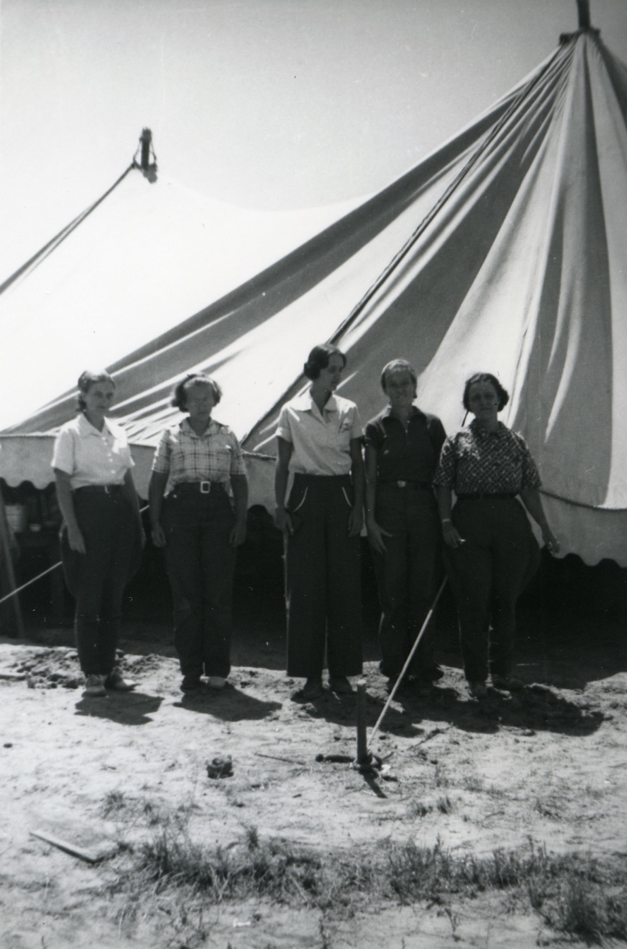
From left to right: Helen Hewitt, Delphine McCready, Pauline Vonnegut, Virginia Hunter, Alice Kober. Courtesy of: Chaco Canyon Old Timers Reunion Oral History Project Photograph Collection 1935, 7 photographic prints (8.5 x 12.25 cm.), PICT 000- 579-0003, Special Collections and Center for Southwest Research, University of New Mexico Libraries.
Even though all five of are standing next to each other, you, Alice, are clearly in front. I wonder if the photographer had planned to arrange all five of you in between the ropes, but you came late and didn’t fill the gap that was left for you between Delphine and Pauline, you just stood where you stopped walking. In your right hand a cigarette, in your left hand a little pouch—maybe the cigarettes, maybe something else. I try to zoom into the picture, but the closer I look the blurrier it gets. Do you also hold your folded glasses in the hand with the pouch? And if you have taken your glasses off, was it vanity? Habit? Obligation?
Or did you want to refuse to be in the picture because you knew that you wouldn’t like how the metallic silver would catch your body, your face from the light and keep hold of it? And then the others wouldn’t stop asking you to join them, either for emotional reasons or for the sake of documentary completeness? Or was it to get it over with quickly, to avoid any further attention, and so you caved? You are 29 years old, and your lips are tightly closed. You are 29 years old, and your arms don’t drag your shoulders, your upper body into obedience’s collapse like Helen’s, Delphine’s and Virginia’s. You are 29 years old, and your hands are full.
PS:
When I write your name, I mistype it often.
My fingers, full of haste, write Alive.
References
Barthes, R. (1967). From science to literature. In: Barthes, R. (1989) The rustle of language. Berkeley & Los Angeles: University of California Press, 3-10.
Irigaray, L. (2002). Why cultivate Difference? Paragraph, 25(3), 79–90.
Irigaray, L. (2011). How can we meet the other?, in: Sencindiver, S. Y./Beville, M./Lauritzen, M. (eds.), Otherness. A multilateral perspective, Frankfurt am Main: Peter Lang, 107-136.
Zielinski, S., & Winthrop-Young, G. (2015). AnArcheology for AnArchives: Why Do We Need—Especially for the Arts—A Complementary Concept to the Archive? Journal of Contemporary Archaeology, 2(1), 116-125.
Updated on November 8, 2020 by Garrett R. Bruner. garrettbruner@utexas.edu
October 27, 2020
The MASt@CHS project
By Tom Palaima
FSA 2007- MacArthur fellow 1985-90
Robert M. Armstrong Centennial Professor of Classics
Director, Program in Aegean Scripts and Prehistory
On November 8, 2019, I presented a seminar on Tn 316 and the Ta tablets at the Harvard Center for Hellenic Studies at the invitation of Greg Nagy and on the occasion of Mycenaean scholar Rachele Pierini being in residence as a junior fellow. You will see in the recent summary that Rachele sent out that what is now known as MASt@chs is celebrating its first birthday. Our first on-line report contains contributions and discussion by Palaima, Pierini, Elizabeth Barber and Brent Vine.
The next meeting on Friday November 6 has main contributions by Vassilis Petrakis on “The relationship between stirrup jars, kingship, and the economic and political landscape in Crete” and Anne Chapin on “Textiles in Aegean Bronze Age Mural Paintings” and a minor contribution by me on “Observations on Terminology and Ideology for Joining in Linear B and Later Greek.”
The idea is to promote open discussion of significant work in progress with publication of quick detailed summaries so as to inspire feedback and further thought.
The MASt@CHS project
by Rachele Pierini
Coordinator and Chief Editor
Hosted by the Harvard’s Center for Hellenic Studies, MASt is a new project aiming to boost discussion and debate among specialists on topics and problems in Bronze Age Aegean studies and then to disseminate the latest results to the wider audience of classicists. To achieve this, the MASt project has designed a twofold strategy: specialist seminars up to 20 participants and substantial reports on the online journal Classical Inquiries.
MASt, which stands for Meetings on Aegean Studies, has been co-founded at the CHS by Gregory Nagy, Tom Palaima, and Rachele Pierini. Pierini acts as Coordinator as well. The project took its earliest steps in Fall 2019, when Pierini, as Research Fellow at the CHS, and Nagy, as Director of the Center, organized a seminar that Palaima offered on November 8, 2019. The fortunate presence in the same period of scholars such as Roger Woodard, Leonard Muellner, and Eric Cline has quickly resulted in on-line Zoom reunions to discuss ongoing research. In just a couple of months, our friendly reunions have grown so much that a more structured framework was required, while maintaining the friendly and collaborative atmosphere of the earliest encounters. A signature element of the CHS, cooperation has played a key role in the construction of this framework as well. Pierini’s discussion with philosophy research fellow, Simona Aimar, for example, resulted in ideas for the project, including the use of an acronym as a name. At the start of 2020, MASt@CHS became a reality.
The MASt seminars now take place online every quarter (January, April, July, and November). Our community networks with a wide array of international speakers from all over the world. In addition to the already mentioned Nagy, Palaima, Pierini, Woodard, Muellner, and Cline, our steady participants include Brent Vine and Sarah Morris (UCLA), Marie-Louise Nosch (Denmark), Richard Firth (UK), Georgia Flouda (Greece), and Doug Frame (CHS). In a two-hour time frame, we usually have up to three speakers presenting their ongoing research. Subsequently, we publish on Classical Inquiries substantial reports of our discussions. Pierini and Palaima act as editors.
Here, for example, is our latest report of presentations and discussion by Pierini, Palaima, Elizabeth Barber and Brent Vine: https://classical-inquiries.chs.harvard.edu/mast-chs-friday-june-26-2020-summaries-of-presentations-and-discussion/. Also, here is a piece that our MASt seminar inspired Nagy to write: https://classical-inquiries.chs.harvard.edu/about-a-perfect-start-for-a-world-wide-web-of-song/.
On November 2020, MASt@CHS will celebrate one year of seminars on Mycenaean Studies.
Updated on October 27, 2020 by Garrett R. Bruner. garrettbruner@utexas.edu
September 11, 2020
This is Retaliation, Not Justice: Speaking Out After 9-11-2001
By Tom Palaima
§1 On September 11, 2001, for my junior Plan II seminar on Stories of War and Violence, I had visiting me in Austin a noted oral historian, the late Joan Morrison, whose oral history of the 1960’s, From Camelot to Kent State, had just been reissued by Oxford University Press. There was supposed to be a book signing that evening in the UT Coop on Guadalupe just west of the UT Tower and Student Union. Despite the events of the day, we showed up at 7 PM for the book signing, but no one except the Coop employee charged with organizing book signings did. I remember talking with Joan. We both knew to expect the worst. And, looking back nineteen years, I can say now we got something close to that.
§2 Our memorial to the 100th birthday of John Chadwick contained a letter that Chadwick (December 23, 1973) had written to Emmett Bennett during the period when the Greek military junta was in power and would eventually employ a tank against student demonstrators at the Polytekkneion in Athens. Chadwick, unfathomably to me, although I admit to finding certain forms of British rhetorical stances not to my liking, complained that “the student riots followed by a coup” had “curtailed his lectures” and were “a distinct bore.” Be that as it may, Chadwick and Bennett had served in code-breaking operations during WWII. Michael Ventris served as a bomber navigator—anyone flying missions over Europe had a 50-50 chance of surviving. One revered professor who taught me Thucydides twice, ancient historian N.G.L. Hammond, told us stories of times he was with the various partisan factions in northern and northwestern Greece during the Nazi occupation. Dangers and brushes with death were routine. Noted Aegean prehistorian Spyros Iakovidis once reminisced with me about the joyous celebrations he was part of when his partisan forces joined in the liberation of Ioannina. All these men knew what war truly was and acted honorably and bravely in defense of what we consider western freedoms.
§3 What we were called on to do around 9-11 was trivial by comparison. I felt an obligation somehow to maintain an informed, historically based, but nonetheless passionate, commitment to argue against the desire for vengeance that would lead to deploying US military might against poorly chosen targets and lead to a senseless loss of lives, a waste of resources that could be used to better humanity, not debase it, and destabilize a region whose problems seem quite beyond solution at least by our historically and culturally ignorant leadership at the time. I also felt that the small part of the American public that I could reach needed to know that we had not been the nice guys or champions of democratic principles and the spirit of freedom in our foreign policy 1947 onward. (See: https://historynewsnetwork.org/article/12418)
§4 Two years before September 11, 2001, I had started writing reviews and feature pieces for the Times Higher Education (Supplement), which I still do—a forthcoming piece is tentatively scheduled for October 1, 2020. Two weeks after 9-11, myeditors asked me for an American perspective on what was going on. As you may read, I gave them substantially the views that José Melena, whom I consider the greatest Mycenologist in the nearly 70 years of Mycenaean studies, shared with me—and I with him. It appeared on 28 September 2001. We reviewed past American foreign policy and the nature of terrorism and then I put forward my conclusion:
We can no longer control our past foreign policy. We can still control the future. We need to make sure that our ideals control our powerful actions.
§5 On October 26, 2001, I wrote a piece that analyzed what was playing out in what we might rightly call the hysteria of the times. It discussed public reaction to a piece my colleague Robert Jensen wrote about how American foreign policy might make people around the world hate us. I had the good fortune to be aware of a similar piece written by Carlos Fuentes. And I have always in my ears the thunderous and holy words of the Reverend Martin Luther King in his speech courageously speaking out against the Vietnam War in Riverside Church NYC April 4, 1967, describing his country, some of yours and mine as “the greatest purveyor of violence in the world.” Nothing the United States has done since then or post 9-11 has disproven Dr. King’s insight.
§6 Still later in 2004 a new journal of Communications Studies asked Jensen and me to write what turned out to be point and counterpoint views of what went on in Texas with public speech about 9-11 in the period leading up and into our preemptive use of military force in our undeclared war against Iraq, justified on the basis of non-existent Weapons of Mass Destruction and leading to such ghastly human rights violations as Abu Ghraib and Guantánamo Bay and the use of extraordinary rendition and enhanced interrogation.
See also: https://www.cbsnews.com/news/extraordinary-rendition/
AND
AND
https://www.newyorker.com/magazine/2019/04/22/guantanamos-darkest-secret .
§7 In one of life’s ironies, 9-11 is my brother’s birthday. He is today 74 years young. His name is Mike Palaima. He is a United States Air Force veteran who served in the late 60’s. He is a good man and has been a good brother and a good human being.
§8 When I think about senseless wars our country has wasted human lives and precious resources on, I think about how lucky I am that Vietnam did not take my brother from me. I also think of what Henry Kissinger said at the truly pointless Vietnam summit held at the LBJ Library at UT Austin in 2016 (see my review http://www.miwsr.com/2018-057.aspx ):
“We’ve been involved in five wars since World War II, which we in effect have lost…. So if you enter a war, you should do it for objectives you can state, and if you cannot describe objectives you can sustain, you shouldn’t enter it.”
§9 That is Henry Kissinger speaking, not a Mycenologist who most of the time these days feels like Kurt Vonnegut in his later years, “a man without a country,” at least without a country that tries to do the right thing.
Updated on September 11, 2020 by Garrett R. Bruner. garrettbruner@utexas.edu
August 24, 2020
Ciphers, a new play by Bernadine Corrigan about Michael Ventris and Alice Kober, with introduction and suggested background readings by Tom Palaima and an excerpt chosen by the playwright
By Tom Palaima and Bernadine Corrigan
“Introducing a new play about the skew lives of Alice Kober and Michael Ventris” with further readings appended
by Tom Palaima, FSA
§a1 We at PASP are pleased to report that an emotionally perceptive, moving and intellectually engrossing play has been written that explores what we might call the unparallel and relatively briefly intersecting lives of two of the three main figures in the decipherment of Linear B, Michael Ventris and Alice Kober.
§a2 The playwright Bernadine Corrigan (born May 20, 1961) used the Kober and Ventris papers and related materials on-line at PASP, as well as the primary written biographically oriented accounts of the decipherment of Linear B: Andrew Robinson on Ventris (The Man Who Deciphered Linear B 2002) and Margalit Fox on Kober (The Riddle of the Labyrinth 2013) as wellsprings for her play.
§a3 Robinson and Fox both made substantial use of materials in the PASP archives to write accounts of the lives and work of the two founding figures of Aegean scripts and Mycenology.
§a4 Corrigan comes at them as human beings. Her play helps us see how they may have related to one another in reality and in Bernadine’s truly insightful imagination.
§a5 Having lived with and worked on the Kober and Ventris and Emmett Bennett archives for a third of a century, I can attest that Bernadine is not making things up, but opening windows into the minds, hearts and souls of these two giants of script cryptanalysis.
§a6 Having read the play closely and thought about it carefully, I can say this much, without giving too much away.
§a7 As I wrote to Bernadine, her play is superb in getting across who Kober and Ventris were as products of their backgrounds and upbringings and life events and the social and educational systems through which they became their adult selves.
§a8 The exchanges among the main characters strike me as true to their persons. The dialogue, in fact, is understatedly brilliant and well founded upon what the archives and personal witnesses reveal. Bernadine has kindly provided an excerpt from Act II, Scene 2.
§a9 Kober and Ventris are both tragic heroes. They are not grand tragic figures like Oedipus or Lear. But extraordinarily ordinary tragic heroes, like Crocker-Harris in Rattigan’s The Browning Version (see review). They are persons who do not fall from Olympian heights. But fall they do and from high enough up to move us to pity and fear and deep, deep regret.
§a10 Ciphers introduces us to Ventris and Kober and lets us see more than their public selves. It shows us their humanly understandable tragic flaws and many more subtleties than it is decent here and now to point out. This is not melodrama and for the most part it is what it is: real.
§a11 As scene follows scene, the play moves from strength to strength. We look forward eagerly to the time when it can be put up on the stage and we can watch actors give voice to Corrigan’s words. Ventris and Kober will come to life.
§a12 Here follows Bernadine Corrigan’s explanation of how she became interested in Kober and Ventris and how she then pursued her ever-deepening interests. We thank her for following her passion. After that comes an excerpt from her play.
§a13 We recommend the following concise, and relatively easy, informative reading:
Really do read the first five!
https://www.wcwonline.org/Women-=-Books-Blog/kober
https://www.bbc.com/news/magazine-22782620
https://sites.utexas.edu/scripts/files/2020/05/1993-TGP-MichaelVentrisBlueprint.pdf
https://sites.utexas.edu/scripts/files/2020/08/2000-TGP-UnlockingTheSecretsOfAncientWriting.pdf
Alison Fell, The Element -Inth in Greek (2012) a spectacular book by a gifted writer with Kober always in the soul of the central character.
https://www.amazon.com/Element-Inth-Greek-Alison-Fell/dp/1908737026
https://repositories.lib.utexas.edu/handle/2152/15875
https://sites.utexas.edu/scripts/about-pasp/pasp-archives-and-finding-aids/#ventriskober
https://trowelblazers.com/alice-kober-deciphered-at-last/
And of course, Robinson’s and Fox’s excellent books.
How I Came To Write Ciphers, by Bernadine Corrigan
CONTACT: berthomp@btinternet.com
§b1 My path to Linear B is perhaps an unusual one. I originally left school at the age of sixteen and for the next twelve years worked variously as a typist, insurance clerk and playworker, then for eight years as a comedy performer and writer with a small degree of success. I wrote and performed in two plays at the Edinburgh Festival: the first was a hit, the second an unsalvageable flop. Time for a change.

§b2 I fetched up in the office of Justin Champion then Admissions Tutor of the History Department at Royal Holloway, University of London, and presented him with my academic credentials, a copy of ‘When Harry Met Cathy – and Anne and Jane and Anne and Kathy and Cathy’ (the Edinburgh hit; the life of Henry VIII in an hour with a cast of three) which convinced him, recklessly, to admit me as a student. I mention Justin by name as I should like to pay tribute to him: he died last month at the age of 59.
§b3 Many history undergraduates have a firm idea of the period upon which they wish to concentrate but as a ‘mature’ student everything looked good, so I simply started at the beginning. Homer. Hooked. Ancient history for me.
§b4 Fast-forward to 2002 and I had completed my BA in Ancient History and was finishing an MA in Hellenic Studies when I happened to attend Andrew Robinson’s talk and book-signing of his biography of Michael Ventris The Man Who Deciphered Linear B. I found the story of Ventris fascinating and the decipherment itself utterly mind-boggling. I was by then living in Hampstead, as had Ventris, and it was some years later as I was passing his house while walking on Hampstead Heath with a group of friends that I pointed out to them the blue plaque on house’s exterior and told them his story. One of the group said; ‘That would make a good play. Why don’t you write it?’
§b5 As it happened I was at something of a loose end, after having gone on from studying at Royal Holloway to teaching there for a few years and eventually leaving in order to travel more with my husband. I was taken with the idea of writing a play again after a break of almost two decades and set about doing more research. Unfortunately I was no longer affiliated to any academic institution and had no external funding, so lengthy study trips to the USA were not possible, and the Ventris materials at the Institute of Classical Studies are not generally available so I was unable to obtain access to the papers and letters stored there. Consequently my research relied on easily accessible published and digitized materials such those available at PASP, and it was Margalit Fox’s book The Riddle of the Labyrinth which convinced me that the juxtaposition of the working-class American woman Alice Kober and the privileged and well-connected Englishman Michael Ventris would be the backbone of the drama.
§b6 I could not concentrate a great deal on the technicalities of the decipherment for they are simply beyond me. I am no linguist. When I began to write I found the historian wrestling with the playwright. As an historian I am infuriated by the careless handling of facts in historical drama but as a dramatist it is almost impossible to stick entirely to the straight and narrow for that produces not a play but a documentary or a lecture. Consequently I have put words in characters’ mouths which were never spoken – though in my defence, some that were – and some major figures in the real story have been brutally excised for reasons of both dramatic clarity and base economics.
§b7 It is extremely difficult to get a new play by an unknown author staged and if the cast list begins to edge toward double figures, almost impossible. The historian argued with the playwright that if there was no room for John Chadwick or Emmett Bennett, how to defend the inclusion of Theseus and Ariadne? The playwright contended that assuming no knowledge on the part of the audience, some explanation of the basics of Linear B would be desirable without resorting to ludicrously unlikely exposition between characters for whom no explanation would have been necessary:
‘I say Miss Kober, have you heard about Linear B, an ancient language inscribed on tablets discovered by Arthur Evans at the turn of the century in Crete?’
‘Why, yes, Mr Ventris, I most certainly have!’
And so on. Consequently, Theseus and Ariadne appear in Ventris and Kober’s imaginations as innocents in the matter of cryptography. They also provide some light relief, particularly Theseus. I fear there may be more jokes than many purists might tolerate. That was not my intention at the outset as I fully intended to write a serious play about a serious subject but there on the very first page appeared, almost unbidden, a joke – and a none-too clean one at that – so I sighed and accepted the inevitable. I should say that the joke has since been deleted. From the first page at least. This is not to say that ‘Ciphers’ is rolling-in-the-aisles comedy, far from it, as we all know that both Kober’s and Ventris’ lives were not entirely happy and their early deaths tragic.
§b8 Kober’s early life was extremely poor and her professional life was without doubt hampered by her gender; how galling it must have been to see opportunities and plaudits offered to men with a fraction of her intellectual gifts. She desperately wanted to decipher Linear B but died while the solution was still just beyond her grasp.
§b9 Ventris, though financially well-off, was the child of a tubercular father and a suicidal mother and an orphan by the age of 18. His success with Linear B failed to bring him any happiness; he had neither the desire – or, it might be argued, the necessary highly-developed linguistic tools – to continue very much further with the subject and the historical and archaeological aspects of the work didn’t hold much appeal for him. His career in architecture seems to have been driven more by his mother’s ambition than his own, and although he was clearly genuinely convinced at an intellectual level of the need for good modern architecture, particularly after the depredations of World War II, he was a competent rather than genuinely creative architect and by the mid-50s was surely aware that he had been outstripped by his peers.
§b10 It is unfulfillment that is at the heart of the play. The trite and popular assumption that hard work will always produce one’s heart’s desire is no more clearly refuted than in the lives of Ventris and Kober. Both worked tirelessly; neither, for different reasons, was ultimately satisfied.
§b11 I write this in the midst of the Covid-19 pandemic and it may seem irrelevant to hope to produce now a play about a subject that to the vast majority of people is hopelessly arcane and the obsession of two people long dead. Perhaps. The best I can hope is that eventually my play might bring the lives and work of Ventris and Kober to even a few people who were previously unaware of them. For though they were very different, they had in common shining intellects and integrity and used those virtues to plough on with their apparently irrelevant obsession through a time even darker than ours and thus left the world better enlightened than they found it. It is to the enormous credit of everyone at PASP that they too continue to bring enlightenment to a world badly in need of it.
August 22, 2020
An excerpt from the play Ciphers written by Bernadine Corrigan
All rights reserved by Bernadine Corrigan
CONTACT for Bernadine Corrigan: berthomp@btinternet.com
Act II Scene 2
KOBER: I am a professional academic, and everything I do, everything I’ve done for the past twenty years has been directed toward this. All my degrees, all the teaching and examining and marking and the endless faculty meetings so that I can afford to come and do this. But that’s fine – that’s just fine because all of that makes me a professional – not an amateur – and all of that means that I am possessed of an intellectual rigour that you –
VENTRIS: Ah yes, I felt sure we were hurtling toward the second-person pronoun, and there he is.
KOBER: You are doubtless a very clever young man. But you’re playing – you guess that Linear B might be Etruscan: you might as well guess that it’s Swahili. A university education would have knocked that sort of nonsense out of you. You could have come here, to Oxford, to study, to work. I dreamed of that all my life. But you couldn’t be bothered. You are a privileged dilettante.
VENTRIS: Oh Miss Kober, I believe you’re trying to flatter me.
KOBER: I do not find you at all amusing.
VENTRIS: Yes, that is being borne in upon me. I’m sorry, I was merely trying to defuse…
KOBER: Well, it’s too late for that, my fuse is well and truly lit.
VENTRIS: Perhaps you should stand in a bucket of sand.
KOBER: When I got your letter blithely telling me that you intended devoting the rest of the year to Minoan ‘because it isn’t really worth doing in fits and starts’ it made my blood boil. That would be such a luxury for me and it seems so trivial to you.
VENTRIS: So you do remember some parts of my correspondence. I’m sure I had no intention of poaching your corpuscles, and I’m fully aware that I am privileged when so many are not – and the irony is that I would hope that I am a socialist, which would probably see me locked up in America – but money is beside the point…
KOBER: Money is always beside the point for people who’ve never been without it.
VENTRIS: That is a truism.
KOBER: Forgive me. We can’t all be geniuses. What do you expect from the daughter of a janitor but crude truisms? What was it you told me yesterday? ‘Oh Naum Gabo and Marcel Breuer are great family friends of mine!’
VENTRIS: I believe I said I was very lucky that Gabo and Breuer happened to befriend my mother. I wasn’t deliberately dropping names.
KOBER: Where I come from men called Gabo and Breuer run a deli!
VENTRIS: Miss Kober you misunderstand me entirely. I wouldn’t for a moment dismiss the difficulties you face, but I rather resent your thinking that I am merely toying with this. Having said that, I see no reason why I should defend myself to you. And I have no intention of playing a game of ‘who works the hardest.’
KOBER: You wouldn’t win.
Updated on August 24, 2020 by Garrett R. Bruner. garrettbruner@utexas.edu
August 8, 2020
A Love Letter to Cyprus and Its Coffee
By Cassie Donnelly
Cassandra Donnelly is a PASP fellow and PhD student in the Classics Department at the University of Texas. She is writing her dissertation on the Cypro-Minoan script. She thanks the Archaeological Institute of America for funding her travel abroad. Read her first travels in Cambridge last year here.
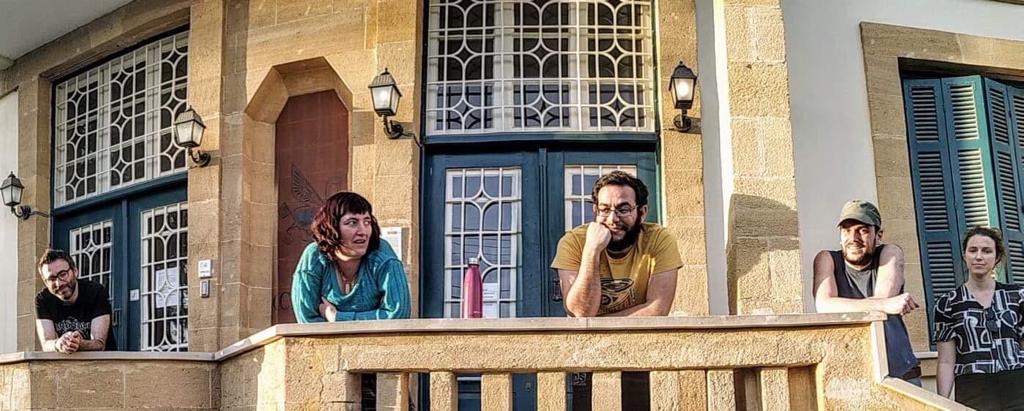
Settling In
When I set off on my year abroad in May 2019 I wasn’t expecting to fall in love. Least of all with Cyprus. I had gone there in late July of 2016 for a week’s work in the Cyprus Museum in Nicosia. I had just been excavating in the small town of Pylos, Greece, and stepped off the plane, bone-tired, to a Deloitte billboard. That first impression stuck. Cyprus is like Greece on free market steroids, I thought to myself with contempt. In addition to its capitalist excesses, Cyprus was incredibly, incredibly hot. From the airport, I arrived to an empty Nicosia. Everyone had already fled its heat, as they do peak-summer every year, for the cooler air of the Troodos mountains. I wandered through old Nicosia’s strange clash of byzantine and bling, exhausted and near delirious from the heat. Every day I would stop by the museum, ragged and defeated, desperately hoping my permit had been received and that today would be the day they would let me see the clay balls and I could finally leave. Little would I have believed then that, when faced with the decision in March 2020 to quarantine at home in the US or Cyprus, I chose to quarantine in Cyprus at the Cyprus American Archaeological Research Institute (CAARI). Because I had fallen in love.
What I love about Cyprus is embodied in its twofold coffee tradition. On the one hand, there is the Cyprus coffee (also known as Greek coffee, or Turkish coffee, but that’s another blog post) tradition and, on the other hand, its espresso coffee tradition. Cyprus coffee is homey. At least for younger people it’s not something you frequently order at a café. Instead, you make it at home for your loved ones and you make it for guests. It’s about hospitality. Cyprus coffee also has a dimension of the mystical to it. How its coffee pours from the container (the brika) as one single mass to form three perfect tiers of foam, coffee, and sediment, in each cup. How the sediment can, in the hands of a fortune teller, come to show you your future. Homey, hospitable, a little bit mystical. In other words, Cyprus. But those three words are not the complete picture. They are complimented by the excesses of Cypriot espresso culture. There are eleven coffee shops in a two-block radius of CAARI. Eleven. It’s not even in the city center. Cypriot coffee shops are not workspaces, but social spaces. They’re places to talk or play tavli with friends for hours and hours on end. The overall coffee standard is high and shops can be quite snooty to reflect this. I have an Italian friend who, in true Italian fashion, says Cyprus is the only country outside of her homeland where she will buy an espresso out. And don’t forget the Frappés and Freddos. Whipped, cold coffee drinks, first made popular in Greece, that are frankly silly drinks, but utterly necessary once the summer temps set in. Homey, hospital, mystical, on the one hand, and social, snobby, and necessarily silly on the other. Yeah, that’s Cyprus.
It took 7 months of living in Cyprus and the quarantine to learn how to make Cypriot coffee. Cyprus coffee is a home tradition and I was living in a hostel, after all. The magnificent Photoulla, who took care of CAARI and became my surrogate grandmother, lovingly made Cypriot coffees for us every Wednesday for CAARI’s “coffee hour.” But still I didn’t learn how to make the coffees for myself. I was contended being served. It wasn’t until Photoulla was forced to stay home by the pandemic that I, lazy boarder that I was, took to making my own Cypriot coffee and, by extension, making CAARI my home.
Learning Cypriot
The key to making Cypriot coffee is patience. At least that’s what the internet directions said. Patience, υπομονή, was one of the quarantine taglines (it’s also good advice for dealing with the Cypriot civil service). It’s the word Cypriot singer Alkinoos Ioannides used to end the comfort ballad he wrote for quarantine called “Together Again,” which he sang along with his school age daughters. We will be together again. Patience. According to Stelios, CAARI’s Cypriot boarder, the key to making Cypriot coffee is to stir it vigorously three separate times. Once when you pour the finely ground beans into the brika, once when the grounds have just begun to heat, and once more just before the concoction starts to boil. It takes persistence. Patience and persistence. The final result, if you’ve done it right, produces the strict hierarchy of foam, coffee, and sediment in each cup.
I love making Cypriot coffee. But it took a while, patience, to get the hang of it. The first time I made it for my quarantine roommates I had not stirred it sufficiently. As I learned, Cypriot coffee needs to be stirred just a little bit more than you think you does. Persistence. It requires persistence. That first batch of Cypriot coffee, though. My roommates’ eyes bulged from their heads as they slurped up the sediment that had rebelled from its place in the cosmic order at the bottom and floated up into their lips. Eventually—through patience and persistence, dare I hammer home the theme further—I learned to make a good cup of Cypriot coffee. As an American, especially one from the northeast, patience didn’t come easy. Nor persistence, for that matter. But I came to love the process of standing, stirring, and serving. I especially like the serving part. Making hot cups of afternoon coffee to share with my roommates, giving the cup with the best foam to the nicest roommate (just kidding) and saving the cup with the worst foam for myself. Reminding myself what the proper hierarchy should be. A meditation on hominess and hospitality.
Telling Fortunes
About six weeks into lockdown, a sister of a friend of one of our quarantine roommates offered to read my fortune. Her instructions were as follows. After drinking a cup of Cypriot coffee, flip the coffee cup onto a saucer covered with a paper towel and leave it there for twenty minutes. After the twenty minutes, transfer the cup to a second saucer, this one uncovered, for another ten minutes. This procedure lets the sediment harden onto the sides of the coffee cup, encrusting it with one’s future. My fortune, according to her, is as follows:
“A project she has in mind will be successful. She will take money soon. A person doesn’t love her. He wants to hurt her with words. Cassie sits together with the person who doesn’t love her. Maybe in an office, we don’t know. She is sad for the person but that person will come to find her and say good words to her. They will travel to meet each other (there is a road). She will go for coffee with the person but not very soon.”
We all agreed that the reading felt a little mystical. Every day I sat together with Stelios in our office, the library. And aside from teaching me how to make a Cypriot coffee, he never said good words to me. About this we all agreed. But where would we travel to meet and where would we get coffee? For my part, I want to return to Cyprus one day. I can think of no better country to get coffee in. I hope that’s the country the fortune is talking about. A return to the homey, hospitable and kind-of-mystical country of Cyprus. I also hope the project it’s referring to is my dissertation project. After a year of working on it, including four months of collecting data at the Cyprus Museum and another four months of library research at CAARI, it’s time to start writing. In the meantime, I can hope my future comes to pass.
Updated on August 8, 2020 by Garrett R. Bruner. garrettbruner@utexas.edu
June 7, 2020
Commemorating John Chadwick’s 100th Birthday
By Tom Palaima
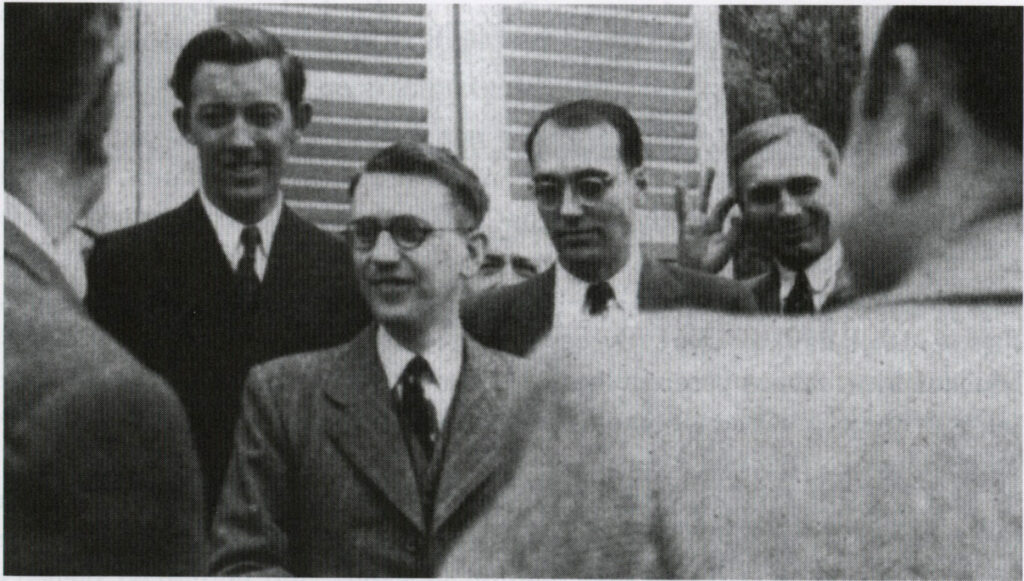
21 May 2020 marked the 100th birthday of John Chadwick, FBA, the closest post-decipherment collaborator with Michael Ventris. The two worked intensely together for four years, according to the truly loving British Academy biographical memoir written by John T. Killen and the late Anna Morpurgo Davies. He was a richly honored scholar who shaped our field through his work, first with Ventris and then alone, on Documents in Mycenaean Greek (1956 and 1973) after first setting it on the right path, again with Ventris, in “Evidence for Greek Dialect in the Mycenaean Archives” in the Journal of Hellenic Studies for 1953. Chadwick’s The Decipherment of Linear B (1958, 1973) and The Mycenaean World (1976) opened the doors of our field to students and the reading public.
In a note of centennial celebration, we direct all those interested in Mycenaean studies to the above mentioned British Academy obituary Proceedings of the British Academy, 115 (2003) 133–165 .
We add here eight documents styled as birthday gifts from the PASP archives and library that reflect the human side of Chadwick’s influence on our field during its first quarter century post-decipherment. These are designed to be somewhat interactive in engaging your scholarly interests. Clicking any image will enlarge them and allow you to download them as files.
Birthday Gift Exhibit A
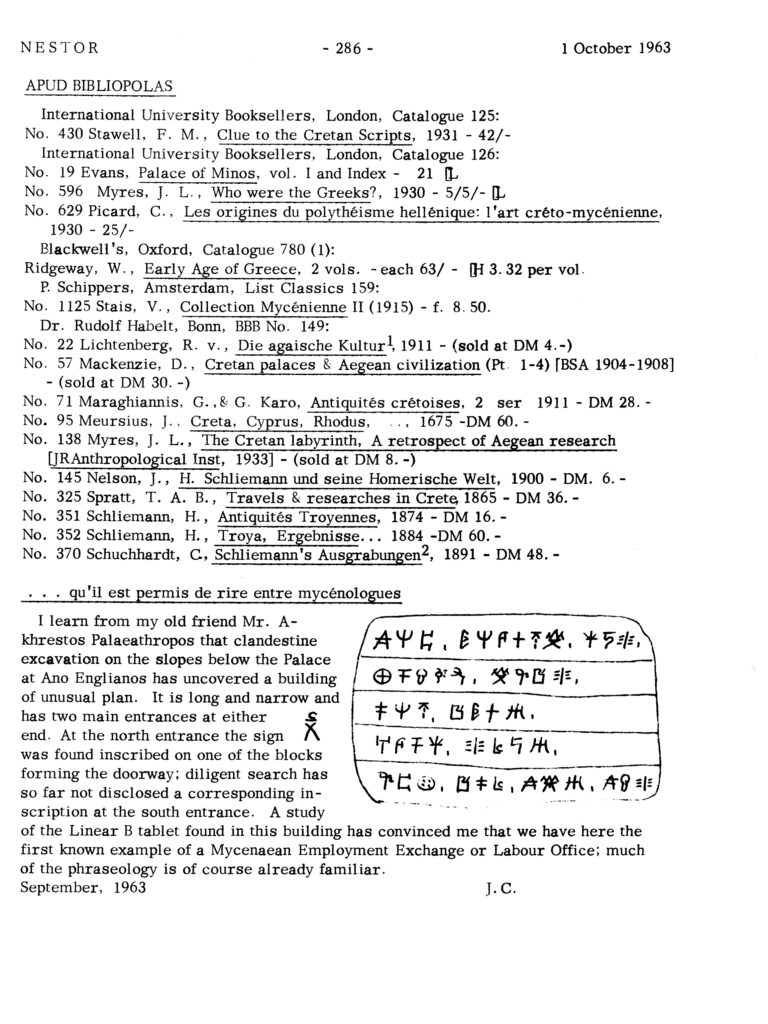
Birthday Gift Exhibit A is a tablet discovery reported to Nestor’s editor by one J.C. in the section of the old mimeographed and mailed Nestor 1 October 1963, p. 286: . . . qu’il est permis de rire entre mycénologues. This section of the monthly bibliographical journal of Aegean prehistory studies is lamentably now defunct.
Information about this tablet find is attributed in the Nestor notice to an old friend named Mr. Akhrestos Palaea<n>thropos (aka Useless Old-Timer). The tablet purportedly came from the inside of a long and narrow building uncovered along the slopes below the Palace of Ano Englianos. The stone façade of the northern entrance of said fictitious building was marked by an inscribed ideogram VIR—we may compare for this idea the masons’ marks on the Peristeria tholos. The ideogram engraved on the building and the contents of the tablet find suggested to J.C. that the building functioned as a “Mycenaean Employment Exchange or Labour Office.”
See if you can read the entries and identify their sources in the Linear B repertory of tablets.
Birthday Gift Exhibit B
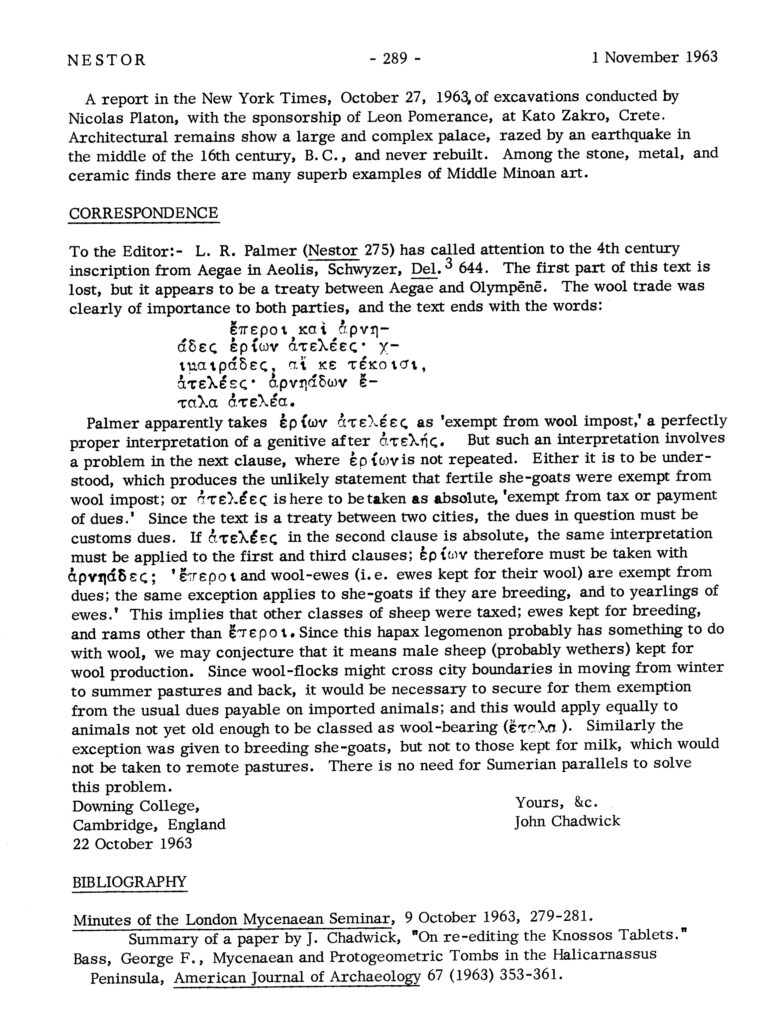
Birthday Gift Exhibit B is a more characteristically serious note (Nestor 1 November 1963, p. 289). In it Chadwick discusses a fragmentary 4th-century treaty inscription from Aegae in Aeolis dealing with wool-flocks and wool trade. It had been brought up and discussed by Leonard Palmer in an earlier send-out of Nestor (1 September, p. 275) in connection with the Linear B tablets monitoring various categories of flocks of livestock. Chadwick here proposes a different, more accurate reading:
ἔπεροι and wool-ewes (i.e., ewes kept for their wool) are exempt from dues; the same exception applies to she-goats if they are breeding, and to yearlings of ewes.
Chadwick then explains the terms of the treaty by bringing to bear practical knowledge of wool trade and flock management no doubt assisted by the work being done at that time by the young John T. Killen on the Knossian wool industry. Chadwick pays close attention to the wording and vocabulary of the text and the conditions of life in the ancient Greek landscape. In his opinion these proved to be sufficient for a correct interpretation. He closes: “There is no need for Sumerian parallels to solve this problem.” Indeed.
Birthday Gift Exhibit C
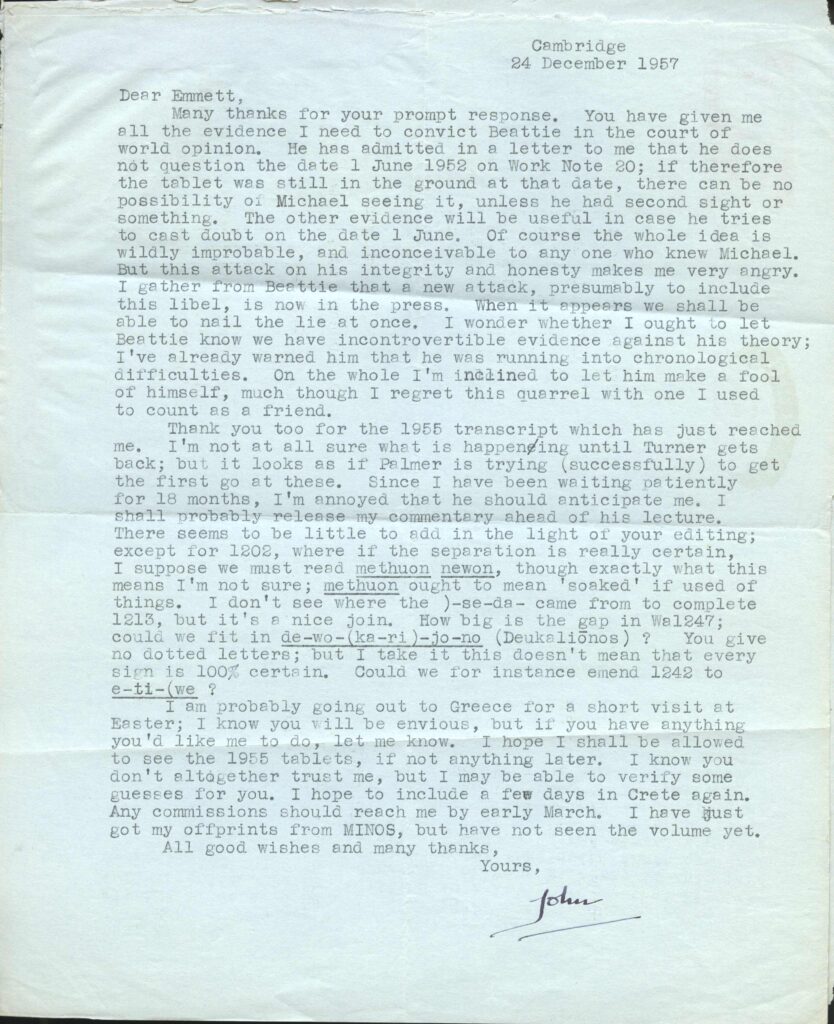
Birthday Gift Exhibit C written on Christmas Eve 1957 strikes a more somber note and reveals a justifiable undercurrent of emotion in defense of the integrity and honesty of Chadwick’s late revered and still lamented friend Michael Ventris.
Chadwick had just received, in the last letter sent from Bennett, proof of the date when the famous Pylos Ta ‘tripod’ tablet Ta 641 had been excavated. He was thus able to refute definitively the preposterous insinuation of Professor Arthur James Beattie (1914-1996) that Ventris had seen this tablet before he released Work Note 20 and had assigned values to the Linear B phonograms in order to ‘read’ the tablet correctly.
See Palaima, “Emmett L. Bennett, Jr., Michael G.F. Ventris, Alice E. Kober, Cryptanalysis, Decipherment and the Phaistos Disc,” in M.-L. Nosch and H. Landenius-Enegren eds., Aegean Scripts, (Incunabula Graeca 105, Rome: 2017) vol. 2, 771-788 for more on this kind of malicious postulating by Douglas Young and Beattie in articles somehow deemed worthwhile publishing throughout this period. A cursory examination of the logic of the arguments in these articles is enough to see that their claims have no merit. And yet….
It is no wonder that Chadwick writes:
Of course the whole idea is wildly improbable, and inconceivable to any one [sic] who knew Michael. But this attack on his integrity and honesty makes me very angry. I gather from Beattie that a new attack, presumably to include this libel, is now in the press.
Beattie’s claims were whipping up hysteria not even sixteen months after the sudden and tragic death of Michael Ventris (September 6, 1956). This made it impossible at the time to bring up the following clear fact. Even if Michael Ventris had seen the tripod tablet Ta 641 privately before publishing Work Note 20 and had tested out values, say for the four-sign word-unit now read as ti-ri-po-de, such a test would have been not very different than what Ventris did do with the Knossos tablets (and that Sir Arthur Evans had done in print seventeen years before [Palace of Minos volume 4, p. 799, as reported in Docs², p. 66] in suggesting that the sign sequence *11-*02 could be read using Cypriote values as po-lo = πῶλος) before his use of the ‘Rosetta Stone’ of Linear B, i.e., the Knossos place names and toponymic adjectives.
At some point, within any analyzed code system, lacking a bilingual (or a partially translated encoded message) test values have to be tried by what are hunches as to what particular words might be. ti, ri, po, de, e, me would have done the job in beginning to unlock the grid instead of ko, no, so, pa, i, to. Beattie’s claim that the decipherment announced on the BBC 1 July 1952 had not resulted from analysis of sign occurrences in the texts and positing of test values, but from forcing or manipulating the values deduced from the tripod tablet onto the whole of the then known Linear B texts is in itself absurd. Such a magic trick could not be performed. At the time, however, simply saying “so what?” would have been insufficient. Not that anything ever proved to be sufficient to move Beattie from a position he held at least publicly until he passed from this world into whatever comes next.
Birthday Gift Exhibit D
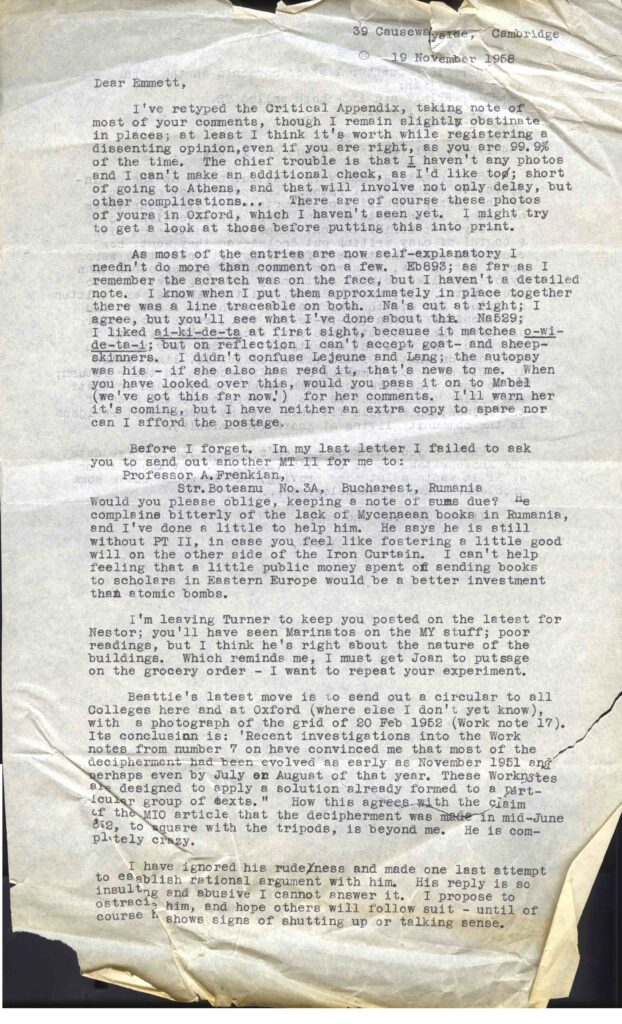
Birthday Gift Exhibit D is a letter of 19 November 1958 to Bennett. It gives us real insight into the early post-decipherment work on tablets from Mycenae, Knossos and Pylos; into the truly obsessive craziness of Beattie; and into Chadwick’s idea that maintaining contacts through the sending of books and offprints to scholars on the eastern side of the Iron Curtain would be a significant step towards alleviating international political tensions.
We also find in it evidence that the British post-war economy was still Orwellian austere. Chadwick asks Bennett to share the pages he is sending to him with Mabel Lang because “I have neither an extra copy to spare nor can I afford the postage.” On a lighter note, Chadwick comments that he is going to have his wife Joan “put sage on the grocery order” because “I want to repeat your experiment.” Most likely this has to do with Bennett’s publication of The Olive Oil Tablets of Pylos. Texts of Inscriptions Found 1955 (Salamanca 1958) and the sage-scented oil listed in the tablets record.
On page 2, Chadwick speculates as to how information was conveyed between outlying centers and the central palace and refers to “my theory that Pakijana is the community living at Khora (Volimidhia).” He closes by referring to arguments among archaeologists, including Blegen, as to the date of the Knossos tablets. And he ends cryptically:
It was love, by the way.
Any guesses as to the nature of the reference here?
Birthday Gift Exhibit E
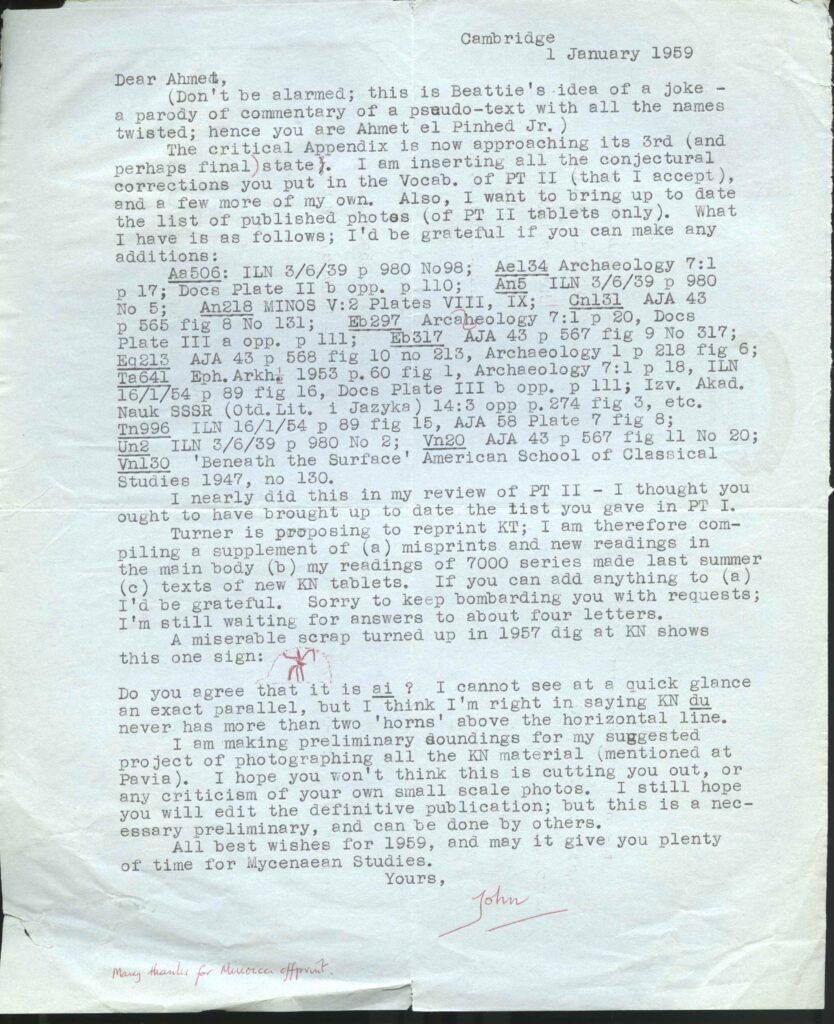
Birthday Gift Exhibit E written on New Year’s Day 1959 opens with the salutation “Dear Ahmet” corrected from “Dear Ahmed”—now we know why it was important in Linear B to differentiate voiced from unvoiced dental stops. Chadwick does not wish the joke to go too far and so begins:
(Don’t be alarmed; this is Beattie’s idea of a joke — a parody of commentary of a pseudo-text with all the names twisted; hence you are Ahmet el Pinhed Jr.)
He then goes on to discuss the careful work involved in reaching the third draft of an Appendix with conjectural corrections to existing vocabulary lists, his own new conjectures for readings, and references to published tablet photos in order to aid researchers and teachers who wish to see and use images of the Linear B tablets. A new transcription volume of the Knossos tablets is underway. A “miserable scrap” of a tablet turned up in the “1957 dig at KN.” Chadwick draws the sign as he sees it and asks Bennett whether it is ai or du. Finally Chadwick mentions “my suggested project of photographing all the KN material” and deferentially adds “I hope you won’t think this is cutting you out, or any criticism of your own small scale photos.”
Birthday Gift Exhibit F
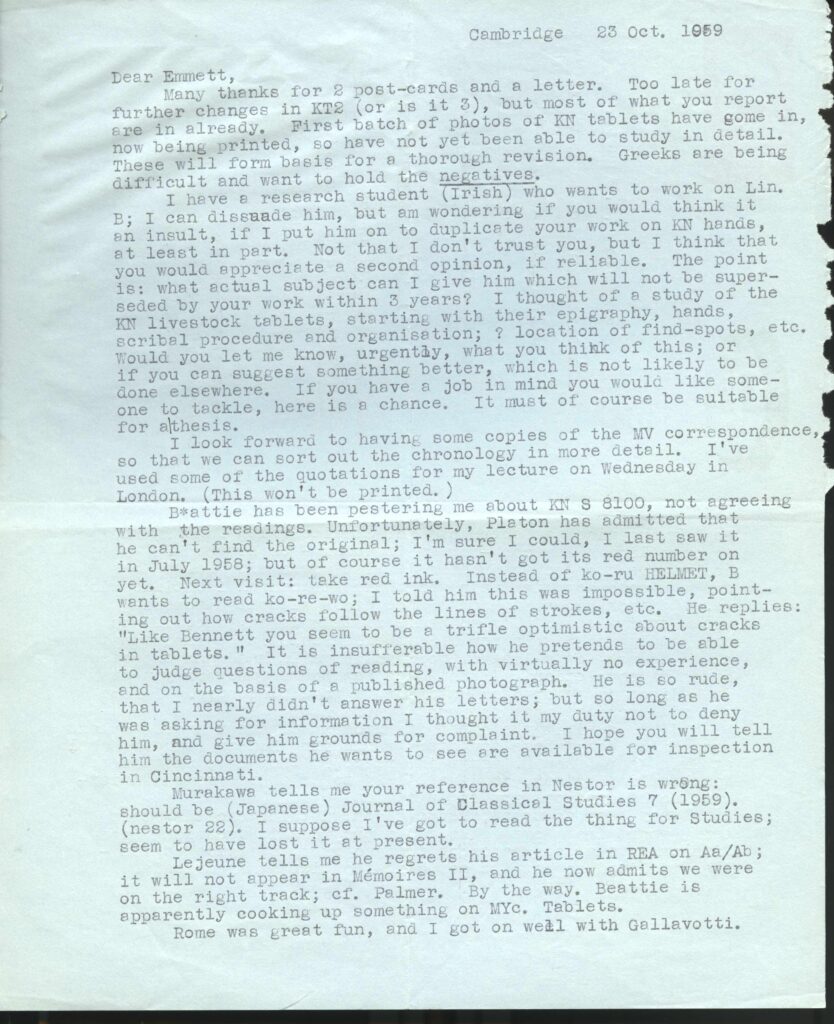
Birthday Gift Exhibit F might be called Birthday Gift Exhibit JTK for in this aerogram (dated 23 October 1959) Chadwick reveals to Bennett:
I have a research student (Irish) who wants to work on Lin. B; I can dissuade him, but am wondering if you would think it an insult, if I put him on to duplicate your work on KN hands, at least in part. Not that I don’t trust you, but I think that you would appreciate a second opinion, if reliable. The point is: what actual subject can I give him which will not be superseded by your work within 3 years? I thought of a study of the KN livestock tablets, starting with their epigraphy, hands, scribal procedures and organization; ? location of find-spots, etc. Would you let me know, urgently, what you think of this; or if you can suggest something better, which is not likely to be done elsewhere. If you have a job in mind you would like someone to tackle, here is a chance. It must of course be suitable for a thesis.
This young Irish scholar, of course, is John Tyrell Killen, now emeritus professor of Mycenaean Greek at Cambridge University. This is five years before the appearance of his ground-breaking classic “The Wool Industry of Crete in the Late Bronze Age,” BSA 59 (1964) 1-15. It is also thirty-two and a half years before he visited Luckenbach, TX in April 1992 and discovered that the ‘finishing of lambs’ in the ‘seventeen western states’ of the United States goes back to the practice of o-pa as studied in the Linear B texts (Floreant Studia Mycenaea Band II 1999, p. 332 n. 34). Chadwick then takes up some more bothersome ideas from the scholar he now refers to—hoisting him on his own petard—as B*attie. It seems that B*attie came up with the batty alternative reading in line Bb of the tablet we now know of as Sk 8100 as ko-re-wo instead of the reading of Bennett and Chadwick from actual autopsy as ko-ru GAL. Chadwick’s explanation of how cracks on the tablets may relate to the actual stylus ductus elicited this crackpot response:
“Like Bennett you seem to be a trifle optimistic about cracks in tablets.”
Chadwick continues:
“It is insufferable how he pretends to be able to judge questions of reading, with virtually no experience, and on the basis of a published photograph. He is so rude….”
Birthday Gift Exhibit G
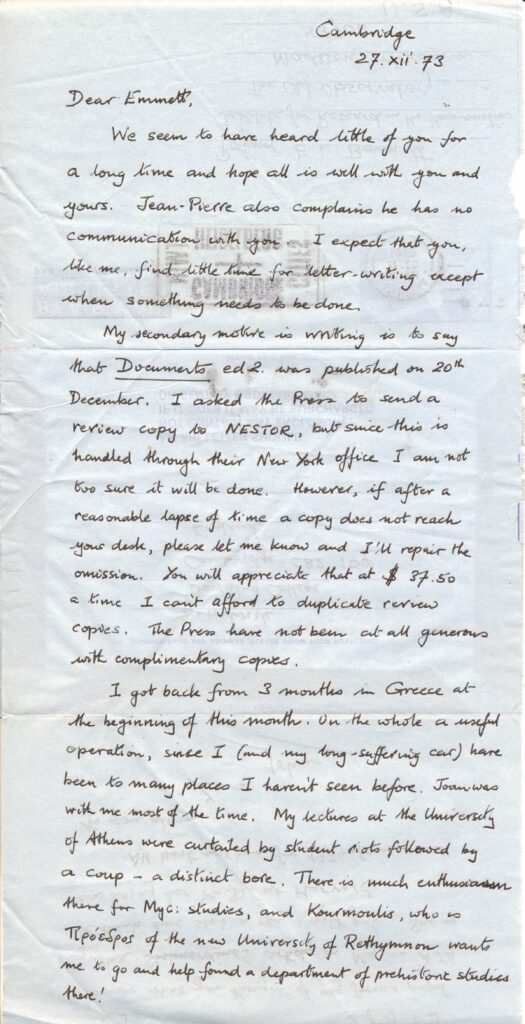
Birthday Gift Exhibit G sent by Chadwick on December 27 1973 announces to Bennett the publication of the second edition of Documents in Mycenaean Greek and fears that a review copy for Nestor sent from the New York office of Cambridge University Press might have gone astray. The cost of the new volume, still never superseded as the ‘bible’ of Linear B studies, $37.50 ($216.54 in 2020 dollars) would have made replacement difficult and the press, writes Chadwick, was being “not at all generous with complimentary copies.”
Chadwick describes in brief his three-month stay in and traveling around Greece during the momentous period from beginning of September to beginning of December 1973 when the country was restless in the seventh year of a repressive rightwing regime. The climate of this time is perhaps best conveyed proleptically by Vassilis Vasilikos’s 1966 novel Z and the Costa-Gavras film (1969) of the same title that won the Oscar for best foreign film.
Chadwick’s wife Joan was with him most of that time. He also reports, with what seems to be an incongruous level of scholarly distraction from the serious realities of everyday life for Greek citizens in a country in its seventh year of a military dictatorship:
“My lectures at the University of Athens were curtailed by student riots followed by a coup—a distinct bore.”
This would seem to refer—with a coda of perhaps ironic rhetorical meiosis—to the courageous student demonstration against the junta of the colonels (1967-74) during the period 14-17 November 1973 that culminated with a tank crushing through the gate of the Πολυτεχνείο sometime after 2 AM on November 17. Unarmed demonstrators were also wounded and killed.
I spoke to a woman in Koroni one summer twenty or so years ago who had been a demonstrator. Her leg was permanently impaired by a bullet that could not be treated at a hospital at the time she was wounded by gunfire for fear that her wounding would be reported and she would be arrested and imprisoned. She had found a politically sympathetic veterinarian to operate on her. This is a clear reminder of how perpetually endangered scholarly freedom is and how easy it is to forget that even humanistic scholarship can divert our attention from greater problems affecting the lives of our fellow human beings.
The letter closes with a query about a young American student:
I wonder what you thought of my former pupil Cynthia Shelmerdine’s article on Ma in AJA, we think here she’s a very bright girl. She is now doing her Ph.D. at Harvard.
She is now Robert M. Armstrong Centennial Professor of Classics emerita at the University of Texas at Austin and the dedicatee of the Festschrift D. Nakassis, J. Gulizio and S.A. James eds., KE-RA-ME-JA: Studies Presented to Cynthia W. Shelmerdine (Philadelphia: INSTAP Academic Press 2014).
Birthday Gift Exhibit H
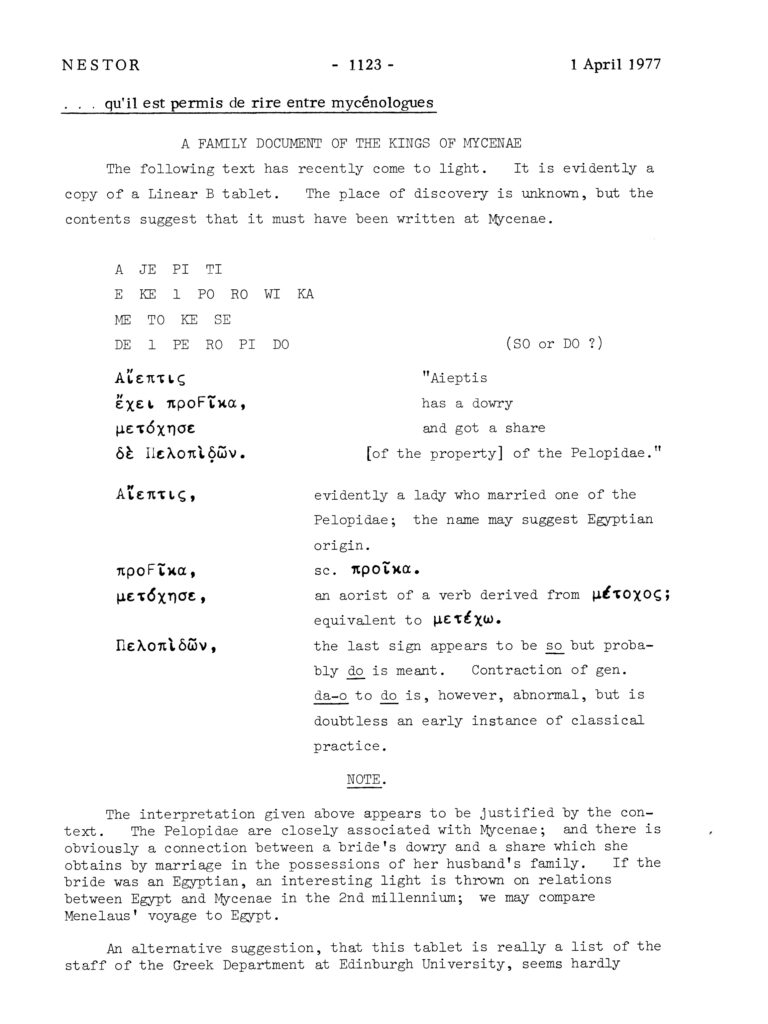
Birthday Gift Exhibit H are the pages of Nestor published on 1 April 1977—note the date—under the rubric . . . qu’il est permis de rire entre mycénologues . Bennett chose this date, well after the fact, to share with interested scholars worldwide a satirical scholarly exchange that took place “[s]everal years ago, before Xerox” and then came back into his memory “[s]ome years later.” In it dueling scholars exchange rival interpretations of a single fabricated Linear B transcribed text that is provided with none of the usual controls upon interpretation associated with Linear B tablets: ideograms and quantities, archaeological find context, associated texts.
References to J. CH*DW*CK, Ch+dw+ck, J.C., Chickweed, J. Chidwock, and Ahmet el Pinhed Jr. in themselves convey the spirit with which these rival interpretations of a contrived document were concocted. The whole is clearly intended to satirize through grossly exaggerated misrepresentation the multivalency of the phonograms in the Linear B syllabary and the supposed ambiguity of the spelling rules. The interpretations make use of great license in proposing alternative readings, correcting purported scribal mistakes, justifying peculiar ways of rendering original sound values and even associating names of faculty members at University of Edinburgh. At the right place at the right time among the right people and under the right circumstances all this could represent good fun.
Bennett was led to think that the time was right in April 1977. I should add that this was ten months before I began my first Linear B seminar from Bennett at University of Wisconsin—Madison. Since I share my mentor’s predilection to encourage laughter among fellow Aegean prehistorians, it is proper to note that I did not meet him until late August 1973, and knew no Linear B even rudimentarily until April 1974. So I had no hand in this publication.
Bennett did deem it a responsible gesture to add the following proviso:
Unfortunately a further word is necessary, since we do not all laugh at the
same things. If you have found the letters funny, and did not notice an incongruity
between the rubric ” . .. qu’ il est perm is de rire … ” and what follows it,
then I did indeed choose the appropriate moment. But if you have been troubled
by it, be assured that this is the only intentional appearance in these pages of
the classic trick for this day: the still-muddy cobblestone under the top hat on
the sidewalk.
We may wonder whether John Chadwick, like Houdini, is spinning around in his grave that these antics are being revived and viewed yet again in the year 2020. We can only add that this is not the only April Fool’s Day tomfoolery in the history of Mycenaean studies. One other example I discussed at length and unfortunately necessarily in all seriousness in the pages of Minos 37-38 (2002-2003) 373-385. But that was long ago and far away.
ἡ γενέθλίος ἡ ἑκατοστὴ εὐτυχής σοι ἔστω.
Updated on June 7, 2020 by Garrett R. Bruner. garrettbruner@utexas.edu
May 26, 2020
PASP Semester in Reflection, Spring 2020
By Jared Petroll
Working with Dr. Palaima through my apprenticeship introduced me to parts of the research process that I had previously not been exposed to. Above all, I realized the collaborative nature of scholarship. In history, the genius of an academic discovery is often attributed to a single person, with the implication that they possessed a sort of superhuman intelligence that distinguished them from others. I now understand that this is far from the truth. Discovery is preceded by hours and hours of careful data collection, consultation, and collaboration with other experts in the field. Moreover, the great foundational scholars of a field are often in communication with each other rather than apart. This is important. It means that one does not have to publish transformative work to do good work and contribute to the knowledge base in any field.
Mycenaean Seals on Arachne
Some of my work entailed looking through Arachne, an online database of seals, seal impressions, and signet rings of the Aegean area in the second millennium BCE that Dr. Palaima introduced me to. Arachne is affiliated with the University of Cologne in Germany. I also used the Corpus der Minoischen und Mykenischen Siegel (CMS), which provides more specific descriptions of the seals. While translating German was difficult, I enjoyed it, realizing how much I was limiting myself by reading things exclusively in my native language. For someone who has never left the U.S., the activity broadened my perspective and reminded me of how the scholarship is a global phenomenon.
Navigating Arachne led me to a particular iconograph, the seated lady, and its presence across multiple art forms. Thought to be a goddess or female of distinguished status within the main cultures of the Aegean area roughly 1850-1000 BCE, the seated lady appears on mirrors, signet rings, wall paintings, and other mediums. Whether these individual images refer to the same person is an open question that still intrigues me now. The iconograph appears in images that possess other clues that refer to their religious significance. These include tripartite shrines, horns of consecration, and sacred birds. I became interested in how these symbols came together and interacted to convey a greater meaning to the viewer because it shows how imagery was used to convey ideas, much like today.
Archiving the Emmett L. Bennett Jr. Collection
One of my favorite experiences was working with PASP’s Emmett Bennett Collection. In order to understand the importance of archival research in scholarship, I was tasked with cataloging detail photos of Linear B signs from the Knossos Tablets. This process included:
- Assigning each photo an individual catalog number
- Entering the appropriate tablet IDs, photograph reel and shot numbers, and descriptive data into a spreadsheet
- Properly handle and store them in mylar sheets and archival containers
With the PASP archivist, I also devised cataloging guidelines for this work to continue in the future. While approximately 200 photographs were archived so far, many more remain.
In this leg of my research, the role that archivists play in organizing, itemizing, and describing primary documents became apparent. Absolutely focused attention to detail was required. Taking notes as I progressed was essential. I also learned how archivists had to interpret as well as document the material they worked with in order to examine and explain its relevance to modern scholarship. While the work was meticulous, I became extremely interested in the photos. Since the images were from the mid 1950s the script was only recently deciphered when they were taken. I began to ponder why some signs were subject to more scrutiny than others, whether the images were used in later publications, and if there were any other items in the Bennett Materials that would provide answers to these questions.
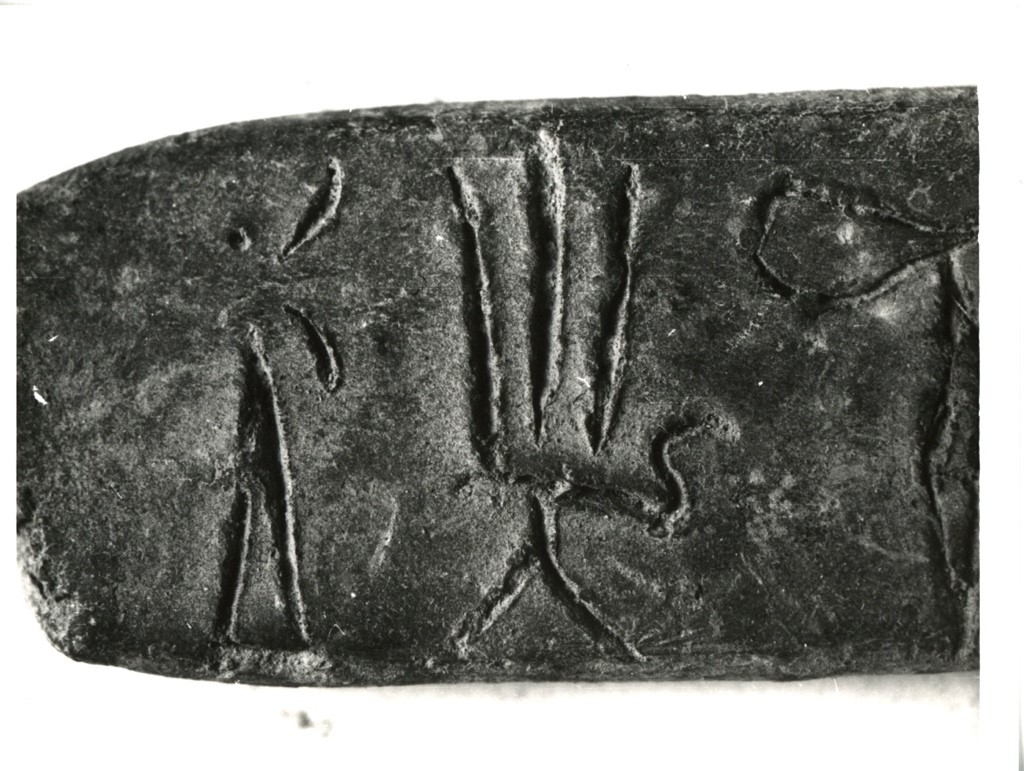
Bennett Correspondence Project
When UT shifted to remote learning in March in response to COVID-19, I began compiling a master list of PASP’s correspondence collections, starting with the Emmett Bennett Correspondence Collection. Bennett developed the system for organizing Linear B signs that is still used today, and it was essential for deciphering the script. His letters to Alice Kober, Michael Ventris, and John Chadwick, demonstrate what brilliant minds each were in their own right. Reading their interactions with each other, paired with examining the Bennett’s photos of the Knossos tablets, felt like witnessing the field of Linear B studies come into being firsthand. And again, themes of international collaboration and mutual respect among scholars were stressed.
All in all, the apprenticeship was an experience that helped me grow intellectually and personally, and I am thankful for the opportunities and insights it provided. I got to see the small village of people it took to research a single topic: archivists, professors, graduate students, and specialists across the world interacting with each other to produce something beneficial to society. I am excited about where my interests in the Aegean Bronze Age might lead next, and for who I will get to work with along the way.
Updated on May 26, 2020 by Garrett R. Bruner. garrettbruner@utexas.edu
May 17, 2020
PASP Publications Page Update
By Garrett Bruner
The Publications page has been updated with over ten years (1985-1998) of offprints by PASP Director Tom Palaima. These articles span the range of Mycenaean literacy, sealings, and administration, Cypro-Minoan scripts, and research on Dionysus in the Linear B tablets. Check below for the updated list, or visit the Publications page for the full index of published works. The rest of them will be added before long.
Recently uploaded Articles by Tom Palaima:
1985
“Secondary Criteria for Identifying Scribal Hands: Interdisciplinary Considerations,” Text 2 (1985) 55-67. || PDF Download
Appendix to P. Åström, K.-E. Sjöquist, Pylos: Palmprints and Palm Leaves (Göteborg 1985) 99-107 || PDF Download
“Ins and Outs of the Archives Rooms at Pylos: Form and Function in a Mycenaean Palace,” American Journal of Archaeology 89 (1985) 251-262 [with J.C. Wright] || PDF Download
“Short, Short Story Complete on This Page,” ASCSA Newsletter (Fall 1985) 5 || PDF Download
1987
“Comments on Mycenaean Literacy,” in J.T. Killen, J.L. Melena, J.-P. Olivier eds., Studies in Mycenaean and Classical Greek Presented to John Chadwick (Minos 20-22, Salamanca 1987) 499-510. || PDF Download
“Mycenaean Seals and Sealings in Their Economic and Administrative Contexts,” in P.H. Ilievski and L. Crepajac eds., Tractata Mycenaea, Proceedings of the 8th International Colloquium on Mycenaean Studies, Held in Ohrid, 15-20 September 1985 (Skopje 1987) 249-266. || PDF Download
“Preliminary Comparative Textual Evidence for Palatial Control of Economic Activity in Minoan and Mycenaean Crete,” The Function of the Minoan Palaces, Proceedings of the Fourth International Symposium at the Swedish Institute in Athens, 10-16 June, 1984 (Acta Instituti Atheniensis Regni Sueciae, Series in 4°, XXXV, Stockholm 1987) 301-305. || PDF Download
1988
“The Development of the Mycenaean Writing System,” in J.-P. Olivier and Th. G. Palaima eds., Texts, Tablets and Scribes: Studies in Mycenaean Epigraphy and Economy Offered to Emmett L. Bennett, Jr. (Minos 10, Salamanca 1988) 269-342. || PDF Download
1989
“Perspectives on the Pylos Oxen Tablets: Textual (and Archaeological) Evidence for the Use and Management of Oxen in the Late Bronze Age Messenia (and Crete),” Studia Mycenaea (1989), 85-124. || PDF Download
“Cypro-Minoan Scripts: Problems of Historical Context,” Problems in Decipherment, 121-187. 1989. || PDF Download
“Ideograms and Supplementals and Regional Interaction among Aegean and Cypriote Scripts,” Minos 24 (1989) 29-54. || PDF Download
1990
“The Purposes and Techniques of Administration in Minoan and Mycenaean Society,” in T.G. Palaima ed., Aegean Seals, Sealings and Administration, Aegaeum vol. 5 (Liège 1990) 83-104, pls. VII-XV [=ASSA] || PDF Download
Round-Table Comments, in ASSA , 242-247 || PDF Download
1991
“Maritime Matters in the Linear B Texts,” in R. Laffineur and L. Basch eds., Thalassa. L’Égée prehistorique et la mer, Aegaeum 7 (Liège 1991) 273-310, pl. LXIII. || PDF Download
“The Advent of the Greek Alphabet on Cyprus: A Competition of Scripts,” in C. Baurain et al. eds., Phoinikeia Grammata, Collections d’Études Classiques vol. 6 (Namur 1991) 449-471. || PDF Download
“Late Bronze Age Aegean Ships and the Pylos Tablets Vn 46 and Vn 879,” Minos. 25-26 (1990-91) 297-317. || PDF Download
1992
“The Knossos Oxen Dossier: The Use of Oxen in Mycenaean Crete. Part I: General Background and Scribe 107,” in J.-P. Olivier ed., Mykenaika (BCH Supplément XXV: Paris 1992) 463-474. || PDF Download
“Ten Reasons Why KH 115 ≠ KN 115,” Minos 27-28 (1992-93) 261-281 || PDF Download
“Mycenaean Scribal Aesthetics,” in R. Laffineur and J. Crowley eds., TEKHNE. Aegean Bronze Age Iconography : Shaping a Methodology, Aegaeum 8 (Liège 1992) 63-75, pls. XX-XXIII. || PDF Download
1993
“Michael Ventris’s Blueprint,” Discovery . Research and Scholarship at The University of Texas at Austin 13:2 (1993) 20-26. || PDF Download
1994
“Seal-Users and Script-Users / Nodules and Tablets at LM I B Hagia Triada” and “Response to Paper of G. Fissore,” in P. Ferioli, E. Fiandra, et al. eds., Archives Before Writing (Pubblicazioni del centro Internazionale di Ricerche Archeologiche Antropologiche e Storiche I: Turin 1994) 307-337, 355-361 (with discussions) || PDF Download
1995
“The Nature of the Mycenaean Wanax: Non-Indo-European Origins and Priestly Functions,” in P. Rehak ed., The Role of the Ruler in the Prehistoric Aegean , Aegaeum 11 (Liège 1995) 119-139, plates XLI-XLII. || PDF Download
“The Last Days of the Pylos Polity,” in R. Laffineur and W.-D. Niemeier eds., Politeia: Society and State in the Aegean Bronze Age, Aegaeum 12 (Liège 1995) 623-633, plate LXXIV. || PDF Download
“A Linear B Tablet from Heidelberg,” in Politeia, 699-670 || PDF Download
1996
“Monad Noir (translation of Horace Carm. 1.38),” Arion Third Series 3.2&3 (Fall 1995/Winter 1996) 177-178. || PDF Download
“‘Contiguities’ in the Linear B Tablets from Pylos,” in E. de Miro, L. Godart, A. Sacconi eds., Atti e memorie del secondo congresso interazionale di micenologia (Rome 1996) 379-396. || PDF Download
with I. Hajnal, A. Kolosimo, J.-P. Olivier, C.J. Ruijgh, “Linear B in the Bay of Naples,” Atti e memorie, 1645-1648. || PDF Download
“Sealings as Links in an Administrative Chain,” in P. Ferioli, E. Fiandra and G.G. Fissore eds., Administration in Ancient Societies, Acts of Session 218 of the 13th International Congress of Anthropological and Ethnological Sciences, Mexico City July 29-August 5, 1993 (Turin 1996) 37-66. || PDF Download
1997
“Potter and Fuller: The Royal Craftsmen,” in R. Laffineur and P.P. Betancourt eds., Tekhne, Aegaeum 16 (Liège 1997) 407-412 || PDF Download
“PH Up 1996,” in R. Laffineur and P.P. Betancourt eds., Tekhne , Aegaeum 16 (Liège 1997) 539-543. || PDF Download
1998
“Linear B and the Origins of Greek Religion: ‘di-wo-nu-so‘,” in N. Dimoudis and A. Kyriatsoulis eds., The History of the Hellenic Language and Writing: From the Second to the First Millennium B.C.: Break or Continuity?, Acts of the 2nd International Conference of the Society for the Study and Spreading of Hellenic History Held at Ohlstadt, Germany 03.-06.10.1996 (DZA Verlag für Kultur und Wissenschaft GmBH: Altenburg 1998 ISBN 3-9806602-0-6) 205-222; discussion 223-224 || PDF Download
Have an offprint or archives request from PASP? Contact us! We can fill digitization requests from any offprint collection we have: Emmett Bennett’s, Frank Stubbings, and Tom Palaima’s.
We will be adding more to our online materials from the Emmett Bennett collection over the summer and an index of those materials to the PASP website.
Updated on May 17, 2020 by Garrett R. Bruner. garrettbruner@utexas.edu
November 11, 2019
PASP Visit Report
By Susan Lupack
Imagine how excited I was to return to the Classics Department of the University of Texas at Austin, and more specifically, to the Program in Aegean Scripts and Prehistory (PASP) – the place where I had spent so many happy, albeit generally somewhat stressful, years working toward my doctoral degree (which I received in 2002). Thanks to the support awarded to me as part of a competitive grant from my current institution, Macquarie University, where I am happily ensconced in its research-rich and remarkably collegial Ancient History Department, I was able to spend a week (13-20 September) delving into the resources that attract so many international visitors to PASP. I am working on a book entitled Mycenaean Religion: The Creation and Expression of a Society’s Ideology, and it seemed like a good week of solid work in PASP would benefit my project immensely. Of course, having that time to consult with Tom Palaima, the co-director of my thesis (with Cynthia Shelmerdine) and now my long-time mentor and friend, was really the greatest draw, and, as I had anticipated, the time spent with Tom was the highlight of my trip.
As I had arrived on a weekend, we had to start off with a stop in The Little Longhorn Saloon where we got to listen to some of that classic honky tonk music that just can’t be found outside of Texas. I was tempted to try the two-step! But the better idea was to get over to Kerbey Lane for some of those gingerbread pancakes that I had been dreaming of for years. It was Joann Gulizio and her partner Ralph who got me there, and pretty much everywhere else that I went for the rest of the trip. I want to say here how amazing they both are, and what fun we had choosing where we would eat every night. But of course there was lots of work that got done as well – my discussions with Joann on Mycenaean religion were extremely productive – I’m already doing some research for an article that Joann and I will be working on together.
It was also a great pleasure for me to teach in the Linear B class that Tom and Joann are co-teaching. For one of the seminars Tom invited me to present my latest ideas on the possibility that the wanax who appears in the Fr tablets receiving offerings of perfumed oil is actually an ancestral wanax whose worship had been incorporated into Late Helladic Mycenaean religion. It was phenomenal to see so many students interested in learning Linear B and working in PASP.
Not surprisingly, I found that the department (like Austin), had changed quite a bit! But of course there were still several familiar faces, including Paula Perlman, Lesley Dean-Jones, Steve White, and Andrew Riggsby. I was fortunate enough to have lengthy talks about my research with all of them. I was also glad of the chance to talk with Garrett Bruner, the archivist extraordinaire who is helping to organize and conserve the valuable resources that PASP houses. And I want to thank Khoa Tran and Vanessa Noya for welcoming me and helping me with all the things that one finds one doesn’t know how to do in a new place!
After my time in Austin, I took a trip down to San Antonio, where I had been invited by Corinne Pache and fellow PASPian Nicolle Hirschfeld to teach in Corinne’s Homer seminar and to give a talk that was co-hosted by Trinity University and the Archaeological Institute of America’s San Antonio chapter. For an audience of around one hundred interested people, I presented the basics of Linear B studies, and then, using that as a foundation, I discussed the more specific ideas I have concerning the Mycenaean worship of an ancestral wanax. The level of engagement of this predominantly non-academic audience was reflected in the large number and high quality of their questions. It was a great night. And it was made even greater by the fact that Corinne and I were able to celebrate the imminent appearance (November 2019!) of the volume that we have been working on (with Bob Lamberton and Casey Due) for nearly four years – the new Cambridge Guide to Homer. This volume was Corinne’s brainchild, and she invited me to serve as the associate editor for the section “The Homeric World.” It will be quite gratifying to see this published, particularly as I was able to involve Tom Palaima and two other PASPians, Dimitri Nakassis and Stephie Nikoloudis, as writers of a few of its essays.
After this trip, which was both so productive and so full of good feeling, I sincerely hope to be able to return before too much time has passed.
Updated on November 11, 2019 by Garrett R. Bruner. garrettbruner@utexas.edu
October 30, 2019
Emmett Bennett – Tom Palaima Correspondence Now Online
By Garrett Bruner
Overview
We are pleased to announce that over 150 letters between Emmett L. Bennett Jr. and Tom Palaima are now online at Texas ScholarWorks. They join the hundreds of items of correspondence from PASP, covering scholars like Alice E. Kober and Michael Ventris.
This set is special. In their entirety, the letters span three decades, from the late 1970s, 1980s, and through the 1990s. They see the twilight of Bennett’s career and the beginning of Tom Palaima’s, documenting the transition of Bennett to emeritus at Wisconsin to Palaima’s hiring by the University of Texas in 1986. They cover an incredible range of Linear B subjects, like recollections of Alice Kober’s work methods, detailed descriptions of Bennett’s own work methods inspecting Pylos tablets in Athens, building better archives with Linear B materials, travels to Rome to study at the Istituto, and even travels to Austin, Texas to study at PASP in the early 1990s (see below for a reminder of Austin’s 1990 atmosphere, written by Bennett October 19, 1992!)
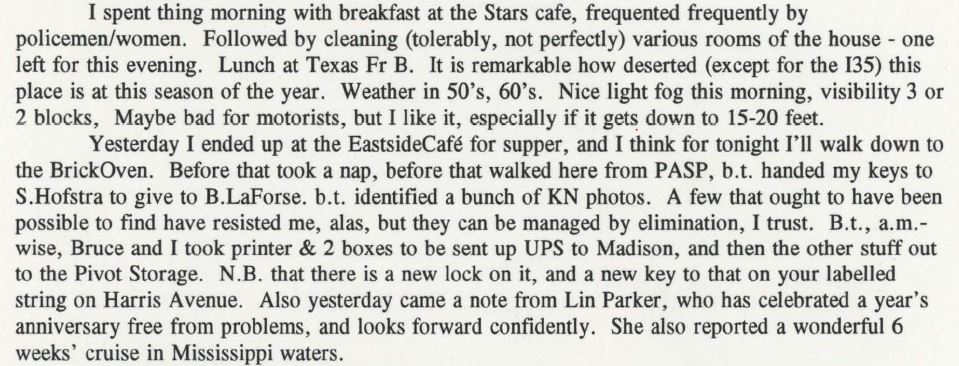
While many items of Bennett’s correspondence are already online, these capture Bennett’s voice like no other. In them, Bennett’s warmth is felt, his wit and attention to detail sparkles, and his everyday concerns are as relatable as anybody’s.
Here, I introduce a series of Bennett’s letters sent to Tom Palaima from Athens, Greece from July 1, 1986 through June 18, 1987. They cover a specific narrative: his appointment to the American School of Classical Studies at Athens (ASCSA) as Mellon Professor of Classical Studies for a year long term. There, he would research the Pylos tablets in the collection of the National Archaeological Museum of Athens for publication in the Palace of Nestor series. What follows here is a preview of his trip: I will describe the first few letters over the first months of Bennett’s time in Athens.
Applying to the American School of Classical Studies at Athens
In 1984, Bennett successfully applied for a Mellon Professorship to research Linear B tablets in Greece in a year-long visit to the ASCSA. Earlier correspondence shows Bennett mulling over the idea of applying, but this is the letter, to me, shows himself committing to the position and project. The application to Professor Stroud was attached by Bennett to Palaima on the letter of January 12, 1984.
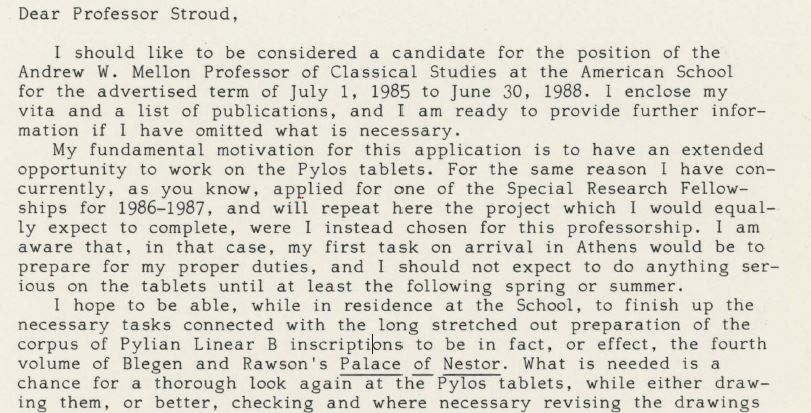
Bennett then outlines some of his year-long project goals: “a thorough look again at the Pylos tablets”, for the fourth volume of Blegen and Rawson’s Palace of Nestor, plans for visits to Iraklion to view the Knossos tablets and other trips to “Thebes, Tiryns, and elsewhere” to investigate inscribed stirrup-jars.
But the application involves more than Bennett’s inquiry for the position and projects. Bennett then reflects on his life’s work with Linear B tablets, from as early as taking courses with Carl W. Blegen as an undergraduate at the University of Cincinnati, to his critical work on the decipherment during the 1950s at Heraklion at the request of Sir John Myres (see that series online), to his hiring at Wisconsin. He very briefly recounts his European travels, from Cambridge to Yugoslavia to Crete. Modestly, he ends the letter on a note of his problematic Greek fluency (which Tom Palaima, in his recommendation, follows up to dispute this to Stroud, writing Bennett’s “modern Greek is better than he lets on.”)
Online, too, is Tom Palaima’s own letter of recommendation to the ASCSA in support of Bennett. For me, the letter is like a time capsule. Tom Palaima was still very early in his career. He was an Assistant Professor at Fordham University, had only recently received his MacArthur Genius award, and (most importantly!) PASP did not even exist! In the letter, Palaima recaps Bennett’s best qualities as a humanities scholar and human being. Vivid to me is an anecdote he relates about Bennett:
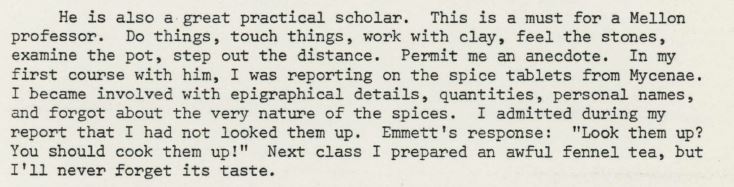
Arriving in Athens
On July 1, 1986, Bennett writes to Palaima to confirm his arrival in Athens, Greece. But not very cheerfully. No mention of the wine dark sea or beautiful ruins. Instead, Bennett begins his stay at the ASCSA with a list of computer issues! Printers, monitors, floppy disks and fonts all trouble Bennett from the beginning, problems that he relates throughout the entire year of residence. At the letter’s close, he wonders if he should have bought an IBM convertible. I wonder what has happened to these machines, if they are still at the ASCSA!
Four days pass and on July 25, 1986, Bennett writes Palaima again. This next letter sets the scene at the ASCSA better than his first. He tells of rain, a thunderclap, and wandering around Athens in search of quality Greek restaurants. He describes going to the bookstore Kardamitsa’s and buys the Mylonas Festschrift, attends dinners at the school, meets old friends and makes new ones. He finishes the letter with comments on a book by Barry Powell.
Getting to Work
It is now August in Greece. A month passes before Bennett writes again on August 18, 1986. This letter is loaded with information on his work. Throughout, he refers at a distance to what had transpired in the month since the previous letter: a return to the United States for more luggage and trips to the Iraklion museum. (He did outline in a letter before his trip a summer itinerary, to “leave maybe 29 or 30 July to Madison, and to Boston in the nick of time.. This extra trip has its own particular aim, but it can also serve to buy a passel of books in Athens…”). He addresses his letter to both Tom and Cynthia (Shelmerdine) together and begins the letter in formal jest at their recent “corporation” (or marriage). At this time in 1986, Tom Palaima would’ve been also just moving to Austin, Texas to begin his tenure as a professor at the University. He would make it his home for the next thirty years.
Then Bennett talks “shop” with Palaima. He relates issues Jean-Pierre Olivier and Louis Godart are having in the publication of the Corpus of Mycenaean Inscriptions at Knossos (CoMIK). He gathers his ideas for courses on Linear B to hold at the American School, with attention on their Winter term and how this affects his scheduling.
Most interesting to me, as archivist, is the next paragraph. It begins with “One of the things you wrote me we might talk about in Cambridge but didn’t get around to is books.” Here, Bennett appears to be outlining what donations he will make to Palaima to benefit PASP (then, referred to by Bennett as CRASP). He divides his books into categories like personal interests, antiquarian books, and his professional books for teaching and researching Linear B. He wonders what to do with all of them, including his Nestor offprints, and considers sending off some to the Burnam Library in Cincinnati, in addition to donating many to “CRASP.” To me, it is very interesting to read the thought process of a professor who is ready to archive his materials, arguing what to keep, what to donate. Bennett even refers, at the end of the paragraph, needing “good lists” in order to track what can also be disposed of.
Two days later, Bennett writes again. This is the first handwritten letter from Bennett while in Greece. The others (and most of his the ASCSA correspondence) were written on the computer, which he now states is “very much in demand”. The letter is brief (only two paragraphs) and his handwriting emphasizes its brevity with its looseness. In the first paragraph, he informs Palaima on a visit by Jean-Pierre Olivier to Tiryns for research on Cypro-Minoan potmarks. The next part of the letter is especially intriguing; he asks Palaima’s help in deciphering a modern Linear B tablet which he discovered in Carl W. Blegen’s archival collection at ASCSA (below)
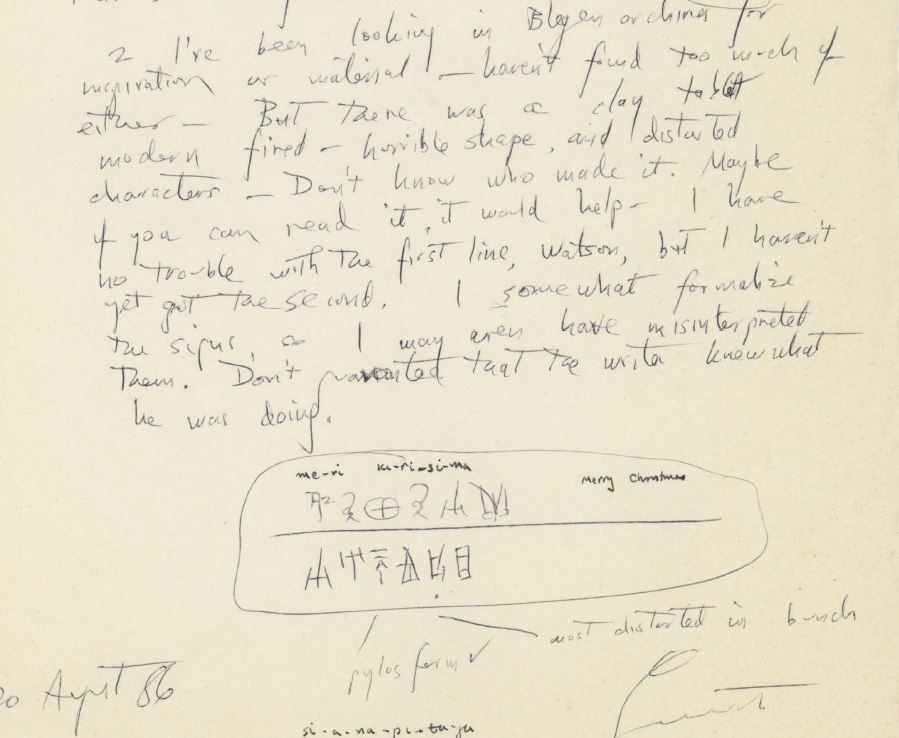
September in Greece, summed up
It is three weeks before Bennett writes Palaima again, on September 8, 1986. The letter is loaded with trip details and adventure. A full two months into his Professorship at the ASCSA, Bennett feels at home. He recaps his attendance at the 6th International Cretological Congress, (Khania, August 24-30 1986), his giving lectures at the ASCSA, making excursions to Mycenaean tombs at Armeni and to the Idaean Cave with Yannis Sakellarakis, and researching with Jean-Pierre Olivier and Louis Godart, among others.
A letter on September 20, 1986 includes a forwarded excerpt from Loretta Freiling with an update from her end at the University of Wisconsin, Madison. She relates to Bennett a recent controversy at Wisconsin: complaints by parents for what’s perceived as corrupt spending, like $250,000 for an email system, which was going unused. Again Bennett emphasizes how useful his access to the Blegen archives at the ASCSA is. He highlights the upcoming Centenary of C. W. Blegen scheduled for January 27, 1987.
As an archivist, I find interesting what materials he’s using at ASCSA (like Blegen’s archives) and what materials of his own he’s creating, like these letters. Throughout, he refers to something like a Pylos tablet database, as early as 1986.
Following this is a four-page letter from Bennett to Palaima, dated September 26, 1986. Here he goes into more detail so far than any other letter about his working on and drawing of tablets; comparisons with his methods to Jean-Pierre Olivier and Louis Godart’s; and sadly, problems with his eyes from the brightness of the sun or the light off the computer screens.
Letters like this continue for the duration of his year as professor at the ASCSA.
Conclusion
On many levels, these letters make for compelling reading. Taken as a whole, with his early correspondence with Kober, Ventris, Chadwick, and now these, Bennett’s correspondence in its entirety spans fifty years. Their richness for telling the story of Linear B decipherment and studies is to me unrivaled. But they are more than only academic correspondence. They touch on the theme of travel, capturing the atmosphere of many places like Rome, Austin, Madison, Athens at certain points in time. They stress the importance of on-location studies and document Bennett’s incredible eye for detail. He constantly shares his love of music, like the sound his flute makes while playing in the Queen’s Megaron parlor at the ASCSA, or attending operas in Rome. They echo other passages of Bennett’s earlier correspondence, like his letter to Sir John Myres in 1950 where he re-caps, in five pages, his meticulous study on Crete in the Heraklion Museum to complete research on Scripta Minoa II and his “most pleasant excursion to Phaistos.” In that letter, he remarks on the grave conditions of certain tablets, but also, his learning how to mend them. In 1987, he laments Pylos tablets coming apart in Athens, echoing those earlier problems still:

Bennett is gone but his spirit comes to life as strong as ever in his letters, his works and our memories. I hope this introduction to his correspondence leads you to investigate further to share his life and its warmth.
PASP aims to make more available in the coming year, to share more voices and stories from our collections.
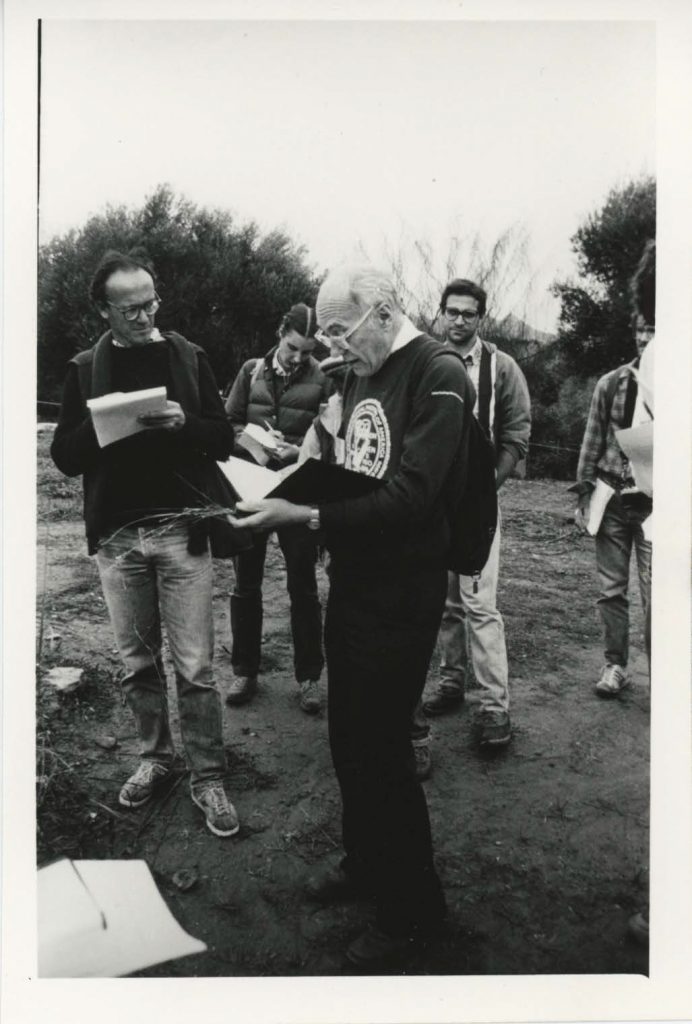
Updated on October 31, 2019 by Garrett R. Bruner. garrettbruner@utexas.edu
October 29, 2019
Updates to PASP Publications Index
Now available on our Publications page are many new and old articles on Linear B and Mycenaean subjects authored by Tom Palaima, Dimitri Nakassis, Susan Lupack, Cassandra Donnelly, and dissertations listed for past and current PASPians Susanne Hofstra, Kathleen Kox, Kevin Pluta, and Joann Gulizio. We thank the staff at UT Libraries for digitizing and making available these valuable works. Keep checking back for more updates to this directory.
Below are listed the updates per each author.
Articles by Tom Palaima
“Note on Vase Inscription KH Z1,” Nestor 6:6 (1979) 1378-1379 || PDF Download
“Observations on Pylian Epigraphy,” Studi micenei ed egeo-anatolici21 (1980) 193-203 || PDF Download
“On the Painted Linear Sign from a Wall at Knossos,” Kadmos20 (1981) 79-82 || PDF Download
“The Organization of Scribal Administration at Pylos,” Acts of the Second International Congress of Peloponnesian Studies, Patras, Greece, May 25-31, 1980 [Athens, 1982] 314-320, plates 14-16 || PDF Download
“Linear A in the Cyclades: The Trade and Travel of a Script,” Temple University Aegean Symposium 7 (1982) 15-22. || PDF Download
“Evidence for the Influence of the Knossian Graphic Tradition at Pylos,” Concilium Eirene XVI ,Proceedings of the 16th International Eirene Congress, Prague, 31.8-4.9 1982 (Prague 1983) 80-84, plates I-II || PDF Download
“Scribal Organization and Palatial Activity,” Pylos Comes Alive, 31-39 || PDF Download
“An Inscribed Stirrup Jar of Cretan Origin from Bamboula, Cyprus,” Kadmos 23 (1984) 65-73 [with P. Betancourt and G.E. Myer] || PDF Download
“Mycenaean Archaeology and the Pylos Texts,” Archaeological Review from Cambridge3:2 (1984) 76-89 [with C.W. Shelmerdine] || PDF Download
“Inscribed Stirrup Jars and Regionalism in Linear B Crete,” Studi micenei ed egeo-anatolici25 (1984) 189-203 || PDF Download
“Secondary Criteria for Identifying Scribal Hands: Interdisciplinary Considerations,” Text 2 (1985) 55-67. || PDF Download
“Perspectives on the Pylos Oxen Tablets: Textual (and Archaeological) Evidence for the Use and Management of Oxen in the Late Bronze Age Messenia (and Crete),” Studia Mycenaea (1988), 85-124. || PDF Download
“A Linear B Tablet from Heidelberg,” in Politeia, 699-670 || PDF Download
“The Modalities of Economic Control at Pylos,” KTEMA 26 (2001) 151-159. || PDF Download
Articles by Dimitri Nakassis
“Beauty in clay: Aesthetics and script in Mycenaean Greece,” in Οι Αμέτρητες Όψεις του Ωραίου στην Αρχαία Τέχνη [The Countless Aspects of Beauty in Ancient Art], ed. Μ. Λαγογιάννη-Γεωργακαράκου (Αθήνα – Ταμείο Αρχαιολογικών Πόρων και Απαλλοτριώσεων) 51-56. || PDF Download
S. Gallimore, S. James, W. Caraher, and D. Nakassis, “To Argos: Archaeological Survey in the Western Argolid, 2014-2016,” in From Maple to Olive: Proceedings of a Colloquium to Celebrate the 40th Anniversary of the Canadian Institute in Greece, Athens, 10-11 June 2016, ed. D.W. Rupp and J.E. Tomlinson. Publications of the Canadian Institute in Greece 10 (Athens: Canadian Institute in Greece) 421-438. || PDF Download
“Labor and Individuals in Late Bronze Age Pylos,” in Labor in the Ancient Near East, ed. P. Steinkeller and M. Hudson (Dresden: ISLET-Verlag) 583-615. || PDF Download
Articles by Dimitri Nakassis and Kevin Pluta
D. Nakassis and K. Pluta, “Vorsprung durch Technik: Imaging the Linear B Tablets from Pylos,” in Aegean Scripts. Proceedings of the 14th International Colloquium on Mycenaean Studies. Copenhagen, 2-5 September 2015, ed. M.-L. Nosch and H. Landenius Enegren (Roma: Istituto di Studi sul Mediterraneo Antico) || PDF Download
D. Nakassis and K. Pluta, “The Linear B Tablets from Pylos,” in Odysseys, ed. M. Lagogianni-Georgakarakou (Athens: Archaeological Receipts Fund) 91-96. [=D. Nakassis and K. Pluta (2016) “Οι πινακίδες της Γραμμικής Β Γραφής της Πύλου,” in Οδύσσειες, ed. Μ. Λαγογιάννη-Γεωργακαράκου (Αθήνα – Ταμείο Αρχαιολογικών Πόρων και Απαλλοτριώσεων) 91-96.] English PDF || Greek PDF
Articles by Susan Lupack
“Helène Whittaker. Religion and Society in Middle Bronze Age Greece (Cambridge: Cambridge University Press, 2014),” European Journal of Archaeology 18, pp. 734–738. 2015. || PDF Download
“The Eastern Boeotia Archaeological Project 2007–2010: The Intensive Surface Survey – Eleon,” Mouseion: Journal of the Classical Association of Canada 13, pp. 293–357. Co-authors: V. Aravantinos, Burns, B. Burke, Y. Fappas, and C. MacKay. 2016. || PDF Download
“Pu-ro, Pa-ki-ja-ne, and the Worship of an Ancestral Wanax,” in Metaphysis: Ritual, Myth, and Symbolism in the Aegean Bronze Age (Aegaeum 39), eds. E. Alram-Stern, F. Blakolmer, S. Deger-Jalkotzy, R. Laffineur, and J. Weilhartner, Liège and Austin, pp. 537–541. 2016. || PDF Download
“The Ea Series: It Takes a Village,” in Aegean Scripts: Proceedings of the 14th International Colloquium on Mycenaean Studies, Copenhagen, 2-5 September 2015, Denmark, 2–5 September 2015 (Incunabula Graeca), eds. H. L. Enegren and M.-L. Nosch, Rome, pp. 347–362. 2017. || PDF Download
“The Bull and the Throne: Religious Festivals at Pylos,” in Mykene. Die sagenhafte Welt des Agamemnon/Mycenae: The Legendary World of Agamemnon, Philipp von Zabern, pp. 187-190. 2018. || PDF Download (German)
Book Review by Cassandra Donnelly
Review of Anna Margherita Jasink, Judith Weingarten, Silvia Ferrara (ed.), Non-Scribal Communication Media in the Bronze Age Aegean and Surrounding Areas: The semantics of a-literate and proto-literate media. Strumenti per la didattica e la ricerca, 196. Firenze: Firenze University Press, 2017 in Bryn Mawr Classical Review 2019. || Bryn Mawr Classical Review Link
Dissertations and Theses by PASPians
Kevin Pluta: Aegean Bronze Age literacy and its consequences, 2011. || UT Libraries Link
Joann Gulizio: Mycenaean religion at Knossos, 2011. || UT Libraries Link
Dimitri Nakassis: The individual and the Mycenaean state : agency and prosopography in the Linear B texts from Pylos, 2006 || UT Libraries Link
Susan Lupack: The role of the religious sector in the economy of late Bronze Age Mycenaean Greece, 2002 || UT Libraries Link
Stephie Nikoloudis: The ra-wa-ke-ta, ministerial authority and Mycenaean cultural identity, 2006. || UT Libraries Link
Susanne Hofstra: Aspects of the Textile Industry in Bronze Age Pylos, Greece, 1993. || UT Libraries Link
Susanne Hofstra: Small Things Considered: The Finds from LH IIIB Pylos in Context, 2000. || UT Libraries Link
Kathleen Cox: Ivory carving in the Bronze Age : the evidence of the Linear B texts and archaeology || UT Libraries Link
Cassandra Donnelly: Mycenaean Scribal Practices: A Comparative Approach. Master’s Thesis. Brandeis University. 2015. || Brandeis Download
Updated on October 29, 2019 by Garrett R. Bruner. garrettbruner@utexas.edu
October 19, 2019
Stanley Lombardo visits PASP and University of Texas
On October 10, PASP welcomed acclaimed translator and poet Stanley Lombardo for a brief visit! His trip to the University, organized by the Plan II Honors Program, was to perform selections from his Achilleid of Statius and Iliad of Homer featuring scenes of Achilles and his mother, Thetis.
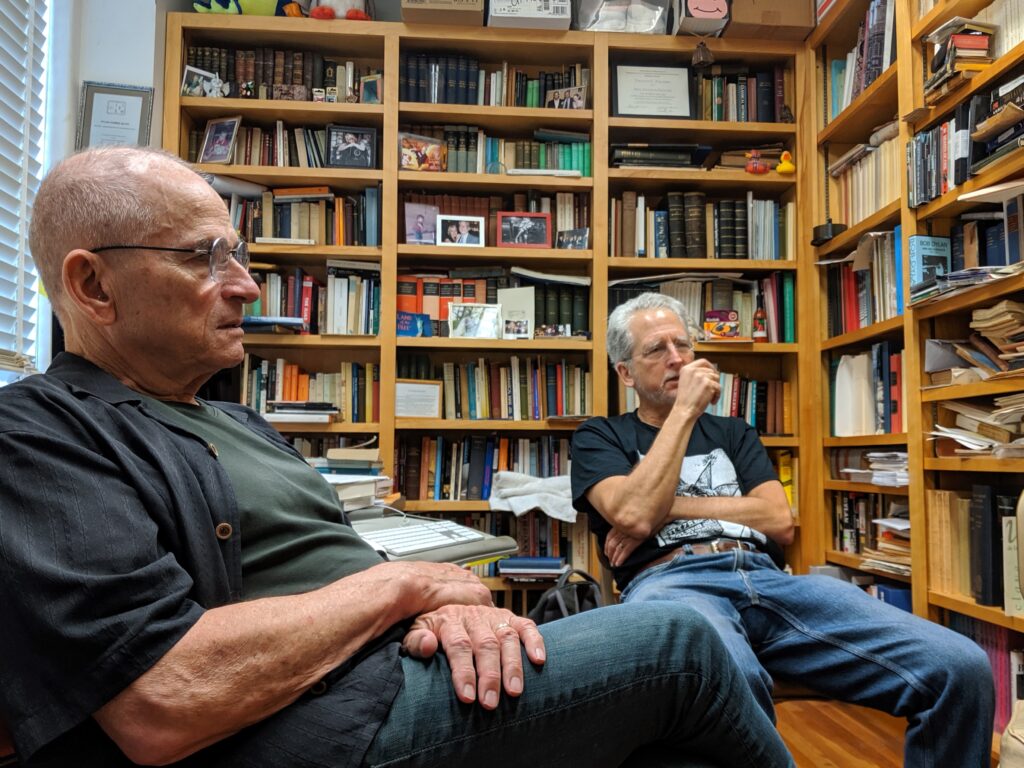
It has been many years since his last trip to the University of Texas for a performance, but Stanley did not miss a beat. The atmosphere conjured by his performance, the selections from the poems and their shared themes made the night an absolute wonder. Scenes from both poems, though nearly a thousand years apart in composition, echo each other, fluidly transition into one another. In both, Stanley vividly expresses Thetis’ concern and her looking after Achilles: by hiding him on Scyros in a virgin’s dress in Statius, to later protecting Achilles in war, when she suits him in his new armor crafted by Hephaistos in the Iliad.
To honor Lombardo’s long tradition of performing Homer and other poets at UT, PASP is making accessible an mp3 of recordings of his reading Homer’s Odyssey on KUT Radio. It comes from his visit to the University of Texas in 1999, almost twenty years to the exact date (October 4) of his visit last week (October 10). Then, he was participating in the Plan II symposium “How War Changes Lives” organized by Plan II Honors and professors Paul Woodruff, Tom Palaima and others. In this recording, Lombardo reads three scenes from his Odyssey translation: Odysseus’ attack on the suitors, Penelope’s recognition of Odysseus, and Telemachus’ visit to Pylos in Book 3. In addition, Palaima joins him on this recording with a reading of his own of the Odyssey in Greek. Throughout the recording, they converse on themes of war as they relate to veterans in Homer and to the present day in the United States.
The recording has a run length of twenty six minutes. Connect to the file by the URL below:
https://utexas.box.com/s/xc2ezspzdsvtgs8lpv2rsrtxirajkyem
Here’s the navigation mark-up:
At 00:00, the recording begins with Tom Palaima introducing Stanley Lombardo and his works.
At 01:27, Lombardo introduces the Odyssey and what scenes he will read (Odysseus and the Suitors, to begin).
At 03:30, Palaima reads the Odyssey in Greek
At 04:10, Lombardo reads the scene of Odysseus confronting the suitors in his home
At 10:59, Lombardo reads of Penelope’s recognition of Odysseus
At 16:29, they break and discuss themes on war, the “How War Changes Lives” symposium
At 23:51, Lombardo finishes the segment with Odyssey Book 3, of Telemachus in Pylos
We thank the Plan II Honors Program for organizing the performance on October 10, 2019 and look forward to future works by Stanley.
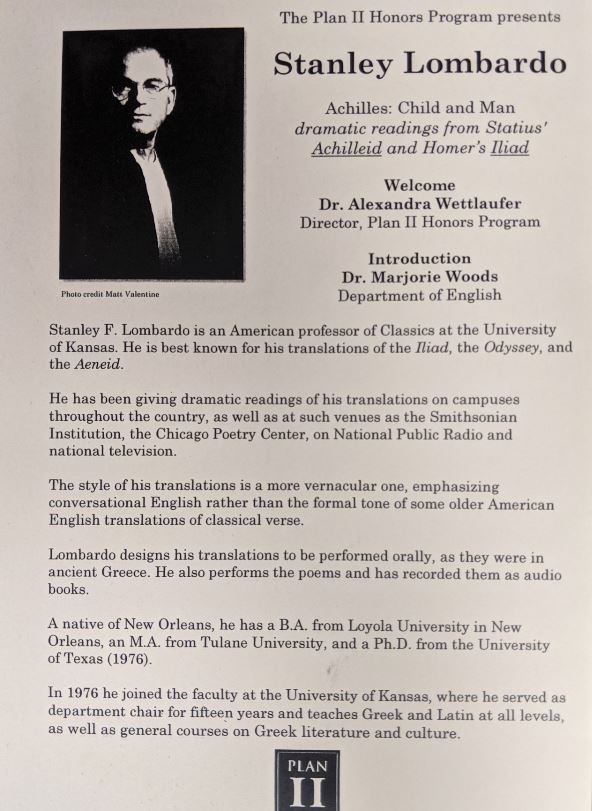
Updated on October 19, 2019 by Garrett R. Bruner. garrettbruner@utexas.edu
October 1, 2019
Michele Mitrovich Awarded AHEPA Scholarship
Congratulations to PASP researcher and PhD candidate Michele Mitrovich for her outstanding research and work which has been recently awarded with a scholarship by the Manhattan Chapter of the Order of AHEPA!
We at PASP are very honored to work with such distinguished company while she assists us on our archival collections and processes RTI images of the Pylos tablets. We look forward to all her future endeavors, from her upcoming presentation at the 18th International Aegeaum Conference in 2020, to her study and publication of Minoan ceramics from Mochlos, Crete for the Mochlos Archaeological Project.
Read more about her work and AHEPA at the announcement through Hellenic News:
Updated on October 1, 2019 by Garrett R. Bruner. garrettbruner@utexas.edu
September 2019
On the Trail of Cypro-Minoan by Cassandra Donnelly
In 2018, PASP scholar Cassandra Donnelly was awarded the CREWS fellowship to pursue research on the Cypro-Minoan script. Here, she shares her travels, research and challenges.
Travels Abroad
As summer winds down and a new semester begins without me at Texas, I feel like it’s a good time to reflect on the past four months I have spent abroad (with eight more to go!) conducting research. A third of my way through my journey so far, I have studied Linear B tablets, Cypro-Minoan clay balls, inscribed miniature vessels (the cutest), and even a Cretan Hieroglyphic nodule. I’ve visited the Fitzwilliam, Ashmolean, and British Museums, and now the Cyprus Museum. Along the way, I have made stops in England (3 months), Italy (4 days), Greece and Israel (3 weeks), and have finally arrived in Cyprus where I will stay for the next six months. Enjoying the scenery, I have swum in the Cam, the Thames, a few of London’s best Lidos, and the Ionian, Adriatic and Levantine seas.

Cypro-Minoan Research in Cambridge
Along with the swims, I’ve immersed myself in researching Cypro Minoan subjects at Cambridge with the CREWS project. Dr. Pippa Steele, the director of the project, has created a welcoming environment where intellectual engagement goes part and parcel with individual research. Wednesday’s were the social day in my schedule. These were the days for CREWS project meetings and the E-Caucus linguistics and script seminars. Project meetings were a time for the CREWS scripts nerds to present research, ask questions, and, occasionally, debate key terms in writing systems studies such as “font.” The Eastern Mediterranean scholars among us shared the task of running a 5-week seminar with the theme “Cypro-Minoan.” Dr. Steele introduced the corpus, I contributed a lesson on the potmarks, Philip Boyes detailed the Cypro-Minoan presence on the Syro-Palestinian coast, and Giorgos Bourgiannis concluded the seminar with the spread of Cypriots and their syllabary in the Iron Age.
Most days in Cambridge were spent in the Classics Library. The resources and staff there are world class. I was quickly able to accomplish the goal I set at the outset of the fellowship, to assemble and analyse the list of all known Late Bronze Age Mediterranean inscribed bowls. The inspiration for my study is the inscribed silver bowl from Hala Sultan Tekke, a coastal trading centre on Cyprus’ south eastern coast. The bowl has always intrigued me since the inscription is in a rare offshoot of Ugaritic alphabetic cuneiform, sometimes referred to as the “short” or “reduced” cuneiform alphabet, which is usually found on the Levantine coast. The metal bowl writing medium, on the other hand, is right at home in Cyprus (where we have 9 examples) and foreign to the Levant, where no examples have been found. In addition to the Cypriot examples, my research acquainted me with Anatolian Hieroglyphic inscribed bowls (4 in number), and to examples of inscribed ceramic bowls from the Levant in both the Egyptian Hieratic script and the Proto-Canaanite alphabet (or Phoenician alphabet, as it later became known), and one example from Egyptian Thebes in Egyptian Hieroglyphic. I was immediately struck by the relative scarcity of such objects in the period under discussion, their concentration in the Eastern Mediterranean, and the number of “scribes” implicated in their production.
The involvement of scribes in the production of these bowls is interesting because the bowls seem to have been given as gifts by one official to another. Sometimes, the scribe not only creates the inscription but also is the giver of the gift too. One of the scribes in question is a Hittite official by the name of Taprammi, who we know from other Anatolian inscriptions in Hittite Hieroglyphs and from Ugaritic tablets found in Syria. From those, we learn Taprammi had several roles within the Hittite administration in both ritual and administrative posts. In those roles, he traveled widely. There is evidence Taprammi took a trip to Syria to conduct business negotiations with the king of Ugarit. (whether on behalf of the Hittite government or his own interests is unclear). His ability to write in Hittite Hieroglyphs appears to be just one of the skills he learned among others. This is in stark contrast to what we know about scribes trained in the cuneiform tradition whose sole role was to craft documents. The figure of Taprammi helps us to imagine the activities of Cypro-Minoan writers who also do not appear to have been trained along the lines of cuneiform scribal training.
Looking Ahead
After the inscribed bowls studies, I have now moved on to my dissertation work. The bulk of this will be completed within the Cyprus Museum, about which I will write more when I have another opportunity to reflect.
Away from home, other thoughts occur and not just on my studies. Many American academics in Classics and adjacent fields love to travel. We are interested in places far away from our homes and have dreams of travel. The reality is that most of us only get to travel intermittently, every summer if we are lucky enough, but not always even then. So I am going to try and make the most of this opportunity and pop back in a few months to let you know how it’s going.
Updated on September 19, 2019 by Garrett R. Bruner. garrettbruner@utexas.edu
July 2019
PASP featured in SAA Archival Outlook May/June 2019
The Program in Aegean Scripts and Prehistory was featured in the May/June issue of the Society of American Archivists’ Archival Outlook. The Ancient Past: Learning a Language to Connect Materials with Users was authored by PASP archivists Sarah Buchanan and Garrett R. Bruner.
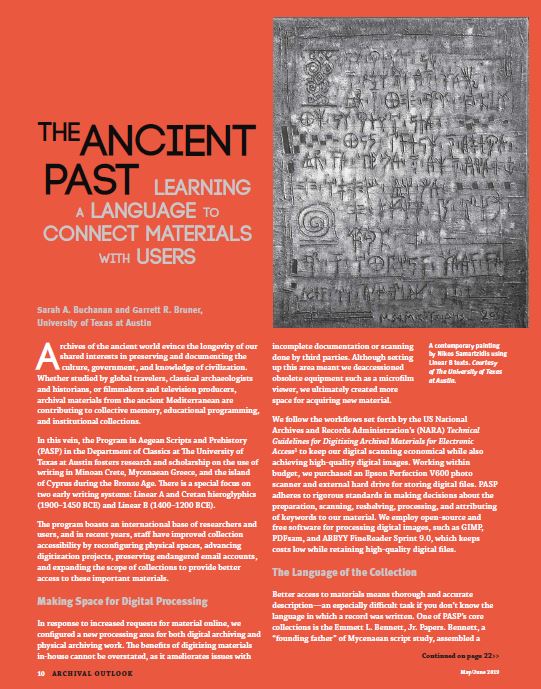
Archives of the ancient world evince the longevity of our shared interests in preserving and documenting the culture, government, and knowledge of civilization. Whether studied by global travelers, classical archaeologists and historians, or filmmakers and television producers, archival materials from the ancient Mediterranean are contributing to collective memory, educational programming, and institutional collections. In this vein, the Program in Aegean Scripts and Prehistory (PASP) in the Department of Classics at The University of Texas at Austin fosters research and scholarship on the use of writing in Minoan Crete, Mycenaean Greece, and the island of Cyprus during the Bronze Age. There is a special focus on two early writing systems: Linear A and Cretan hieroglyphics (1900–1450 BCE) and Linear B (1400–1200 BCE). The program boasts an international base of researchers and users, and in recent years, staff have improved collection accessibility by reconfiguring physical spaces, advancing digitization projects, preserving endangered email accounts, and expanding the scope of collections to provide better access to these important materials.
University of Texas Libraries Texas Scholarworks permanent link: https://repositories.lib.utexas.edu/handle/2152/74857
Keep checking back for more updates on PASP archives projects.
Updated on July 27, 2019 by Garrett R. Bruner. garrettbruner@utexas.edu
July 2019
Summer 2019 Recap. By Garrett R. Bruner
Overview
For three years I have served on the Oplontis Project under the direction of Dr. John Clarke and Dr. Michael Thomas. The Oplontis sites are located in the small town of Torre Annunziata, about ten minutes from Pompeii. Oplontis shares the same fate of its neighbors Pompeii and Herculaneaum of being destroyed by Vesuvius in 79 AD. On site for the four week excavation season, my role is to catalog the finds recovered from our opened trenches.
After the season’s end, I stayed in London for two weeks to do further research on archiving and data management of archaeology projects. This research began in the aftermath of learning, years ago, about the erasure of Dr. Emmett Bennett Jr.’s email account at the University of Wisconsin following an Office365 migration. It still puzzles me. It raises the question, what plans are there by departments to archive their faculty’s research? Is there a plan for UT Classics?
I used this trip as a sort of launchpad to begin to answer this question. Before leaving, I had many discussions on this with other faculty and archivists at the University of Texas to frame questions for interviews and get wider perspective. Conversation touched on some Emeriti who possess decades of irreplaceable archaeological records and research but with no place to store it. On this trip, I wanted to compare how other universities are preparing faculty to preserve their research beyond publication and how to organize something of this scale for any department. I was fortunate to interview and brainstorm with many archaeologists, professors, archivists and digital archivists, architects, and data coordinators to begin to answer these questions. A final objective from these discussions and research would be a proposal which would address the issues and recommend solutions.
This report briefly recaps these trips and discussion.
Oplontis Project Season 2019
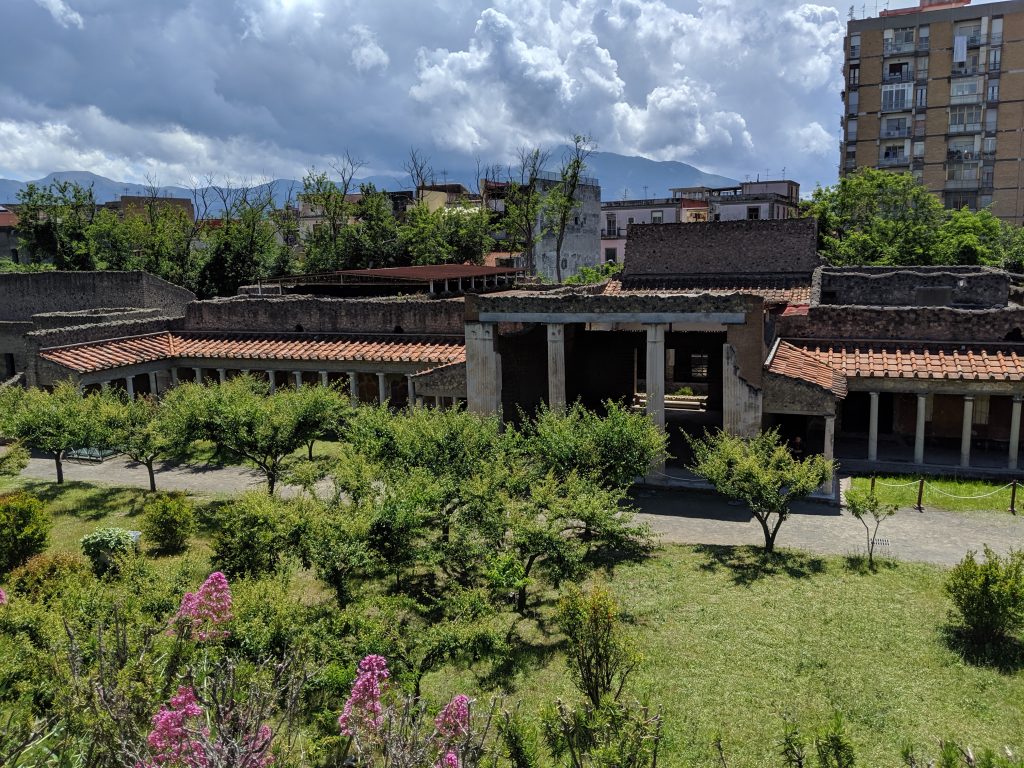
I began my trip in southern Italy at the archaeological site of Oplontis for the 2019 excavation season. This lasted from May 20 to June 15. There I worked on a number of cataloging projects regarding our excavation’s finds. My normal project is the on-site finds processing of recovered finds from opened trenches. This year, however, we completed a number of projects concerning our backlog in addition to normal processing. These related mainly to holes in our database and finds inventories. Last, I put together an inventory of the Special Finds excavated by the Oplontis Project at Villa A for future publication.
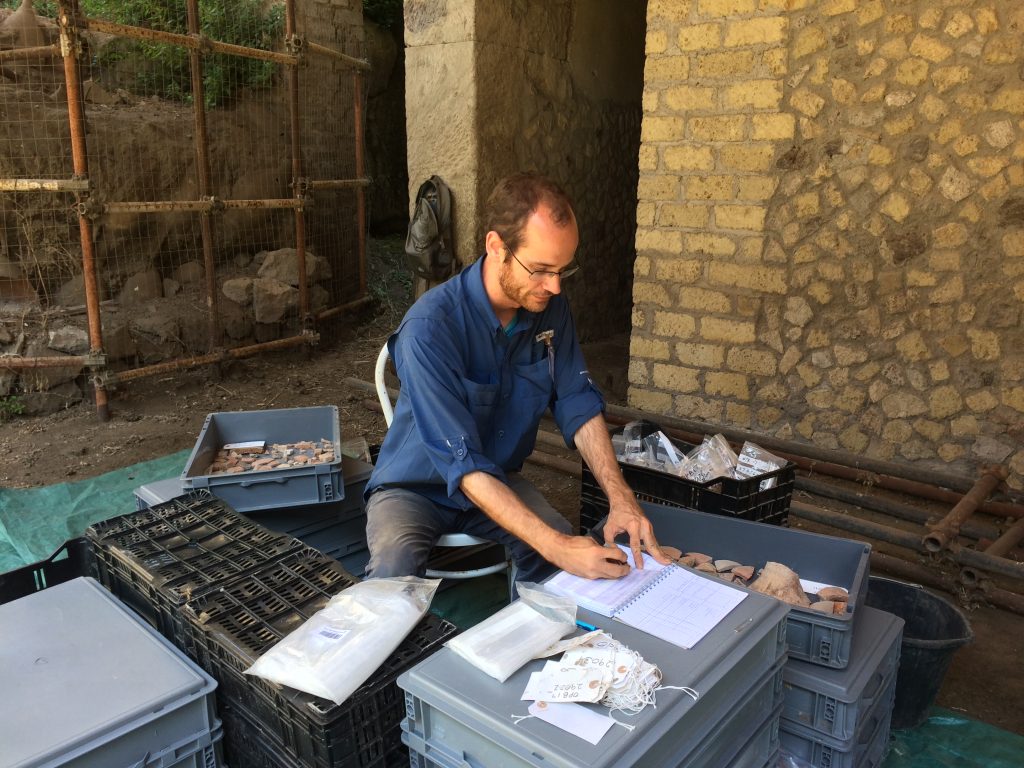
The season went well. It began with a lot of rain and a few cool days and ended with days hitting over 100 degrees (which is good for pot washing). With my team of catalogers, we completed all cataloging of this year’s finds, re-housed previous seasons’ finds in order to create new shelving space, and re-cataloged many of these old finds which were not consistent with current standards. All of this work will be entered on our database for the most up-to-date inventory of the objects recovered at the Oplontis Excavations.
In the back of my mind throughout all of these excavations is the question I also ask at PASP. What plans are there to archive this research, by professors or departments? If there is no plan, should there be? A season of excavation produces all sorts of records and metadata, like finds inventories, stratigraphy data, environmental sample analysis, photographs, and drawings. What is the future of the data collected for the Oplontis Project, or any archaeology project at the University of Texas, apart from its publication?
On these concerns, I had good conversations with architect Jess Galloway. Galloway serves on the Oplontis Project as a researcher of the Villa architecture and waterworks and has decades of experience with archaeology projects. Specifically we touched on legacy media and obsolete data collection by old versions of the AutoCAD software which he uses to capture precise measurements of the site’s architecture. This is a application many archaeology projects use.We discussed how old versions can be still emulated or migrated to stable formats. The importance of this is crucial: legacy archaeology projects, like in the 1980s-2000s, would record architecture or contextual information using AutoCAD but this data can possibly become obsolete with every new version. Soon, data might be irretrievable. Already, it is expensive to retrieve.
Reasons AutoCAD should be preserved that we touched on:
- Protects the integrity of the research
- Archaeology sites can be destroyed or change over time
- If the site is changed, old records can restore or inform original states
- Reduce costs now by migrating earlier to stable platforms
- AutoCAD (and other proprietary software packages) requires expensive licenses, making access to data difficult for collaborators

In the middle of the Oplontis season it was by good fortune that I met the former PASP archivist, Sarah Buchanan. One afternoon, we met by chance in the hotel lobby where I was lodging, “Hotel Villa dei Misteri”, located only a few minutes walk from the Porta Marina entrance to Pompeii. It was good to meet her (in person) finally, briefly catch up, and learn about her latest work. Over the summer, she worked on site for the Venus Pompeiana project, performing data management and collection.
There, we also caught up on our PASP report recently published by Archival Outlook.
Digging did not fill my entire schedule. On weekends, we were free to travel, so I made it to Baia, Naples, and Pompeii. Another group made it to Capri. The ruins of Baia were spectacular (grab the train from Naples to Lucrino and walk the rest of the way to Baia). Some highlights of Baia are its spectacularly placed Aragonese castle, its expansive Baths including the echo-chamber Temple of Mercury, and amazing coasts. Ruins are scattered throughout the city; a minute from the docks is a Temple to Venus and in the center of town is a huge ruin (shaped like an open egg) known as the Temple of Diana. Nearby Baia, fifteen minutes walk from Lucrino, is Lake Avernus, a volcanic lake where it was written in antiquity to be the entrance to the underworld.
What amazed me was Baia’s absence of tourists for all its wealth of offerings. On a Sunday, castles, ruins, and beaches were all the more pleasant without fighting through crowds. Within the baths, I saw perhaps three or four people and no guards. There you could freely wander through tunnels, up and down stairs, observe frescos. It wasn’t too hot, with plenty of shade. Experimenting with the Mercury temple’s otherworldly echoes was an unexpected marvel. All this contrasts with Pompeii, where houses can be shut, guards can be too much, peddlers can be annoying, and crowds can spoil a view, or, the day.
Between the Oplontis season’s end and arriving in London on the next leg of my trip, I was able to spend time in Ravello and its awesome Villa Cimbrone, see many churches in Naples, and visit the Borghese Museum in Rome.
London
After Italy, I visited the United Kingdom for two weeks, basing myself out of London. This was my first visit ever to the UK. There, I had a few appointments with archives on the subject of what is done for preparing or processing Emeritus papers within their institutes. Also, I spent time at Museums to get first-hand knowledge of Linear B and Myceanean Greek history. Last, I also caught up with former PASP visiting scholar Regina Dürig who is nearing completion on her Alice Kober dissertation research. (One exciting detail was that she discovered a “new” photo of Kober on an archaeology project).
British National Museum
My lodging at the International Hall within the University College of London made it easy to visit the British National Museum. It was a ten minute walk from “home” in Russell Square.
This is one of the world’s largest museums covering cultures from Ancient Egypt, Greece, Japan, India, Africa, in nearly every era and all geographies in-between. The wealth of objects is indescribable and overwhelming, from the Rosetta stone, to Egyptian mummies, a full Samurai suit, and the Elgin Marbles. It takes some bit of planning and concentration not to get side-tracked. What interested me, primarily, then, was the Mycenaean Greek and Greek Epigraphy sections as they related to Linear B. The Museum holds two Linear B tablets on display amid a number of other Aegean script items (below, also are terracotta ball inscriptions in Cypro-Minoan script). This is the first Linear B tablet I have seen. Their size, which I had already known to be small, still is striking to me, especially the size of the written characters. Coming off my archaeology trip, there was so much to learn from the archaeological context of Linear B items with respect to what other objects exist. I had not seen many of the As an archivist, their provenance interested me (it was written they came to the British National Museum from Arthur Evans’ collection).
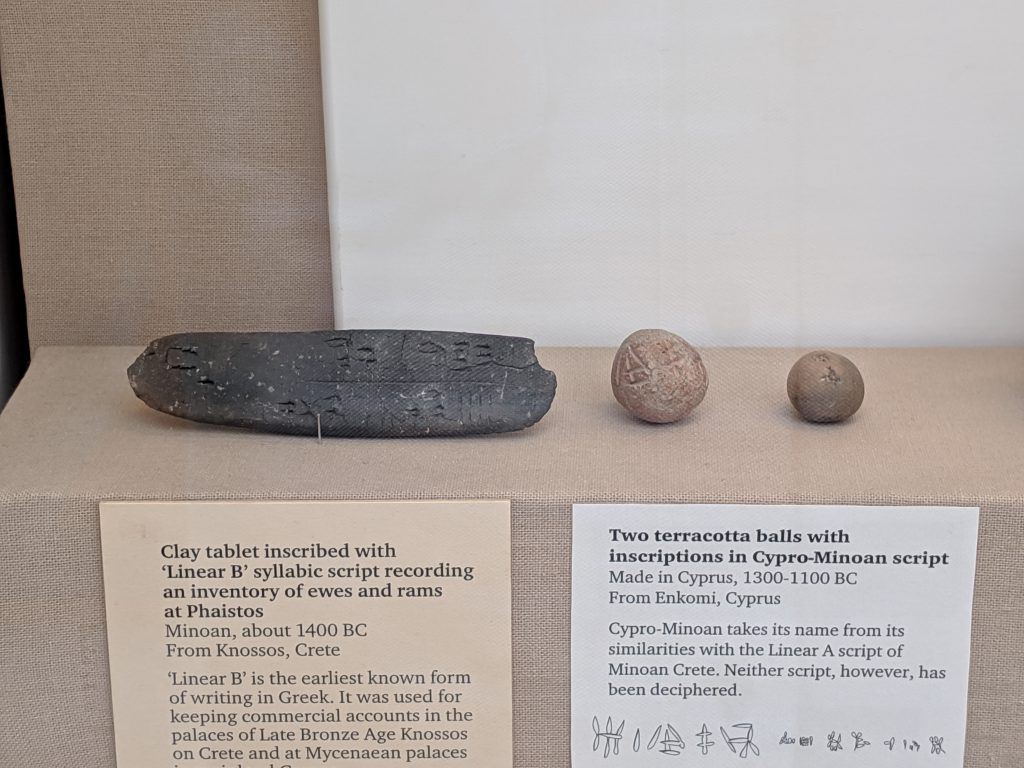

Cambridge
After my first weekend in London, I visited Cambridge for a day trip to meet their Classics Archivist, see their classics archive repository, and visit the Mycenaean Epigraphy Room. I was fortunate also to meet PASPian Cassie Donnelly who recently was awarded the CREWS fellowship. She has been there since early May.
In my meeting with the Classics Archivist, I learned Cambridge Classics shares many dilemmas and solutions as PASP regarding how to archive Emeritus collections. Some of them are sensitive. Specifically, like anywhere, funding and staffing is an issue. This has the effect of simply putting archival processing “on ice.” Archivists are stretched thin working on several projects at once. Another problem is how to get professors or their heirs interested and welcome their collections. As equal a dilemma is then the processing and “selling” of these ideas to the University as objects with enduring significance. Conversation on how professor collections are “passed around” followed, which seems to be the more traditional (and unpredictable) route of Classics faculty collections being transferred to archives, or, even, accessed. (For example how this relates to PASP, see the letter from Letter From Emmett L. Bennett Jr. to Thomas G. Palaima, June 30, 1992, where on page 2 he briefly relates the a chain of provenance of Arthur Evans’ archival materials).
The archivist also demonstrated to me in some detail their utilizing the Access to Memory (AtoM) platform. This links their online archival finding aids to their collections materials, like that of Alan John Bayard Wace and also links them to a wider network of archives throughout the United Kingdom at Archives Hub. This is a direction PASP must explore, like encoding our finding aids and enhancing the access and browsing of our online materials.
After the meeting, I was toured through Cambridge’s many colleges and old town center by PASPian Cassandra Donnelly. I was shown the Mycenaean Epigraphy Room and felt some distant homesickness for PASP’s archives and excitement for all the archival material remaining to be processed.

Museum of London Archive / Bloomberg London Mithraeum
Back in London, I coordinated with the post-excavations manager of the Museum of London Archaeological Archives (MOLA) at the Mortimer Wheeler House to receive a tour of their operations and after that, a field trip to the London Mithraeum exhibit, located in the basement of the Bloomberg building. Museum of London Archaeological Archives preserves archaeological artifacts and research on London based excavation projects. The goal in this visit was to observe a large scale operation which deals with the creation, publication and preservation of archaeological data. This would inform some idea how to go about this, permanently, at the University of Texas, as opposed to the setup I am familiar with, which is project-by-project (like Oplontis or The Institute of Classical Archaeology).
This was a very useful field trip. The manager took me from bottom to top: from loading docks where recent finds had been delivered and their being processed, to the work floor where they are researched, to the databases they are linked and mapped out on ArcGIS, to their publication in books. From there she showed and demonstrated to me an RTI (Reflective Transformation Imaging) station used to photograph writing tablets from the London Mithraeum, something similar which has been done for many Linear B tablets.
It was important to see the organization and structure of tasks assigned to specialists. It amazed how their work cohered, how the division of tasks gets so much completed.
After, we visited the ruins of the Temple of Mithras in downtown London. The London Mithraeum is in the City of London area and originate from the 3rd century Roman London. Upon entering the entrance in the Bloomberg building, visitors are first faced with a wall of finds on exhibition from the site. They are diverse as iron nails to mosaics to writing tablets. One writing tablet on display actually contains the oldest mention of London.
Downstairs, visitors enter the lowest level of the site, seven meters beneath modern pavement. It is called the Mezzazine. There, one waits for the next presentation of the Temple of Mithras ruins. In the waiting area, there are more interactive displays which provide information on the history and mythology of the Mithras cult. They also tell the story of the temple ruin’s discovery after the Blitz, their public exhibition (and slight damage) on the streets for several decades, to the modern reconstruction now housed below the Bloomberg building. Resin casts of the tauroctony are explained in detail for their symbolic imagery by the displays. (The real tauroctony and some other sculptures of the London Mithraeum is on display at the Museum of London, a few minutes walk away).
Visitors are then let into the room housing the ruins. It is a large, dark, rectangular room, with the ruin walls set into the floor. Visitors walk on a platform around them. Then, a rectangular box of light encloses the ruins, mist lightly drifts in, and sounds of chanting begin as low murmurs to gradual humming. At the end of the ruins, a large tauroctony altar display glows. Pilasters appear as shadows within the box of light by carefully hung “capitals” dispersed throughout the room.
What really impressed me was the harmony between the Temple ruins and the art installation they were couched inside. The dark atmosphere, sound effects and lighting all conjured an atmosphere of awe for the passing ritual. Then it is over. Visitors are only allowed in for the moment of the “performance” and then are ushered out. This was very different than simply “presenting” the ruins, as, perhaps, could be compared to the British Museum’s Nereid Monument.
It reminded me of the importance of making the Past fresh. There is room for both traditional museum displays and more interactive presentations. In the Linear B realm, the paintings of Nikos Samartizidis conjure similar feelings.
York
A short overnight trip to York included an appointment with the digital archivists of the Archaeology Data Service (ADS) of the University of York. ADS sets the standard for the digital preservation of archaeology data ranging from commercial to academic projects within the UK. They preserve and make widely accessible completed archaeological datasets from around the United Kingdom.
An American counterpart is the Digital Archaeology Record (tDAR) and Open Context, two data repositories that are specifically for archaeological data. Here at the University of Texas at Austin, the Texas Data Repository (TDR) is a new option for archiving any kind of data produced at UT. It’s free for UT researchers but not just for archaeology data. Currently PASP has two datasets, SMID and the Cyprus Inscriptions database, preserved and accessible at the Texas Data Repository.
A few lessons from the Archaeological Data Services:
- They provide guidelines to users on how to submit and curate their data for longterm preservation
- Publishing their own research on changing standards and technology
- Simple yet rigorous data management help
- Paid service. Researchers must budget for future preservation.
My take away from this meeting, with respect to my own research of how to preserve faculty collections, are the costs. ADS is not free nor is it cheap to run. Digital archiving requires maintenance, staffing and money for continued access. Here it was highlighted that these costs should be addressed in earlier research phases of archaeological projects.
Outlining a Path Forward
The purpose of this visit was to survey what options exist for archiving faculty collections which include archaeological records. It highlighted a number of mutual dilemma across many institutions and also solutions. These would be addressed to not only PASP but also UT Classics more generally. This trip was only a beginning to collect information on this problem.
There’s no easy answer. Emeritus professors should not worry what happens to their materials after retirement. A plan for archiving their papers properly would address many issues raised from this trip (and experience):
- Ensure to them there is staffing and space to archive their works properly.
- If they worry their collection is isolated and not used, ensure to them meaningful collaboration within larger archival networks so that they are part of a larger system, like UK archaeology and archives has with Archaeology Data Services and Archives Hub.
- Consider incentives to keep professors papers within their departments.
- Ensure that professors are aware to budget for the preservation of their materials.
- Ensure we provide guidelines so they are practicing some degree of data management to make the transition from its everyday use to longterm preservation is more stable and efficient.
- Consider how to do more than digitize materials; already, PASP does outreach within the department, like Cassandra Donnelly’s “Clay Time” workshop, or, utilizing materials in creative arts, like Samartizidis, or interactively, as in the case of the London Mithraeum, or integrating them into course work. For instance, in the case of archaeologists like Wace or Blegen, archives might attempt reconstructing through GIS site plans or in databases their finds registers.
This summer I was fortunate for all the cities, museums, people (including three PASP-ians), I was able to connect with. There’s no lack for inspiring or practical conversations or ideas. It stressed the variety and prevalence of the interest in ancient history, from traditional museums, to art installations with ruins as a center piece, interactive apps, to pavement drawings of archaeological trenches (like above).
Drawing from it and other case studies (like collections at PASP or at UT), I hope some awareness of the problem has been clearly stated and some solutions that could benefit everyone.
Updated on July 22, 2019 by Garrett R. Bruner. garrettbruner@utexas.edu
May 2019
Clay Time: A Workshop in Late Bronze Age Scripts. By Cassandra Donnelly
During the last week of April, the Program for Aegean Scripts and Prehistory (PASP) hosted its first ever “Late Bronze Age Clay Time! Study Break” in the Classics Lounge in Waggener Hall at the University of Texas at Austin. Approximately twenty undergraduate and graduate students, along with some staff and their children, produced a veritable archive of Late Bronze Age (LBA) tablets. We provided attendees with the clay (local-fire “Longhorn Red” clay from Armadillo Clay), three types of styluses, and one of three different instruction packets. The first type of instruction packet pertained to Mycenaean Greek and Linear B, the second to Ugaritic, and the third to Cypro-Minoan. Each packet included instructions for how to make one of three tablet types, a signary in the corresponding script, and a model text to write in the corresponding language. Each of the texts, once combined, tells the story of the Late Bronze Age copper trade as mediated by Cypriot traders.

The idea for “Clay Time!” arose at the suggestion of our archivist Garrett Bruner. I was in the midst of telling him about my recent experiments in making Cypro-Minoan (CM) clay boules (or balls) at home. Driven by an interest in the distinctiveness of the CM “tear drop” ductus,
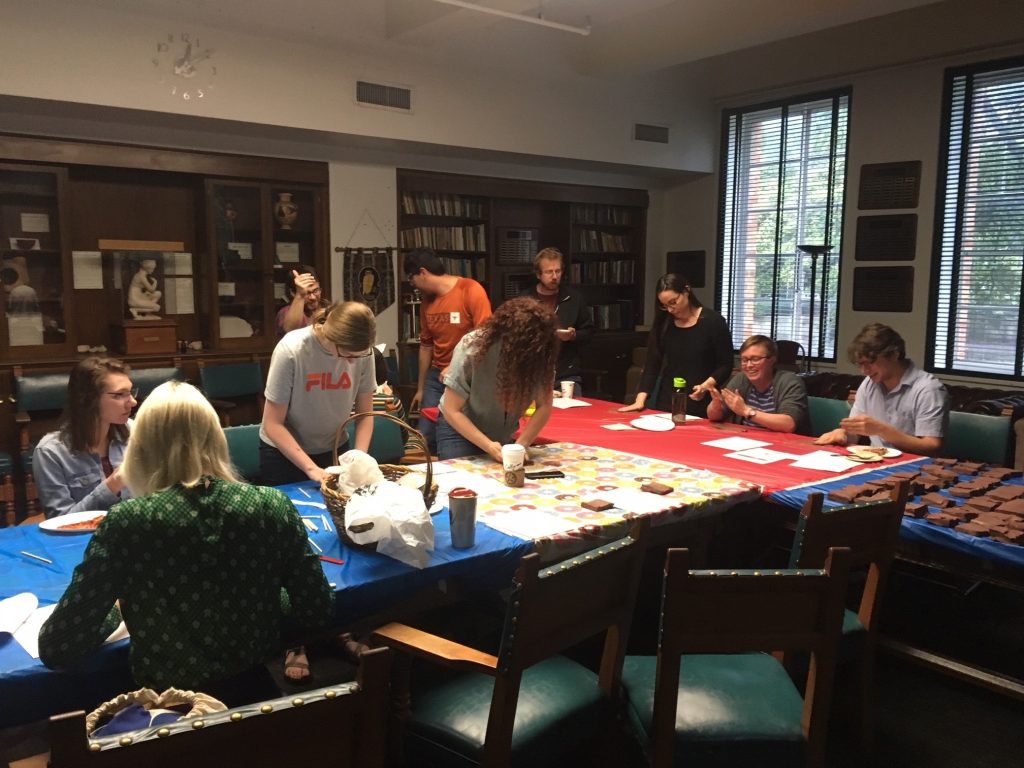
or method of inscription, which features on some CM tablets and balls, I had been experimenting with whether the tear-drop shape comes from the stylus being impressed or drawn into the clay. The former method, of impression, recalls the technique used for making cuneiform wedges, while the latter method of drawing was used to inscribe the signs of the Linear scripts. Registering my enthusiasm for clay time, Garrett figured it would be easy enough to spread. For my part, I figured it would be a nice way to spread the LBA gospel. I may have also been keen to test a hypothesis or two concerning stylus choice and impression vs. drawing styles.

We supplied students with three different instructions for the three different scripts and three different stylus choices.
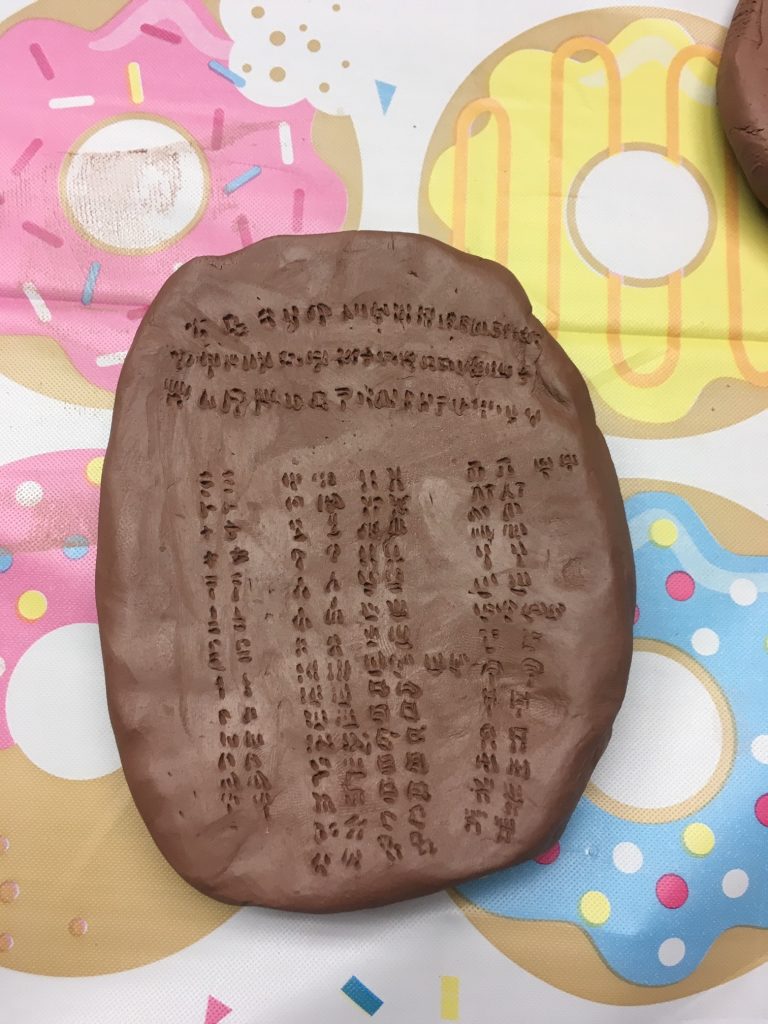
The only thing we did not tell them was which stylus matched which script. The three stylus types on offer were bladed styluses, after the Linear B model, pointed, round-tips for Cypro-Minoan, and rectangular tipped styluses for Ugaritic. The first two stylus types were shaped from wooden dowels using an exacto knife and a pencil sharpener, respectively, and the third, rectangular styluses were unworked chop-sticks. As for the tablets, there were three shapes on offer: for Linear B, leaf shaped tablets, for
Ugaritic, cushion-shaped tablets, and for Cypro-Minoan, convex-shaped tablets (modeled CM ## 208). Instructions for how to shape the tablets were drawn from the work of Thomas Palaima in the case of Linear B, and Jonathan Taylor in the case of the Ugaritic tablets. As both authors have noted, very little is written on the subject. In the case of the Cypro-Minoan convex tablet, no instructions were supplied as none exist (I am mean, I know). In addition to the written instructions, we assembled a powerhouse of script and tablet consultants: Kevin Pluta and Joann Gulizio for the Linear scripts and Øyvind Bjøru and Aren Wilson-Wright for Ugaritic. I was the lone CM expert.
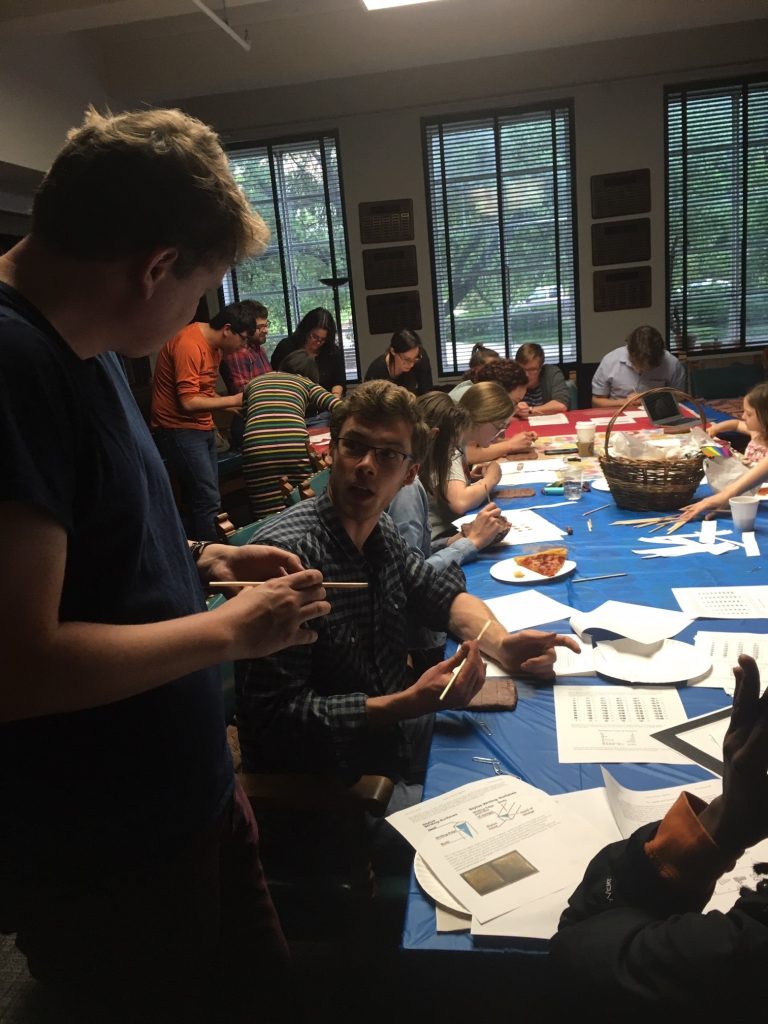
Overall, the day was a success. No one threw their tablets down in disgust or frustration, though one or two people were serial re-pulpers. The places where people needed the most help were in the creation of the Linear B tablet (there was a tendency to make very thin tablets), and in deciding which styluses to use for the Ugaritic and CM scripts. The overwhelming tendency in both cases was for people to try and use the blade styluses first. In the case of Ugaritic this appears to be due to the triangular shape of the blade. In the case of Cypro-Minoan, I believe this was because of the ambiguity regarding whether the script is drawn or impressed. One of the most interesting outcomes to me was that two different people who made Cypro-Minoan tablets, once they hit upon the right stylus-type, experimented with both drawing and impressing signs. They ultimately settled on a combination of the two styles, which is where I myself had landed when inscribing my own clay balls.
All-in-all, the day was educational and fun, both for the participants and for the observer’s alike. A great thank you to Garrett for coming up with such a fun idea!
Updated on May 15, 2019 by Garrett R. Bruner. garrettbruner@utexas.edu
February 2019
Archivist: A Connective Branch in the PASP Ecosystem.
By Sarah Buchanan
Archivists rarely dwell in a sense of finality, rather many archivists position their work as capturing – actively and interventionally – “representative” snapshots of life activities both past and present. We try to supplement the storied box of archival materials that arrives at an archive, with specific dialogue, interviews, or oral history of the persons involved in the creation of the records, so that we may one day tell the materials’ story with authenticity and reliability (to quote a well-known Luciana Duranti article I have the privilege now of teaching in my Appraisal class). Such an approach – one of connecting disparate threads of a story longer than your self – is the one I adopted as PASP Archivist from 2013-2016.
As a first-year PhD student at Texas’ iSchool, I brought a material interest in classical archaeology that could complement a core research agenda in archival studies, especially given the efforts of digital classics professionals at research libraries and archaeological data repositories. A timely conversation with Zach Fischer (MSIS ’13) at the iSchool Capstone event led to my meeting with Dr. Palaima and PASPians Will Bibee and Dygo Tosa (MA ’13) where we discussed preparing archival collections for access. It was a wonderful introduction to the singular resources PASP stewards for an internationally networked community of Aegean scholars. Soon my archival contributions at PASP, which I will describe, were propelling and sustaining my dissertation research and scholarly growth. I am honored to have been able to shape PASP into a world-class resource through archival work.
Jerry E. Ifie (1942-2004), a Classics scholar from Nigeria, was a Visiting Professor at Texas in 1996 and 1997, and PASP had a small collection of his papers. I started with his collection. Writing a biography of the records creator and describing the Ifie items at hierarchical archival levels allowed me to provide better context and awareness for researchers who might encounter the finding aid we contributed to the then-UTDR, now Texas ScholarWorks, in late 2014. I know that Professor Palaima has had undergraduate students interested in Nigeria use this material.
By then, I had also aided in the donation of an archival collection dealing with the undeciphered Minoan/Cretan Linear A script from linguist and textile historian Dr. Elizabeth Wayland Barber. Making a tangible connection between Dr. Barber and Lydia Neuman, then-TAM graduate student and currently head of exhibitions at the International Quilt Study Center & Museum, University of Nebraska-Lincoln, in the course of my work is still to me rewarding reminder of the rippling impact an archivist can have across disciplines and even across generations of scholars.
As PASP archivist, I assisted PASP Visiting Scholars Flavia Carraro (France), Carlos Varias García (Catalonia, Spain), and José Melena (Spain) with their research inquiries.
Closer to home, my participation in PASP’s epigraphy workshop offered to young visitors during Explore UT in spring 2015 and 2016 remains a highlight of my doctoral program.
Dr. Palaima, the Robert M. Armstrong Centennial Professorship, and funding from the Department of Classics and the College of Liberal Arts supported me in activities like the 2014 Summer Course in Greek and Latin Epigraphy held at Ohio State University. I learned much there about archaeological collections management.
Now I integrate museum artifacts as much as I can in teaching archival studies, but meanwhile have returned to epigraphy through research and studying the information practices of scholars in the humanities. Research-wise, Texas helped me connect the field of Classics with archives, continuing today with the cuneiform collections in Austin, Columbia (both in the CDLI, the former thanks to my work with Dr. Adam Rabinowitz, Tiffany Montgomery, and Dr. John Huehnergard), and other museums with which I engage. I have deepened that connection through epigraphical, archaeological curation, and provenance research projects.
PASP launched the informal Scripts Institute in Fall 2014. Dr. Kevin Pluta and I took the opportunity to present to colleagues across campus the early results of our RTI (Reflectance Transformation Imaging) work with Sumerian and Akkadian cuneiform tablets (primarily, but also squeezes and coins). Dr. Alex Walthall’s Digital Archaeology Lab and the UT Libraries’ photogrammetry equipment foster its continuation in exciting directions.
After acquiring the Barber collection, PASP also acquired the William C. Brice collection in 2014. I prepared a finding aid for the Brice Collection and another large collection in the Emmett L. Bennett, Jr. Offprints. These experiences gave me a lifelong toolkit of archival techniques and academic strategies that I continue to draw on regularly as an assistant professor.
I also gained a valuable set of insights by recruiting and interviewing candidates to succeed me as PASP Archivist in early 2016 – learning how to articulate needs and goals in forward-thinking and inclusive ways so as to retain support. Though she and I worked together for only a few months, the time management and multimodal communication skills I developed quickly proved their transferability as I began my work at University of Missouri, notably the ArCla (Archives of Classical Scholarship) collaboration during 2017.
Archivist Garrett Bruner has quickly transformed PASP’s archival operations into a systematic and multifaceted program, expanding particularly its interdisciplinary graduate training, metadata automation, and email preservation achievements.
We have a two-part article forthcoming in Archival Outlook, the magazine of the Society of American Archivists, detailing recent collections processed and ongoing digitization projects. I miss Dr. Palaima’s daily generosity and wise appreciation of the archival enterprise (to quote the esteemed archival educator and our mutual friend Dr. David Gracy), but am so gratified that great work continues with Garrett Bruner.
I have enjoyed talking with fellow Dylanologist on University of Missouri’s campus, Dr. Dennis Trout, about teaching and research and the opportunities we have to build and visualize new branches between archival studies and classical studies.
Keep up with Sarah Buchanan’s work on her faculty page at University of Missouri.
Updated on February 20, 2019 by Garrett R. Bruner. garrettbruner@utexas.edu
February 2019
A Semester in Review by Zoé Thomas
For the months of August through December 2018, I had the opportunity to work with the archival staff of the Program of Aegean Scripts and Prehistory on a large collection of miscellaneous letters found among the various personal effects of Emmett Bennett, Jr.
The collection, which consists of nearly 300 letters, cards, and notes, includes serious academic debates, gentle advice for hopeful scholars, personal letters, and the ever-present bureaucratic correspondence that now is taken care of with e-mails. Working under the direction of the PASP Archivist Garrett Bruner, I learned about the international standards for archival procedures and labeling. Drawing from my previous archival experiences at my undergraduate institution, I eagerly jumped into the process of sorting, naming, scanning, and tracking down missing information about each letter. By the end of the semester, we had just reached the metadata entry phase of the project, and collectively Bruner and I have been tackling this monumental task.
In addition to my work on the Bennett Correspondence project, I helped translate and enter the metadata for a series of letters written in French by the scholar Jean Pierre Olivier, a close associate of Bennett’s and his co-author of The Pylos Tablets Transcribed (usually shortened to PTT in their extensive correspondence). I also worked for the Pylos Tablet RTI project under the direction of Kevin Pluta and Cassandra Donnelly. The RTI project involved transforming a series of captured photographs into a texture-based digital facsimile.
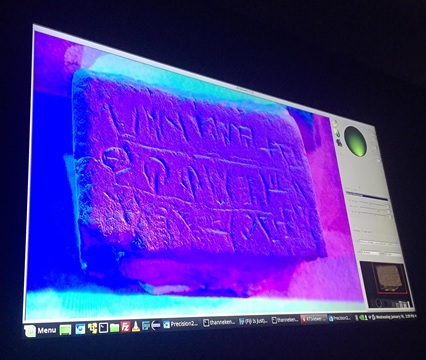
My interest in the RTI work led me to participate in the Multi-Spectral RTI Workshop hosted by the University of Texas at Austin; I brought a cast of the archaic Cypro-Minoan tablet from Enkomi (housed at PASP) to the workshop to create the first digital facsimile of the object using their equipment. Using the images that the team generated, we learned how to use multi- spectral RTI software to create facsimiles for academics all over the world using different forms of light analysis to reveal subtle textural and color changes in the surface of objects.
My time working at PASP was marked by wonderful learning experiences. Professor Palaima kindly gave me the tools I needed to begin learning Linear B; Garrett Bruner happily taught me how to do basic conservation of delicate paper materials; Cassandra Donnelly was a constant source of invaluable information regarding the history of Linear B scholarship. On more than one occasion Bruner, Donnelly, and I worked together as a team to decipher scrawling handwriting, identify scholars and friends mentioned in the letters, and share exciting discoveries we had made in perusing them.

One of my favorite moments was discovering a letter (HMtoELB19651115 – the upload to Texas ScholarWorks is pending) from Hugo Mühlestein, a Swiss scholar , to Bennett. Mühlestein created his own “Mycenaean crossword,” the clues written in French and the answers actually written in Linear B, which he sent to Bennett (along with the key) “puisqu’il est permis de rire.” Hopefully Mühlestein’s work will continue to provide amusement for the Linear B scholars among us willing to take a stab at the crossword — the solution key will be uploaded to Texas ScholarWorks along with the letter. Bennett also kept the sheet of paper upon which he tried to work out Mühlestein’s Linear B crossword. Professor Palaima recalls Bennett doing the New York Times crosswords with a ballpoint pen in about a half hour, sometimes less.
The novelty of a Mycenaean crossword, carefully drawn out by hand, clues thoughtfully laid out and typed, Bennett’s own worksheet included, is a symptom of the most striking thing about Bennett’s personal correspondence — the human side to academia. Excluding the bureaucratic correspondence, emotion bubbles up in almost every letter, whether it is fighting over Linear B theories with other scholars or a heartfelt letter from across the country (or globe!) to Bennett from his former students, scholarly admirers, colleagues, and friends. Many of the letters I worked with were from his students who had gone on to pursue careers outside of Classics. They still took the time to thank Bennett years after the fact for his kindness and his careful instruction. Still more were filled with the little human foibles that mark daily life: the spelling mistakes, the little doodles, the dreams, the rejections, the papers that seem to get lost when we need them and show up right when we no longer want them. On one memorable occasion, Olivier sheepishly writes to Bennett to tell him he found his manuscript notes concerning The Pylos Tablets Transcribed under a loaf of bread (letter JPOtoELB19681009).
For a graduate student just stepping into the world of academia, it is comforting to see “the greats” like John Chadwick, Colin Renfrew, and Bennett himself fall into the same little traps that we all find ourselves in. But the importance of this, I think, goes even further than the implications that our heroes are people too. Our heroes are people who work together to achieve great things. Of course they are bright and capable people in their own right, but it is through collaborative work that we agree or disagree often, learn more, produce our best content, and have the most impact on the lives and work of others. Working with Bennett’s correspondence is a pleasant reminder of the very real role we play in each others’ lives inside and outside of the academic world. This is a truly important ‘something’ that frequently slips our minds as we think about funding, deadlines, conferences, and grading. My time in PASP, living amongst the remnants of Bennett’s letters and his lasting influence, has made me more appreciative of the long tradition of collaboration and the strong sense of community within the field of Classics. Perhaps more importantly, it helps me keep our reality in perspective: that we are humans first, academics second, and that missing paperwork is probably hidden under a loaf of bread.

Zoé Elise Thomas is a first-year Classical Archaeology track PhD student in the Department of Classics of the University of Texas at Austin. Her research interests lie in identity studies, domestic architecture, bioarchaeology, digital humanities, and finding the best cat cafe.
Updated on February 2, 2019 by Garrett R. Bruner. garrettbruner@utexas.edu
January 2019
Emmett Bennett Jr. in Greece, October 1986
In the coming months we will be digitizing correspondence between Emmett Bennett Jr. and Thomas G. Palaima. The correspondence will cover Bennett’s trip to the Peloponessus in 1986. Below, a picture of Bennett with on location from the period.
From Left to Right:
John McK. Camp II, director ASCSA excavations of Athenian Agora and now, too, Stavros Niarchos Foundation Professor of Classics Randolph-Macon College.
Gail Hoffman, then regular member ASCSA 86-87 and now professor of Classical Studies Boston College.
Emmett L. Bennett, Jr., longtime ASCSA member and then professor of Classics and institute for Research in the Humanities, University of Wisconsin Madison.
Joe Walsh, then Oscar Broneer Fellow ASCSA 86-87 and now professor of Classics and History at Loyola University Maryland.
Bill Hutton, then regular member of the ASCSA and graduate student at UT Austin. Now associate professor, Classical Studies, William and Mary College.
Keep checking back as we add more of our collection material to the Texas ScholarWorks digital repository!
Updated on January 16, 2019 by Garrett R. Bruner. garrettbruner@utexas.edu
January 2019
Brent Davis – New Insights into the Language of the Phaistos Disk
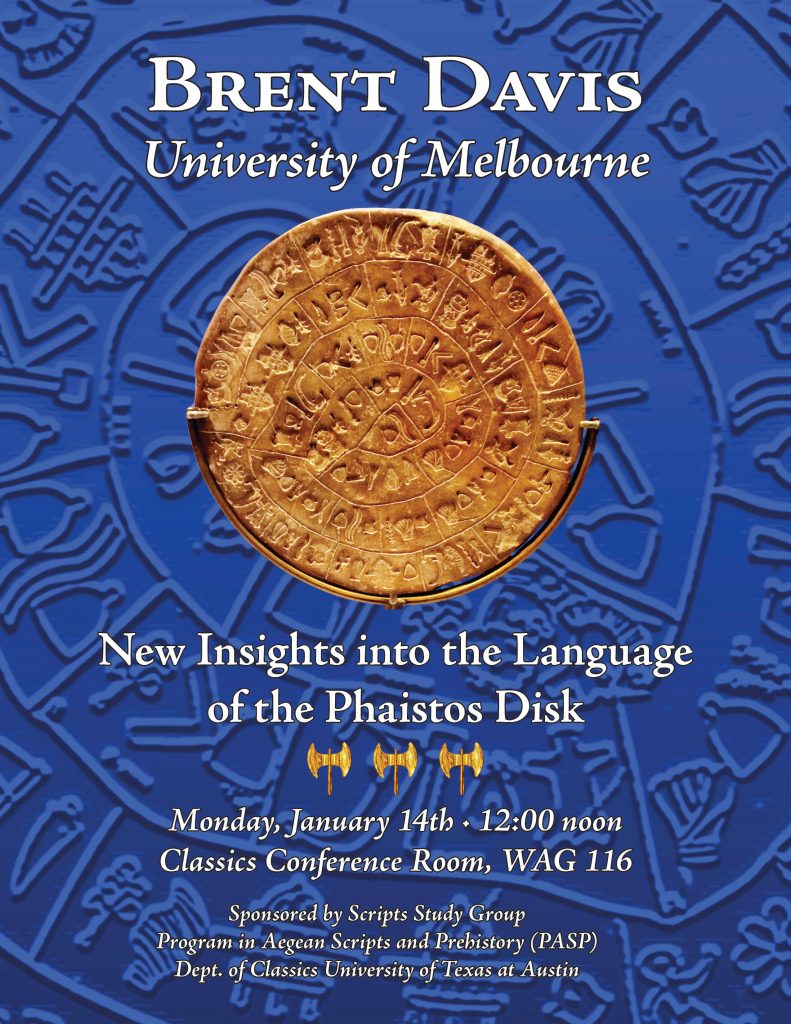
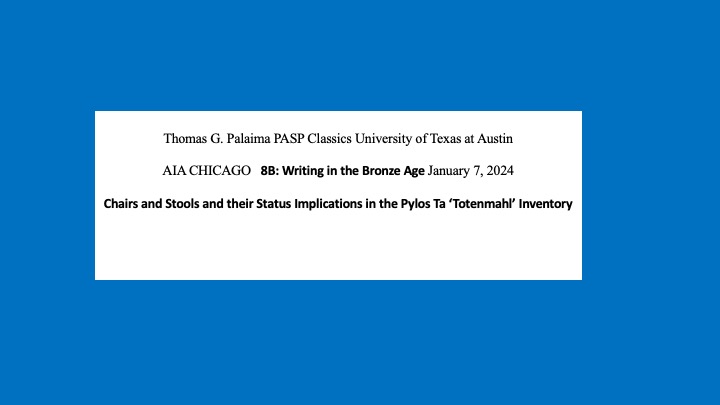
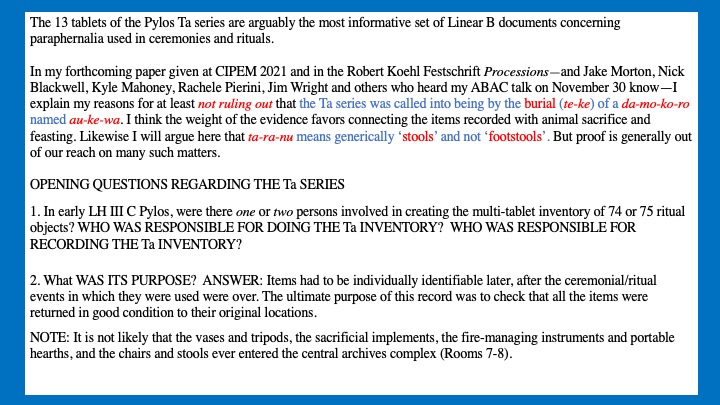

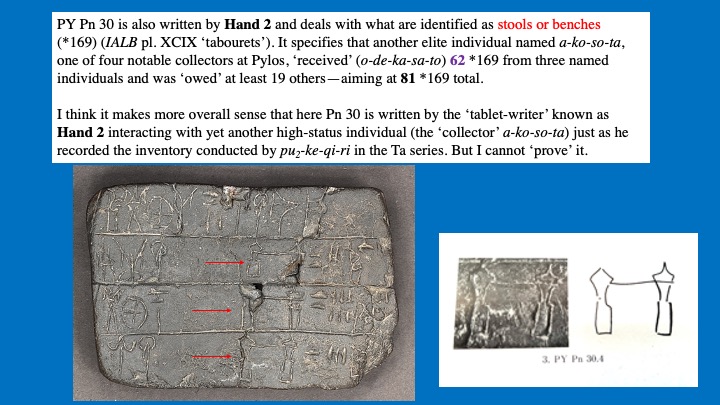
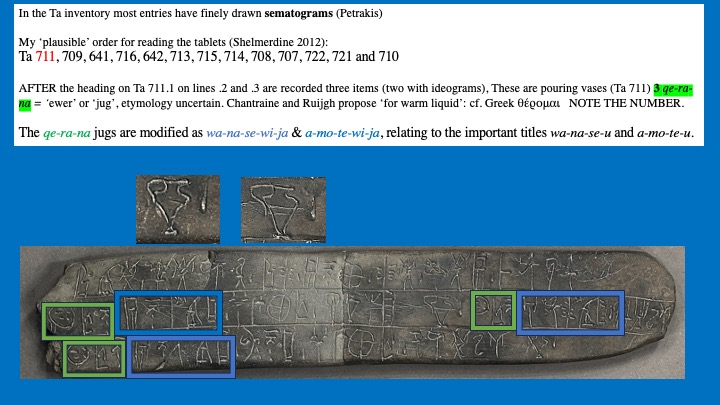
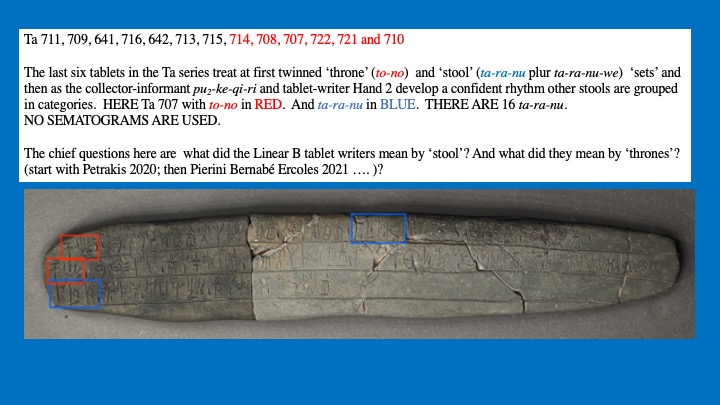
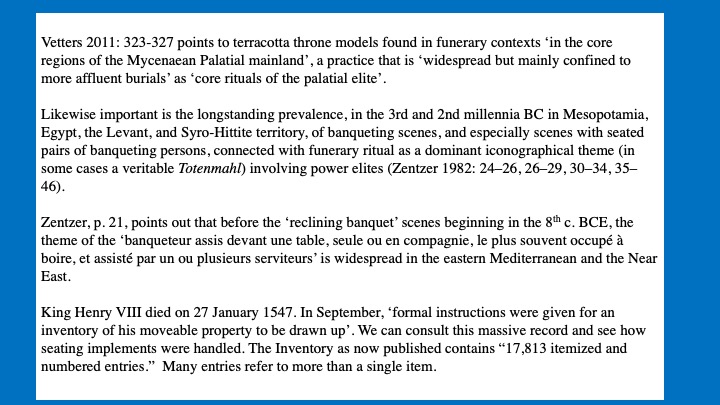
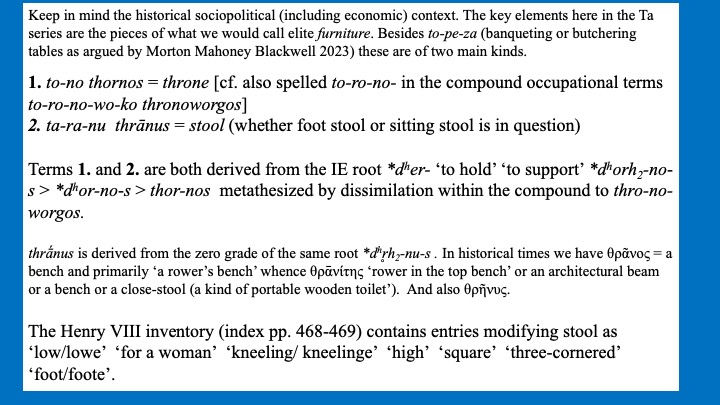
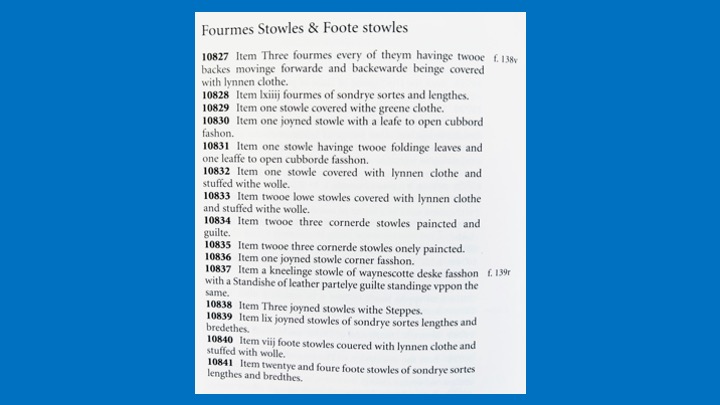
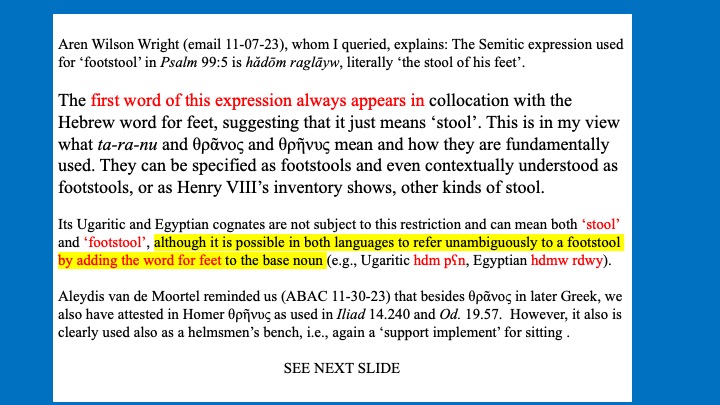
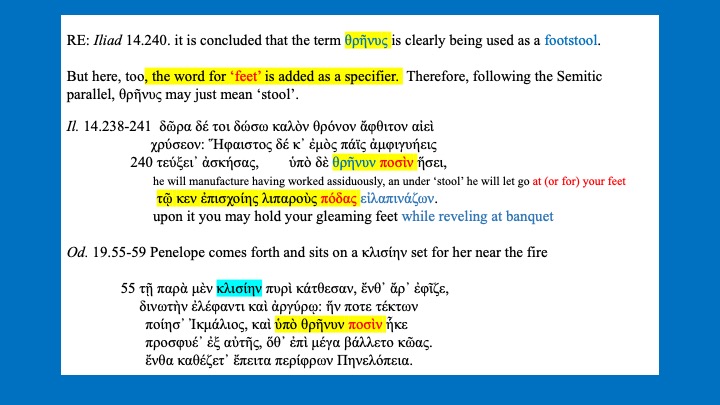
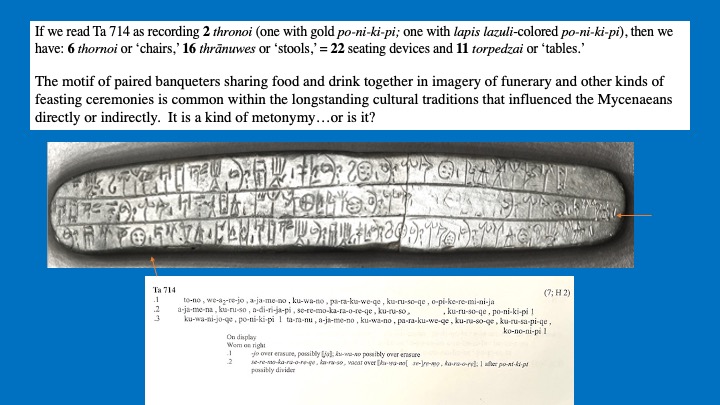
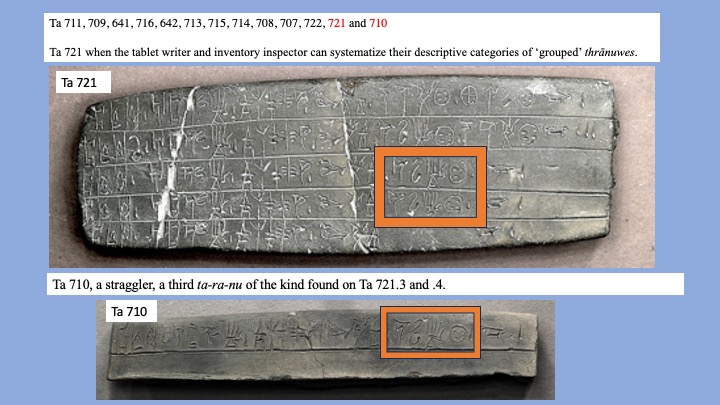
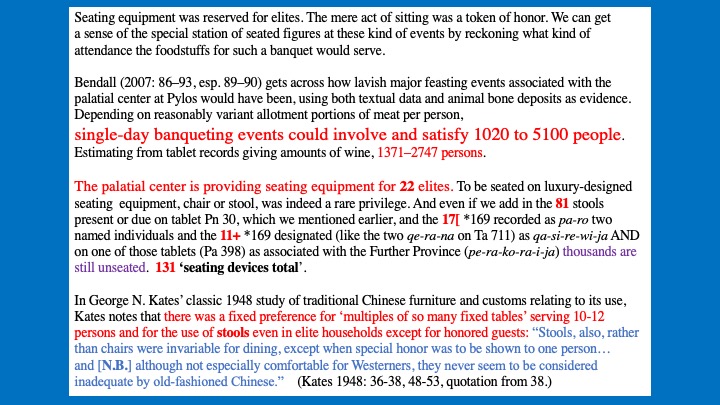
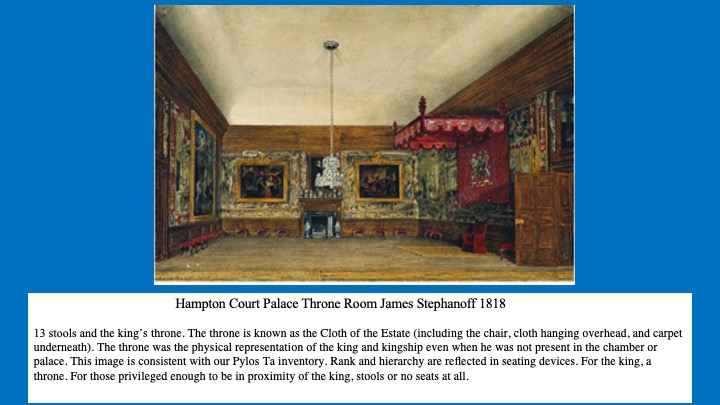

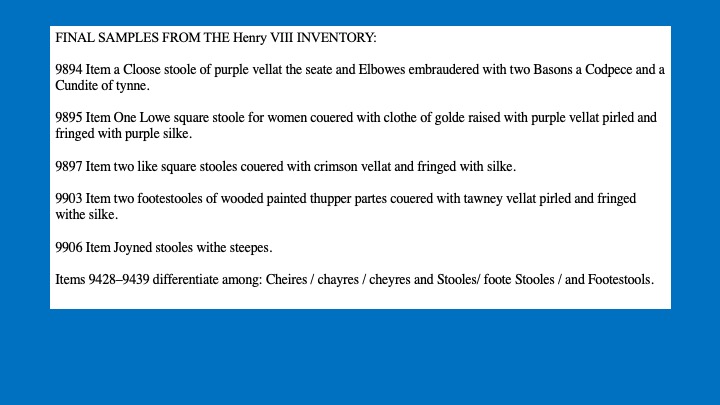

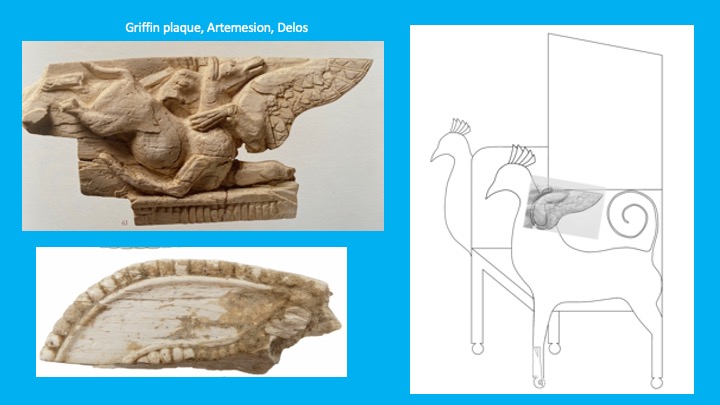
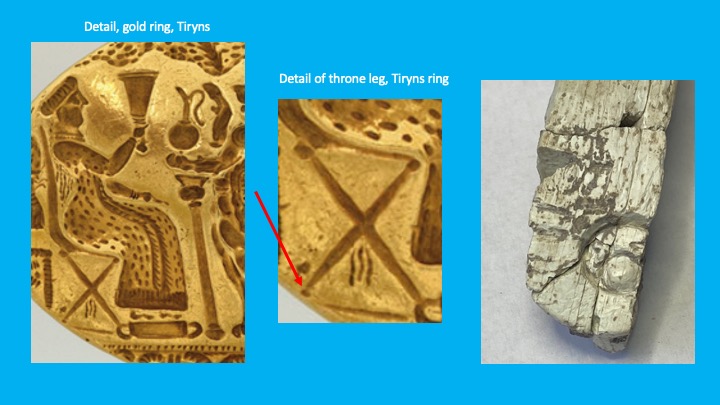
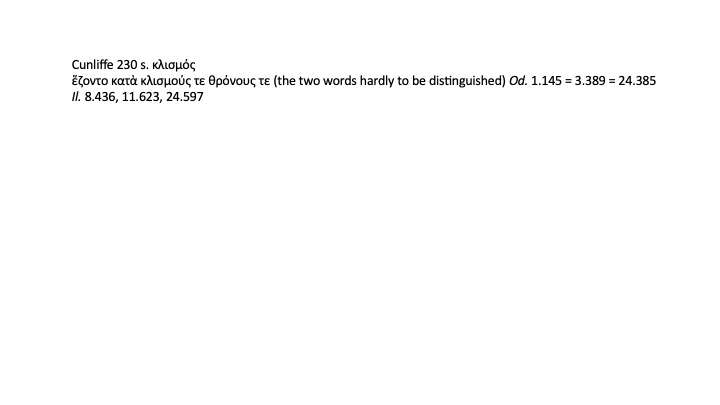
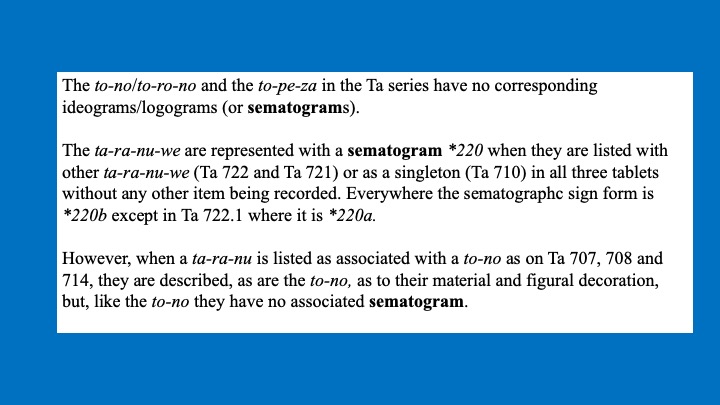


Updated on January 14, 2019 by Garrett R. Bruner. garrettbruner@utexas.edu
December 2018
The Phaistos Disk: A New Way of Viewing the Language behind the Script
Make time in your holiday schedule for the upcoming talk by Brent Davis on the Phaistos Disk!
When and Where: Monday January 14, 2019.
12 noon – 2 PM in WAG 116 Seminar Room
This talk outlines a new linguistics-based method of investigating the languages behind the undeciphered members of the Bronze Age Aegean family of syllabic scripts. Using this new method to compare the script on the Phaistos Disk against Linear A reveals a statistically significant similarity in the behavior of the homomorphs in the two scripts, strongly suggesting that both scripts encode the same language.
Brent Davis is a Lecturer (US: Asst. Prof.) in archaeology at the University of Melbourne, Australia. He received his undergraduate degree in Linguistics from Stanford, and in 2011 completed his PhD at the University of Melbourne on Minoan ritual vessels and Linear A.
With a background in both archaeology and linguistics, his interests include not only the cultures of the ancient eastern Mediterranean, but their languages and scripts as well, particularly their undeciphered scripts. He has published numerous articles and chapters on ancient cultures and scripts, as well as on archaeological theory, and has undertaken more than a decade of archaeological fieldwork in Israel at Tell-es Safi/Gath, the site of a major Philistine city.
Brent’s superb monograph Minoan Stone Vessels with Linear A Inscriptions. Aegaeum (Annales d’archéologie égéenne de l’Université de Liège et UT-PASP) 36 Leuven; Liège: Peeters, 2014. Pp. xxiv, 421. ISBN 9789042930971 was reviewed comprehensively by UT’s own Aren Wilson-Wright and Tom Palaima in Bryn Mawr Classical Review: http://bmcr.brynmawr.edu/2015/2015-11-36.html .
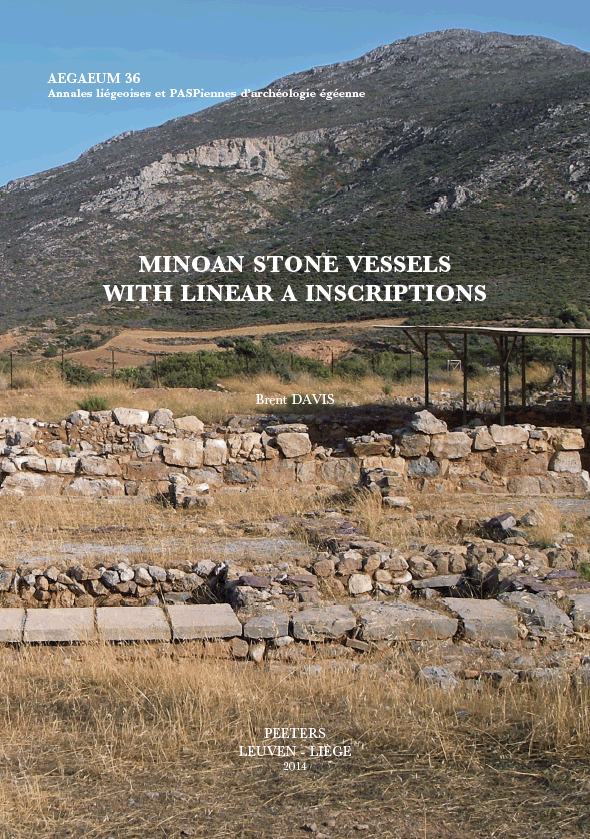
Updated on December 15, 2018 by Garrett R. Bruner. garrettbruner@utexas.edu
December 2018
PASP Visit Report by Helena Tomas, University of Zagreb
Zagreb, 7 December 2018
Faculty of Humanities and Social Sciences
 University of Zagreb
Ivana Lučića 3
10000 Zagreb
Croatia
A report for the Visiting Scholar Fellowship at the University of Texas at Austin
(16 March – 14 April 2018)
In spring of 2018 (16 March – 14 April) I spent a month at the University of Texas at Austin as a visiting scholar. I was invited by Thomas G. Palaima, Robert M. Armstrong Centennial Professor of Classics, chair of the Department of Classics and the Director of the Program in Aegean Scripts and Prehistory (PASP).
The aim of the Fellowship was to conduct a research at PASP related to my previous work on the pinacology and epigraphy of tablets inscribed in Linear A and Linear B. This research falls within the realm of my comparative study of clay documents in the three Aegean Bronze Age administrative systems (Cretan Hieroglyphic, Linear A and Linear B) that I have been conducting over the past 15 years. Although they are clearly related, these three systems show remarkable differences in the types of employed documents, especially in sealings. The issue has been addressed in my doctoral dissertation Understanding the transition from Linear A to Linear B script, supervised by Prof. John Bennet at the University of Oxford (defended in 2003).
Since the completion of my dissertation I have concentrated on one of the rare document-types that matches in the three administrative systems – the clay tablet. I decided to approach clay tablets as objects themselves and pay full attention to their physical features, and not treat them as secondary to the contents of inscriptions they carry. Clay documents are, after all, archaeological objects and not pure carriers of information, so their materiality should be equally acknowledged. For that reason, I decided to explore how physical aspects of documents influence the type of conveyed information, how/if those physical aspects also shaped the way of thinking of the early administrators, and to what extent physical qualities of documents allowed for specific functions and administrative practices (for most sealing types and some tablets the latter is indeed the case).
The first phase of that research was supported by the 2007 Michael Ventris Memorial Award for a study entitled “Pinacological and epigraphical differences between Linear A and Linear B tablets”, the results of which have been published in a series of papers (as listed in my CV submitted to Prof. Palaima prior to my arrival to Austin). In that study I focused on the comparison of the chronologically closest Linear A and B tablets, i.e. Linear A tablets of the LM IB date and Linear B tablets from Knossos, and showed that they display more differences than similarities. In some instances these differences can be explained as an improvement of scribal practice from Linear A to Linear B, but in most cases they clearly show that Linear A page-shaped tablets served an administrative purpose distinct from those in Linear B. Indeed, the differences are so noticeable that page-shaped tablets from the two administrative systems have little more than their name in common. Such profound differences between the chronologically closest Linear A and Linear B tablets indicate that this document type went through extensive transformations. Differences become even more obvious once we move outside the chronological framework of my focus to date. For example, it is generally understood that the main Linear B pinacological innovation was the introduction of the elongated (or palmleaf-shaped) tablet, which was unknown to the LM IB Linear A administrative system. But we must not forget that the MM II Linear A administration had knowledge of elongated tablets, as did the contemporary Cretan Hieroglyphic system. This obviously means that the clay tablet underwent a transformation even within the Minoan administrative system, that is from MM II examples to those in LM IB. The transformation of the clay tablet within the same administrative system is observable even in Linear B. For example, most elongated tablets are extremely small in the Room of the Chariot Tablets deposit and have a minimal amount of text; they are larger and textually more complex in the other Knossian deposits, but the largest tablets and most extensive texts are found in the Pylian archive.
This expanded comparison of pinacological and epigraphical features of Aegean clay tablets was then a subject of my postdoctoral research in Greece (Alexander S. Onassis Fellowship in 2010). The study not only encompassed those changes observable on tablets of chronologically earlier and later administrative systems, but also changes in chronologically distinct tablets within the same system and results of those comparisons have also been published as individual papers. My research on that topic continues and the final result will be a detailed diachronic study of the Aegean clay tablet from its earliest modest examples in the MM II period on Crete to the latest both complex and numerous examples on the LH IIIB Mainland. This study should improve our understanding of what administrative practices in different places and in different times led to the creation of different types of tablets. The overall aim of this research is to emphasise: 1) that tablets should not be considered secondary to sealings in our studies of similarities and differences between Minoan and Mycenaean administrative systems; 2) that the clay tablet is not a uniform type of document and that its numerous transformations have not yet been properly explored and demonstrated; 3) that recognising these transformations can have a far-reaching impact on still unresolved issues in Aegean studies. This last point refers specifically to disagreements over the date of the Knossian Linear B tablets. I have already mentioned above that the Knossian and the Mainland tablets display some differences, and I would consider it a success if the study proposed here showed that these differences reflect the chronological gap between the two.
My time at Austin was devoted to just mentioned study of similarities and differences between Linear B tablets from Crete and those from the Greek Mainland. A month of a fellowship at the Program in Aegean Scripts and Prehistory provided an unparalleled environment for that research thanks to the archive of excellent photographs of almost all Linear B tablets and the accompanying relevant publications. In addition, during my research at PASP I had an opportunity to examine RTI images of Linear B tablets from Pylos and thus familiarise myself with pinacology and epigraphy of that archive. On several occasions that examination was conducted together with prof. Thomas Palaima and his graduate students. Thus I had a chance to also get a taste of what goes on at PASP on a weekly basis, and my only regret is that I could not enjoy that privilege for a longer period of time. Prof. Palaima and his students have been analysing the mentioned RTI images in a very detailed, lively, insightful and motivating manner. Despite my two decades long dealing with the Aegean scripts, I never had a chance to experience such an enthusiastic and productive teamwork of a professor and students. During such readings of tablets I realised that I always mostly worked alone and that I miss fruitful and inspiring discussions of the sort and sharing the joy of little discoveries which would occur frequently at PASP while reading and interpreting the tablets. Before my departure from Austin I was given copies of the RTI images of Linear B tablets from Pylos which allows me to continue examining them from Croatia. This next stage of my diachronic study of Aegean clay tablets (the comparison of Linear B tablets from Knossos and Pylos) will be presented at the forthcoming Mycenological Colloquium at the British School at Athens in 2020.
In addition to just described study of tablets, a significant portion of my time at PASP was spent on reading the archives of unpublished letters sent mostly to professor Emmett Bennett (I thank Garrett Bruner, the PASP archivist, for sorting out these letters in a such a superb way that navigating through them was easy and efficient). They were extremely useful for getting acquainted with the decipherment efforts of the first half of the 20 th century. Before coming to PASP I had not realized that Emmett Bennett was such a central figure of the Linear A and Linear B “decipherment world”. What I discovered at PASP was that absolutely everyone was writing to Prof. Bennett informing him of his or her work, or asking for advice and guidance. The most precious were the letters written before the decipherment of Linear B in 1952. It was so interesting for me to trace back right and wrong decipherment paths, including those of Michael Ventris himself. Because so many of those attempts at deciphering remained fruitless, the work of numerous scholars was never published, so I only found out about it from those archived letters. Even if fruitless, those efforts are extremely useful for following the logic of decipherment strategy. Being myself a scholar who deals with an undeciphered script (Linear A) I could track in those letters some of my own patterns of thinking, and then analyze why they would be right or wrong. By doing that I realized that I would love to write an article on the historiography of the Linear B decipherment. A month in Austin was not enough to gather all the data for that article, especially because my research time was dominated by the study of tablets. But, should another opportunity present itself for a research visit to PASP, it would definitely be devoted to writing up of such an article. It is not only the letters to Emmett Bennett that would contribute to that, but also many other unpublished notes and other relevant materials that are sitting at PASP shelves, especially the precious notes and notebooks of Alice Kober. While at PASP I also realized that just like Emmett Bennett was the center of the Linear B world during his time, Thomas Palaima is the same center of that world today. He has created an unprecedented research place for the Aegean Scripts in which true unpublished treasures are stored, and not just a library with the most relevant publications. And just like everyone was writing to Emmett Bennett before, all Aegean scholars seem to be writing to Thomas Palaima now – notes and letters of names of almost everyone who has done any work on Linear A and Linear B can be spotted all over PASP.
I would actually like to end this report by saying a few more words about Professor Palaima. He has always been my academic idol, but I was never fortunate to be his student. Having shared for a month the premises of the PASP and having observed his ways of teaching and discussing the Aegean Scripts, I learned why he has always been considered such a superb teacher and not only a superb scholar. He has a talent of creating circumstances in which in a very skilful and spontaneous way he can lead his students through a complex labyrinth of prehistoric scrips (whether deciphered or still undeciphered) and bring them to a proper, self-confident and independent research path. I always knew that Prof. Palaima was highly respected and admired by other fellow scholars and former students. While in Austin I was very much pleased to see that his colleagues and current students share the same attitude. In addition to all his knowledge and expertise, he is an inspiring and charismatic person, so sharing a work and research environment with him for a month was a true scholarly joy. For all those reasons Prof. Palaima’s invitation to Austin and an offer of a visiting fellowship was an exceptional privilege for me and a treasured recognition of my so far work.
In addition to Prof. Palaima, I would also like to thank Joann Gulizio, Kevin Pluta, Garrett Bruner, Cassandra Donnelly and Dimitris Nakassis for their generous help with absolutely everything I needed while working at PASP, and for being so welcoming and accommodating. I would also like to thank Vanessa Noya and Khoa Tran for sorting out all the logistics of my visit. Finally, I would like to thank Prof. Palaima for inviting me to give a guest lecture during my stay.

Helena Tomas
Professor of Aegean Archaeology and Mycenaean Epigraphy
Department of Archaeology
Faculty of Humanities and Social Sciences
University of Zagreb, Croatia
htomas@ffzg.hr
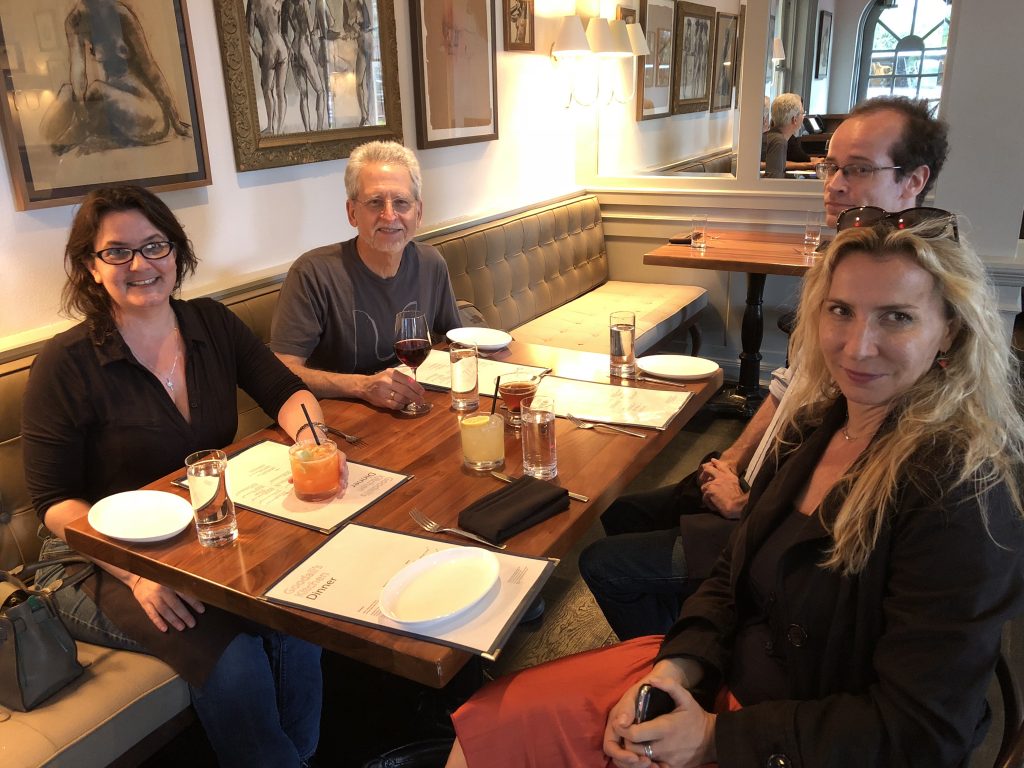
Updated on December 8, 2018 by Garrett R. Bruner. garrettbruner@utexas.edu
October 2018
“Beauty in clay: Aesthetics and script in Mycenaean Greece” by Dimitri Nakassis
Recently published by Dimitri Nakassis in the book ΟΙ ΑΜΕΤΡΗΤΕΣ ΟΨΕΙΣ ΤΟΥ ΩΡΑΙΟΥ ΣΤΗΝ ΑΡΧΑΙΑ ΤΕΧΝΗ / The Countless aspects of Beauty in Ancient Art is a chapter on the aesthetic of the Linear B script. Check it out here!
Updated on October 27, 2018 by Garrett R. Bruner. garrettbruner@utexas.edu
October 2018
CREWS Fellowship Awarded to PASP Researcher and Classics PhD Candidate Cassandra Donnelly
The Contexts of and Relations between Early Writing Systems (CREWS) of Cambridge University has awarded PASP’s own Cassandra Donnelly to develop her research on Aegean scripts.
The announcement can be found below, with information on her research and a brief interview:
Cassandra will be presenting a brief talk on Sunday, October 21, on her research of Bronze age Aegean society in the 11th annual Archaeology Playdate hosted by the Austin society of the Archaeological Institute of America. Talks will be presented in Patton Hall (RLP) in Room 0.102.
3:30 PM Cassie Donnelly, Classics:“Epigraphic Evidence for Regional Administrative Practices in Late Bronze Age Cyprus”
Cassandra Donnelly also coordinates Scripts Institute lectures in Classics every semester. Upcoming is a presentation by Dr. Joann Gulizio of UT-Classics titled “Divine Families in the Mycenaean Pantheon at Pylos? Connections between PY Tn 316 and the Fr series”. It will be held on Wednesday, October 24th, at 12 PM in WAG 116. Hope to see you there!!
More information about CREWS can be found here.
https://www.classics.cam.ac.uk/research/projects/contexts-of-and-relations-between-early-writing-systems-crews
And follow their blog at:
https://crewsproject.wordpress.com/
Updated on October 20, 2018 by Garrett R. Bruner. garrettbruner@utexas.edu
May 2018
William C. Brice – Scripta Minoa III Correspondence Now Online
Now online at Texas ScholarWorks are over 150 items of correspondence from the William C. Brice collection. This correspondence spans four decades of research and includes the very brightest Classics figures of the period, like decipherers Michael Ventris and John Chadwick, Emmett L. Bennett Jr. archaeologists Sinclair Hood and Leonard Woolley, and classicists like Mortimer Wheeler and Anthony Snodgrass. They cover a great range of subjects like script research in Linear A/B and the latest archaeological discoveries in the 1950s by Sinclair Hood.
A bulk of the letters document Brice’s progress on Scripta Minoa III, a volume which was intending to be the comprehensive catalog for all Linear A inscriptions discovered up to that point. It was an international effort spanning half a century of research which Brice would painstakingly edit following the death of Sir John Myres. It includes contributions from Sir Arthur Evans, Sir John Myres, Michael Ventris, Emmett Bennett, Maurice Pope, Sinclair Hood, John Boardman, among many other leading figures. In 1957, the project was ultimately discontinued by the Society of Antiquaries of London for a variety of reasons, but Brice’s effort was compiled and organized for another publication, Inscriptions in the Minoan Linear Script of Class A, published 1961.
Keep checking back!! Another batch of correspondence from the Brice collection, most of it concerning the Scripta Minoa III project, is being digitized over the summer of 2018.
Updated on May 3, 2018 by Garrett R. Bruner. garrettbruner@utexas.edu
April 2018
Bob Dylan in Nuremberg – by Thomas G. Palaima
Between April 15-25 Tom Palaima attended the 2018 Aegaeum conference in Venice and then lectured at the University of Zagreb. He was also present at Bob Dylan’s concert in Nuremberg.
1 Things Have Changed
2 Don’t Think Twice, It’s All Right
3 Highway 61 Revisited
4 Simple Twist of Fate
5 Duquesne Whistle
6 Melancholy Mood (Frank Sinatra cover)
7 Honest With Me
8 Tryin’ to Get to Heaven
9 Come Rain or Come Shine (Harold Arlen & Johnny Mercer cover)
10 Pay in Blood
11 Tangled Up in Blue
12 Early Roman Kings
13 Desolation Row
14 Love Sick
15 Autumn Leaves (Yves Montand cover)
16 Thunder on the Mountain
17 Soon After Midnight
18 Long and Wasted Years
Encore:
19 Blowin’ in the Wind
20 Ballad of a Thin Man

A younger Croatian professor friend of mine, Helena Tomas of University of Zagreb, and I drove up for this show from Venice, where we had spent the week at a scholarly conference. We came up through the Brenner Pass and across lots of history. “Lots of water under the bridge / lots of other stuff, too.”
It was her first show. We felt privileged to be sitting in row 5 audience just to the right of the piano (and the left of his Oscar statuette for “Things Have Changed” and—from the Tempest cover—what looks like a copy of the classical stylized bust of a river goddess from the Pallas Athene statue grouping outside the Parliament Building in Vienna).
From our vantage point, we could see Bob sitting or standing at the keyboard where he stayed the entire night (with the exception of his three standards which Bob sang stage center mostly singing back across the stage toward his piano although for a brief segment on one number facing Stu Kimball audience left) with a preternatural look of intense concentration and absorption—and at times delight—on his face as he coaxed, tickled or attacked the keyboard to produce the haunting melancholic delicacy of “Simple Twist of Fate”and “Tryin’ to Get to Heaven,” the rag-time hints of “Duquesne Whistle,” or the take-no-prisoner building rhythmic tsunami of “Thunder on the Mountain.”
Weather was magnificent. In late afternoon Nuremberg had 82 degrees, light blue skies and 9 mph breezes. Strolling in with Helena we stopped and listened, coming and going, to two musicians performing in separate places Dylan’s music. We thought of the “Homeridae,” literally the sons of Homer, local or itinerant song-poets who must have likewise performed song parts from the Homeric repertory surrounding main festival events when the great oral songsters gathered.
The stage setting and colors of the lighting produced extraordinary, but not obtrusive, atmospheres for the songs.
Helena loved best “Simple Twist of Fate,” “Come Rain or Come Shine” (which Bob did knock out of the park Arlen and Mercer created for him to play in, complete with choreographed arm gestures), “Desolation Row,” and “Thunder on the Mountain,” which she rightly described as building and building and building and building……..
Lyric subtleties:
On “Simple Twist of Fate” the hotel had a “flashing neon sign” that allowed the “she” of the song to ask: “What do you have in mind?” And when the ‘he’ reads “the note she left behind,” Bob breaks the narrative and interjects “What did it say?” before giving us the new standard variant, something like: “We should have ended up in 58 / and forgotten about this simple twist of fate.”
Likewise at the end of “Desolation Row,” still the song dearest and most embedded in my heart and soul and which I used to sing, in its entirety, as a lullaby to my now grown son, the new standard variant:
“Yesterday is dead and gone / Tomorrow might as well be now.
Some of them live on the mountain / some of them down on the ground
Some of their names are still the same
Others, well, they just left town.”
Bob and his band left town after re-instantiating Bob’s music and making it new for us, so that we will be leaving town with it in our heads and hearts and souls in a new way for our today’s selves, like the German man I talked to at the adjacent men’s room stall after the show. He noted that Bob’s voice was in stunningly good form. And I agreed. And he agreed with me that the band was producing music as if it were at times the Nelson Riddle Orchestra and at other times sidemen behind Jelly Roll Morton. And he was heading to Baden-Baden, staying briefly ‘on the road’ with Bob and his band.
Thank you, Bob, as you move toward the completion of your seventy-seventh year among us mere mortals.
Tom Palaima, Austin TX
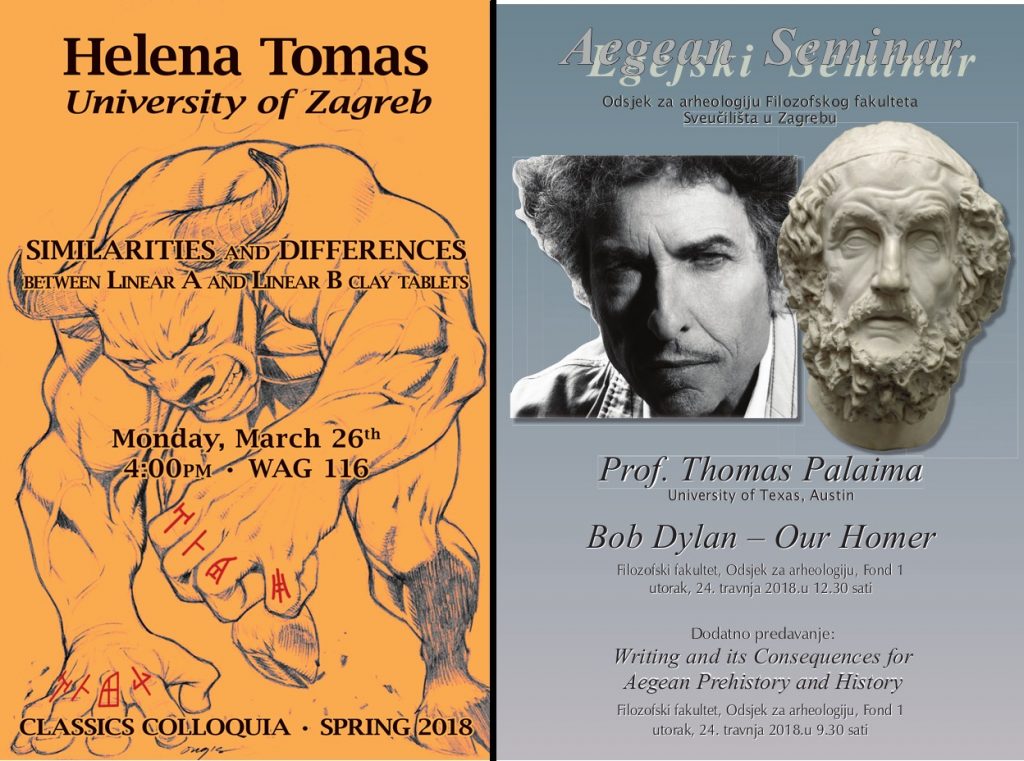
Helena Tomas was a visiting scholar of PASP in the months of March-April 2018.
Updated on April 25, 2018 by Garrett R. Bruner. garrettbruner@utexas.edu
April 2018
Aegean Scholarship at UT accessible at Texas ScholarWorks – by Kevin S. Lee
As the PASP research assistant, one of my tasks this semester was to curate and process material for the Aegean Scholarship collection on Texas ScholarWorks. This is part of PASP’s ongoing mission of making accessible as much of our research materials and resources as possible.
The Aegean Scholarship collection at TSW serves as the digital home for Aegean-related dissertations and theses authored by former PASP students, touching on topics like Minoan religion, Mycenaean archives, and figures of authority in Mycenaean society. The students’ dissertations demonstrates the rigor of scholarship PASP attracts. For instance, Dimitri Nakassis’ 2013 book Individuals and Society in Mycenaean Pylos grew out of his 2005/2006 dissertation entitled “The Individual and the Mycenaean State: Agency and Prosopography in the Linear B Texts from Pylos.” Dr. Nakassis’ work is pivotal in new understandings of Mycenaean palace-states as networks of individuals rather than monolithic blocks. Dr. Nakassis now teaches in the Department of Classics at the University of Colorado at Boulder.
TSW’s Aegean Scholarship collection also curates faculty research on the Aegean studies. For now, this consists primarily of the scholarship currently of Thomas Palaima and Cynthia Shelmerdine.  The scholarly works of Professor Palaima span his entire UT career and reflect a lifetime of comprehensive and granular research. They consist of a range of articles on a variety of Mycenaean subjects, book reviews, and conference papers. It has been my responsibility to digitally process and make permanently accessible fourteen articles and conference papers Professor Palaima has published in UT publications. They run the gamut from a reappraisal of the last years of the Palace of Nestor at Pylos to humorous pieces delivered at iterations of the Aegean Conference. Also online are Palaima’s research into the history of Linear B decipherment, covering individuals like Michael Ventris, Alice Kober, and Emmett Bennett. Like his contributions to the Times Literary Supplement and Austin American-Statesman, these reflect the whole person of Professor Palaima, both learned scholar and jovial concerned citizen.
We are in the process of having all former PASP Electronic Theses and Dissertations digitized to TSW, so keep checking back!
Updated on April 9, 2018 by Garrett R. Bruner. garrettbruner@utexas.edu
February 2018
Paintings and Poetry in Linear B – The Nikos Samartzidis Collection
PASP is very pleased to exhibit the works of Nikos Samartzidis collection. Samartzidis is a painter and poet and has exhibited his works in Germany and Crete. These collection pieces are works of art inscribed with Linear B on canvas, clay tablets, and compact disks. In the works, Linear B is used as a script for poetry. Works on canvas, board, clay and CD are on display at PASP.
In his works, he quotes ancient poets like Hesiod and Homer and many modern Greek poets like Elytis and Cavafy. In the painting below, Dylanology II, he even transcribes the lyrics of American musician Bob Dylan into Linear B.
Dylanology II, 2017
Source: Bob Dylan, Blowin’ in the wind
Free Translation by Nikos Samartzidis
po-sa, ko-ro-ni-a, po-re,
na, u-pa-re-ke, e-na, qo-u-no
pi-ri, na-ka-te, me-sa, te-ta-ra-sa
ka-i, po-sa, ko-ro-ni-a, po-ro-u
ka-po-jo, a-to-ro-po-i, na, u-pa-ro-ko-u,
pi-ri, to-u, a-pe-so-u, na, e-i-na, e-re-u-te-ro(2),
te, a-pa-te-se, pi-re, mo-u
te, pa-i-re-na, o, a-ne-mo,
pu(2)-so-ta,
me, to, a-ka-ta-re-po-to, qo-u-e-to, to-u
ro-we-ro-to, a-re, ti-si-me-ra-ma
«…Πόσα χρόνια μπορεί να υπάρχει ένα βουνό,
πριν να χαθεί μέσα στη θάλασσα;
Και πόσα χρόνια μπορούν κάποιοι άνθρωποι,
να υπάρχουν πριν τους αφήσουν νάναι λεύτεροι;
Την απάντηση φίλε μου την παίρνει ο άνεμος,
φυσώντας μέ το ακατάληπτο βουητό του…»
“…How many years can a mountain exist,
before it is washed to the sea?
Yes, and how many years can some people exist,
before they’re allowed to be free?
The answer, my friend, is blowin’ in the wind.
The answer is blowin’ in the wind…”
These paintings are also permanently accessible through Texas ScholarWorks (URL). Transcriptions and translations of the works are included with every entry, too. Also at PASP are clay tablets and etched CDs in Linear B and many papers of Samartzidis, like exhibit handouts, news articles covering his work, and notebook pages.
More of his works can also be accessed at his website.
In the near future, a digital exhibit of his works will be published on Scalar. There, paintings from PASP’s Samartzidis collections will be presented with interactive transcriptions and transliterations from Linear B to Greek and English.
Updated on February 27, 2018 by Garrett R. Bruner. garrettbruner@utexas.edu
February 2018
William C. Brice Collection update by Yogita Sharma
From December 2017 to February 2018, I performed the digital processing of the correspondence between Beatrice Gwynn and William C. Brice for online access. This was completed under the supervision of PASP archivist Garrett Bruner. The Gwynn-Brice correspondence is now online and open access at Texas Scholarworks where all digitized PASP collection material can be found.
Overview
This correspondence are the first items made online from PASP’s William C. Brice collection. This small series of correspondence consists of twenty-two letters, the bulk of which were written by Gwynn to Brice. All material was processed following PASP’s guidelines for processing digital materials. I scanned letters to NARA guidelines, read each item, and created the metadata for Texas ScholarWorks as per their Dublin Core schema.
Related material to this correspondence can be found in the Emmett Bennett Jr. Collection, also housed and made accessible online through Texas ScholarWorks. Letters from Beatrice Gwynn to Emmett Bennett on the same subjects, in the same time frame as these letters, highlight Gwynn’s collaboration with the very brightest in Linear B studies. In addition, letters from Chadwick and Bennett in the same period (mid 1960s) make mention of Gwynn’s efforts.
Item Summary
In the letters, Gwynn introduces herself to Brice as a student of Mycenaean scripts. From there, the letters shed light on her Linear A and B research and Brice’s feedback.
The following letters and themes will be most intriguing to scholars:
BGtoWB19680804, BGtoWB19681114: Gwynn articulates her understanding of the Minoan libation formula.
BGtoWB19680911, BGtoWB19690105: Gwynn on the value of the fraction L7.
BGtoWB19681020, BGtoWB19700222, BGtoWB19700320, BGtoWB19700426, BGtoWB19700524: Gwynn lays out her ideas on the relationship between Crete and Greek mainland, Linear A and B, Enkomi script, and Phaistos Disk. Also significant in this regard is her comparative table of scripts.
BGtoWB19690706, BGtoWB19700222: Her transcriptions of the Enkomi tablets.
In her letters, Gwynn emerges as a woman who presents her own strong arguments and views on the decipherment of Linear B. She provides detailed explanations of her disagreements with Brice. Gwynn’s letters to Brice are yet another valuable resource to those interested in the history of Linear B studies, especially the contribution of women to its decipherment.
Conclusion
This project helped me understand and practice digital processing of metadata. The fact that the content was obscure and rich only added to my learning and pleasure.
Check back soon. More from William C. Brice’s collection, including his correspondence on the failed publication of Scripta Minoa III, and with scholars like Michael Ventris, Emmett Bennett, and Sinclair Hood will appear online at TSW throughout 2018.
Updated on February 9, 2018 by Garrett R. Bruner. garrettbruner@utexas.edu
December 2017
Visit Report by Regina Dürig and Christian Müller
Regina and Christian were visiting scholars at PASP during the month of October 2017. In their research for a literature-and- music project, they focused on the Alice Kober Papers.
Read their report to their work at PASP here. And check out the reports to other visiting scholars on the side bar!
Updated on December 14, 2017 by Garrett R. Bruner. garrettbruner@utexas.edu
November 2017
“Dear Bennett, Dear Miss Kober” by Kevin Lee
During September and October I worked under PASP archivist Garrett Bruner preparing the correspondence between Emmett Bennett, Jr. and Alice Kober for online publication. The Bennett-Kober correspondence is now online for open access at Texas Scholarworks.
Overview
This correspondence is part of the E.L. Bennett Jr. Papers. I followed the guidelines set by PASP on processing all digital material. With the scanning already completed, my job was to go through each item, letter by letter, to create metadata for Texas ScholarWorks based on their Dublin Core schema. Garrett provided the schema of this sheet and I added the necessary entries.
The Story Told
The tale that emerges is the evolving collaboration between Kober and Bennett on the decipherment of Linear B. Each enters the arena armed with a different dataset. Kober was assisting Sir John Linton Myres on the publication of the Linear B tablets recovered by Sir Arthur Evans at Knossos. Bennett, who played a comparable role for Carl Blegen, tackled the palace archives excavated at Pylos. The collaboration between Kober and Bennett moves from sharing and correcting their transcriptions of various tablets each has access to, to meeting in person to bring together and standardize classification references to Linear B words. The latter picks up towards the end of 1948, after Myres and Blegen agreed to allow mutual access of their materials, and continues through Kober’s declining health and eventual death in May of 1950.
The Bennett-Kober letters are of a largely technical nature, as one would expect with this kind of work. Shop-talk about classification systems, edits, and proposals for edits orbit around a score of Linear B transcriptions. This is an invaluable collection for those interested in history of scholarship and the mechanics of Linear B’s decipherment. There are two crucial letters for understanding this collection:
1. The first letter in the series, AKtoELB19450114, in which Kober explains her punch-card system.
2. AKtoELB19481122, in which Kober briefly explains both her classification system and statistical methodology.
Reading those first will give the reader a greater sense of the rest of their letters. Another note of warning is that we have more letters penned by Kober than Bennett; we can only guess at what Bennett mentioned in missing letters from Kober’s responses.
In all, however, it is easy enough for a non-specialist such as myself to follow along with the unfolding tale of scholarly cooperation and discovery. For instance, in letters before June 1948, Kober wavers on whether or not the Pylos script is in fact Linear B. But following “the rules of evidence” where they lead, she becomes convinced that the Pylos tablets write the same language as those from Knossos.
The Dramatis Personae
In addition, as per usual, the letters act as windows to their writers, and aspects of their characters flash through. Both begin addressing each other with the formal “Dear Mr. Bennett” and “Dear Miss Kober.” In June 1948, however, Kober says she is finally getting tired of using “Mr. Bennett.” We do not have Bennett’s response to her, but thereafter her letters are addressed “Dear Bennett.” Bennett himself maintains the formal “Dear Miss Kober” throughout. In ELBtoAK19480604, Bennett expresses the traditional academic embarrassment with commerce when he shows off a custom-made set of Linear B stamps in order to “sell…or rather, in keeping with academic dignity, and my own inclination, to show you something I got for myself, and which you might like for yourself.”
Academic exasperations we know today were equally present then. In AKtoELB19490212, Kober expresses irritation at how out of date her transcriptions of the Knossos Tablets, which she was proud of two years before, have become, and the problems that has caused. In AKtoELB19490216 she states, in the context of sharing an office with four other teachers, “[a] city college is no place for scholarly research, I’ve found to my cost.”
Furthermore, Kober has a rueful humor to her. In AKtoELB19451230, after a 3-page litany of questions re: her transcriptions of the Pylos tablets, she writes “I could keep this up all night, but I’ll spare you.” In an earlier letter, dated January 14 of the same year, she deadpans “It’s harder to get articles published in Europe during the war than it was to get military secrets…”
The Mystery Letters
This project has been a good review and expansion of skills I picked up at a previous archiving position. It also involved detective skills I’ve enjoyed putting to use. There were for instance two misdated letters at the end of the collection; one from Kober to Bennett dated December 5, 1950, and another from Bennett to Kober, undated save assignation to 1950.
In the case of the former, the date was obviously incorrect, for Kober died in May of that year. The problem sprang from the fact that (1) Kober simply dated the postcard as “Tuesday,” and (2) the post office stamp indicating the date of receipt was incomplete, leaving out the year. The post office worker must have noticed this and assumed he didn’t stamp hard enough, for there is a second stamp over the first with exactly the same problem, leaving a palimpsest. Examining it up close, I found that there is a faint “1” between the “DEC” and the “5.” This indicates Kober’s local post office in Brooklyn received her postcard on December 15th. I checked the calendars for the years of the Kober-Bennett correspondence, and only in one of them – 1948 – did December 15th fall on a Wednesday, the day after which Kober dates her postcard. Furthermore, the text of the card squarely places it in this year, for it was in the winter of 1948 and 1949 that Kober and Bennett travelled back and forth between New York and New Haven to examine each other’s material, and this postcard contains Kober’s instructions to Bennett for using the subway to get from Penn Station to her office at Brooklyn College. I appropriately renamed it AKtoELB19481214, and you can find it in the collection under that title.
Regarding our other mystery letter without a date, internal clues hint at the time of its writing. In this letter (now titled ELBtoAK19490214), Bennett mentions that his three children have come down with illness, and that he plans to come down to New York “Thursday or Saturday of next week, the 24th or 26th.” This gave some context for me to go off from. Kober, in her February 16, 1949 letter, expresses her hope that Bennett’s children recover. Also, in February of 1949 the 24th and 26th of the month fell on a Thursday and a Saturday, respectively. This gives us the terminus ante quem. To further narrow down the date, in her February 12th letter Kober took Bennett to task for a bad numbering method, which he leads off his mystery date letter with a response to. There’s thus a four-day period in which Bennett could have written this letter. He likely wrote it Monday the 14th or Tuesday the 15th, given the usual time between their correspondence.
The Briefest Conclusion
In toto, this project has been an excellent experience. I am proud to have contributed to the open access publication of this correspondence. It provides a crucial glimpse into the scholarly ground-pounding required to advance Linear B to the point it could be deciphered.
Updated on November 22, 2017 by Garrett R. Bruner. garrettbruner@utexas.edu
October 2017
Bennett Correspondence now on UT ScholarWorks

A batch of correspondence from PASP’s Emmett Bennett Jr. collection are now online and accessible through the University of Texas ScholarWorks (TSW) digital repository. Like all collection material uploaded to Scholarworks, it is open access, free to the public. You don’t need an account to access collection material through Texas ScholarWorks!
The letters were scanned at a high resolution and converted to PDFs by Classics graduate students. Some PDFs, like typewritten letters, were scanned with OCR to allow users to copy and search within the documents. The correspondence follows a set of Dublin Core based metadata elements, which improves their access, searchability and organization. This metadata ensures the collection materials’ endurance in the digital realm as it can be transferred to any platform or updated to the infrastructural changes within ScholarWorks.
The Bennett Correspondence can be accessed by here:
This correspondence presents a general view of authors Bennett had professional contact with over several decades (1940s-1990s). The bulk of the letters are written between 1950 and 1965. They span a range of Linear B subjects in the years leading up to its decipherment: classification of tablets for publication (Pylos, Mycenae and Knossos), readings of tablets and ideograms, discovery of new tablets, classification and publication of tablets, and controversies surrounding the decipherment. Classicists, linguists, archaeologists, and students make up much of Bennett’s correspondents. Of particular interest are Bennett’s letters with Sir John Myres, John Chadwick, and Carl Blegen.
The bulk of the Myres letters document Bennett’s trip to Crete in 1950 and the publication of Scripta Minoa II. At the Heraklion museum in Crete, Bennett took the place of the late Alice Kober to set a classification system for the Knossos tablets based on Evans’ numeration of them. This work would be critical for the publication of Scripta Minoa Volume II. The results can be seen in Scripta Minoa Volume II in the “Concordance” pages. As Myres handwriting can be difficult in itself to decipher, we offer transcripts of these letters in plain text files. They can be accessed at the item level of each letter between Myres and Bennett. The transcriptions and metadata for Sir John Myres’ letters were completed by Amanda Rodriguez in July 2017.
A very rich source of information on the decipherment comes from John Chadwick’s letters with Bennett. Chadwick letters cover a range of subjects, like readings of tablets and their classification, publication news and reviews, and convention recaps. As Michael Ventris’s collaborator in the decipherment of Linear B, a significant yet tragic letter is Chadwick’s informing Bennett of Ventris’s death two days after Ventris’s fatal car crash. Following Ventris’s death, Chadwick would relate to Bennett his defense of Ventris’s decipherment against critics like A.J. Beattie and Ernst Grumach.
Chadwick’s letters can be accessed here
Letters between Beattie and Bennett also document a coldness between the scholars deciphering Linear B.
Bennett’s letters also bring to light the attention Kober brought to women in the archaeology field. In a letter with A. H. Hahn, Bennett investigates Kober’s biography for an article in Notable American Women, 1607 – 1950. The following response from Hahn provides more information on her efforts to uncover Kober’s life from her family and friends.
We are very excited to make these documents accessible and open access. They supply very unique information on the lives of Linear B scholars, the times they worked in, and their breakthroughs in Linear B decipherment.
Currently, as of October 2017, PASP aims to digitize the remaining Bennett correspondence and provide the same open access availability to them through Texas ScholarWorks. Correspondence between Bennett and Kober is being immediately processed by PASP Assistant Kevin Lee. These will be uploaded by November 2017.
Updated on October 26, 2017 by Garrett R. Bruner. garrettbruner@utexas.edu